![Virtuoso Legal Services [Best Legal Opinion Services 24×7]](https://legalopinion.org.in/wp-content/uploads/2023/09/cropped-logo.png)

Protecting Your Brand: Trademark Registration Legal Experts
Trademark Registration Legal Experts – Trademark protection safeguards brand identity, business reputation, and commercial goodwill in competitive markets. Therefore, businesses must secure trademark registration early to prevent misuse, imitation, and unfair competition. In India, trademarks cover names, logos, slogans, packaging, and distinctive brand elements under the Trade Marks Act, 1999. Entrepreneurs, startups, companies, and NRIs rely on legal experts to secure exclusive rights over brand identity. Virtuoso Legal Services assists clients in Chennai and across India with trademark filing, objections, oppositions, and enforcement actions. Early registration reduces infringement risks and strengthens market recognition. Moreover, courts and tribunals treat registered trademarks as strong evidence of ownership. Consequently, businesses gain legal protection, commercial value, and enforcement rights against infringers using identical or deceptively similar marks in trade or services.
Protecting Your Brand: Trademark Registration Legal Experts – Virtuoso Legal Services
Importance of Trademark Registration for Business Growth
Trademark registration creates legal ownership over brand identity and prevents unauthorized use by competitors. Consequently, businesses secure exclusive rights to use their mark in commercial activities. Legal experts analyse brand uniqueness, distinctiveness, and registrability before filing applications. Common disputes arise when businesses operate without registration and face imitation, domain misuse, or counterfeit products. Courts evaluate originality, prior use, and goodwill while deciding infringement disputes. Therefore, early registration strengthens legal standing and supports brand expansion. Entrepreneurs also gain licensing opportunities, franchising rights, and valuation benefits through registered trademarks. Additionally, registered marks enhance investor confidence and market credibility. Proper legal guidance ensures compliance with procedural requirements under Indian intellectual property law and reduces objections during examination by the Trademark Registry.
Types of Trademarks Recognised in India
Trademarks in India cover multiple categories depending on business identity and usage. Therefore, identifying the correct category improves registration success. Common types include:
- Word marks for brand names
- Device marks for logos and symbols
- Service marks for service businesses
- Collective marks for associations
- Certification marks for quality standards
- Shape marks for product design
- Sound marks for audio branding
- Colour combination marks
Each category requires distinct legal evaluation. Consequently, legal experts assess distinctiveness and filing strategy before application submission. Proper classification ensures stronger protection and reduces rejection risks during examination.
Key Elements Required for Trademark Registration
Trademark registration requires specific legal conditions to ensure acceptance by the Registry. Therefore, applicants must meet statutory requirements before filing. Important elements include:
| Requirement | Legal Importance |
|---|---|
| Distinctiveness | Ensures uniqueness |
| Non-descriptiveness | Avoids generic rejection |
| Lawful use | Confirms legality |
| Proper classification | Defines goods/services |
| Prior search | Avoids conflicts |
| Applicant identity | Establishes ownership |
| Usage evidence | Proves goodwill |
These elements determine registration success. Consequently, legal review before filing reduces objections and strengthens application approval chances.
Common Trademark Risks Faced by Businesses
Businesses face several risks when they delay or ignore trademark registration. Therefore, proactive protection becomes essential for brand survival. Common risks include:
- Brand imitation by competitors
- Domain name disputes
- Counterfeit product circulation
- Unauthorized logo usage
- Social media impersonation
- Franchise misuse of brand identity
- Loss of goodwill and reputation
- Legal infringement litigation
Legal experts identify these risks early and recommend preventive registration strategies. Consequently, businesses protect brand identity and avoid costly litigation.
Legal Framework Governing Trademarks in India
Trademark protection in India is primarily governed by the Trade Marks Act, 1999 and Trade Marks Rules, 2017. Additionally, disputes may proceed under civil law using the Code of Civil Procedure, 1908 (CPC) for injunctions and damages. Criminal infringement cases involving counterfeiting, fraud, or forgery may attract provisions under the Bharatiya Nyaya Sanhita, 2023 (BNS). Investigation procedures follow the Bharatiya Nagarik Suraksha Sanhita, 2023 (BNSS), while evidence standards fall under the Bharatiya Sakshya Adhiniyam, 2023 (BSA). The Office of the Controller General of Patents, Designs and Trade Marks (CGPDTM) regulates trademark registration in India. Therefore, proper legal guidance ensures compliance with statutory procedures and strengthens brand protection across commercial markets.
Legal Issues in Trademark Protection and Brand Disputes
Trademark disputes arise due to unauthorized use, similarity, or misrepresentation of brand identity. Therefore, businesses must act quickly to protect rights. Common legal issues include:
- Trademark infringement
- Passing off actions
- Domain name disputes
- Brand dilution
- Counterfeit goods
- Logo imitation
- Unfair competition
- Misleading branding
Courts evaluate goodwill, market reputation, and consumer confusion while deciding disputes. Early legal intervention improves enforcement success and brand protection outcomes.
Trademark Registration Process and Examination Procedure in India
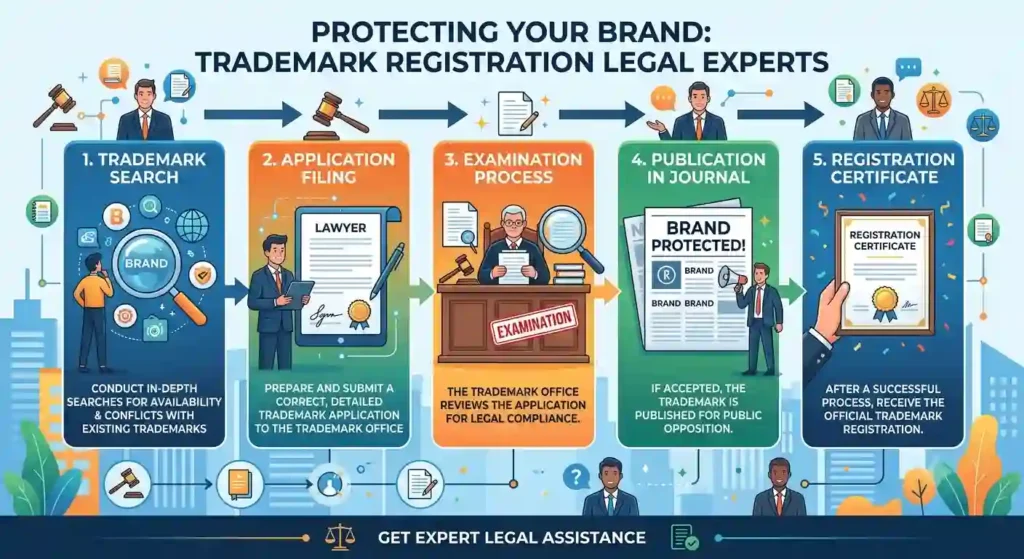
Trademark registration in India follows a structured legal process under the Trade Marks Act, 1999. Therefore, applicants must follow procedural compliance to secure approval from the Trademark Registry. The process begins with a trademark search to verify uniqueness and avoid conflicts with existing marks. Subsequently, applicants file Form TM-A with details of goods, services, and applicant identity. The Registrar then examines the application for distinctiveness, legality, and similarity issues. Legal experts at Virtuoso Legal Services assist businesses in drafting accurate applications and responding to objections. Moreover, publication in the Trademark Journal allows third-party opposition before final registration. Consequently, proper legal representation reduces rejection risks and strengthens approval chances for startups, companies, and NRIs seeking brand protection in India.
Trademark Examination, Objections, and Hearing Process
Trademark applications often face objections from the Registry due to similarity, descriptiveness, or procedural defects. Therefore, applicants must respond carefully within statutory timelines. Examination reports highlight legal grounds under Sections 9 and 11 of the Trade Marks Act. Legal experts prepare structured replies with supporting evidence and case law references. If objections persist, the applicant attends a hearing before the Registrar. Common objection issues include:
- Lack of distinctiveness
- Similar existing trademarks
- Descriptive brand names
- Incorrect classification
- Improper documentation
- Public confusion risk
- Deceptive similarity
Proper legal drafting improves acceptance probability. Consequently, expert representation ensures compliance and strengthens registration outcomes.
Opposition Proceedings and Third-Party Challenges
After publication in the Trademark Journal, third parties may oppose registration. Therefore, opposition proceedings become a critical stage in trademark protection. Competitors, brand owners, or interested parties may file opposition within statutory timelines. The applicant must respond with legal evidence and justification of ownership. Legal experts analyse prior use, goodwill, and market reputation before defending applications. Opposition proceedings involve:
- Filing notice of opposition
- Counter-statement submission
- Evidence exchange
- Hearing before Registrar
- Final decision
Successful defence ensures trademark registration and exclusive brand rights. Consequently, strategic legal representation becomes essential during opposition disputes.
Government Authorities and Trademark Administration in India
Trademark administration in India is regulated by specialized government authorities ensuring proper intellectual property protection. Therefore, applicants must interact with designated offices for compliance. Key authorities include:
- Controller General of Patents, Designs and Trade Marks (CGPDTM)
- Intellectual Property India (IP India)
- Trademark Registry Offices (Chennai, Delhi, Mumbai, Kolkata, Ahmedabad)
- Ministry of Commerce and Industry
These authorities manage examination, registration, opposition, and renewal processes. Legal experts coordinate with these offices to ensure smooth procedural compliance and timely approvals.
Legal Remedies in Trademark Infringement Cases
Trademark law provides strong remedies against infringement and brand misuse. Therefore, courts and tribunals protect registered owners through civil and criminal actions. Common remedies include:
| Remedy Type | Legal Purpose |
|---|---|
| Injunction | Stop infringement |
| Damages | Financial compensation |
| Account of profits | Recover gains |
| Delivery of goods | Seizure of infringing products |
| Destruction order | Eliminate counterfeit goods |
| Passing off relief | Protect unregistered marks |
| Cost recovery | Litigation expenses |
Legal remedies depend on evidence, market confusion, and infringement severity. Consequently, timely action ensures stronger enforcement outcomes.
Evidence Required in Trademark Disputes
Strong evidence plays a crucial role in trademark litigation and enforcement proceedings. Therefore, brand owners must maintain proper documentation. Essential evidence includes:
- Trademark registration certificate
- Usage invoices and sales records
- Marketing and advertising materials
- Website and digital branding proof
- Customer recognition evidence
- Social media branding records
- Competitor comparison proof
- Market reputation documents
The Bharatiya Sakshya Adhiniyam, 2023 (BSA) governs admissibility of evidence in courts. Proper documentation strengthens infringement claims and legal enforcement actions.
Litigation Strategy, Enforcement Actions, and Brand Protection Measures
Trademark litigation requires a structured strategy combining civil remedies, evidence strength, and urgent injunction relief. Therefore, businesses must act quickly when infringement occurs. Courts often grant interim injunctions to prevent further brand misuse during proceedings. Legal experts at Virtuoso Legal Services prepare cease-and-desist notices, injunction suits, and counter-infringement defenses. Additionally, businesses may coordinate with police authorities in counterfeit goods cases involving fraud or large-scale duplication. Investigation procedures follow the Bharatiya Nagarik Suraksha Sanhita, 2023 (BNSS), while criminal liability arises under the Bharatiya Nyaya Sanhita, 2023 (BNS). Evidence evaluation follows the Bharatiya Sakshya Adhiniyam, 2023 (BSA). Consequently, integrated civil and criminal enforcement strengthens brand protection and reduces commercial losses caused by infringement or passing off activities.
Courts, Tribunals, and Jurisdiction in Trademark Disputes
Trademark disputes in India are adjudicated before specialized courts and tribunals depending on the nature of the claim. Therefore, selecting the correct jurisdiction ensures effective legal remedies. District Courts handle infringement suits and passing off actions with territorial jurisdiction. High Courts, especially commercial divisions, handle complex intellectual property disputes and appeals. The Intellectual Property Appellate Board framework has been replaced by High Court jurisdiction in many cases. Civil Procedure Code, 1908 (CPC) governs procedural aspects such as injunctions, pleadings, and evidence presentation. Courts evaluate goodwill, confusion likelihood, and prior usage before granting relief. Consequently, proper legal representation ensures compliance with procedural rules and strengthens enforcement outcomes for brand owners across India.
Role of Police and Criminal Enforcement in Trademark Protection
Certain trademark violations involve criminal activities such as counterfeiting, forgery, and large-scale brand duplication. Therefore, police intervention becomes necessary alongside civil proceedings. Brand owners may file complaints with local police stations or specialized cybercrime and economic offence wings. Authorities investigate under provisions of the Bharatiya Nyaya Sanhita, 2023 (BNS) for cheating and trademark fraud. Search, seizure, and investigation procedures follow the Bharatiya Nagarik Suraksha Sanhita, 2023 (BNSS). Courts rely on evidence standards defined under the Bharatiya Sakshya Adhiniyam, 2023 (BSA). Legal coordination ensures proper FIR registration, raid actions, and seizure of counterfeit goods. Consequently, combined civil and criminal enforcement strengthens brand protection and deters repeat infringement effectively.
Legal Remedies and Brand Enforcement Strategy
Trademark owners have access to multiple remedies designed to protect brand identity and commercial value. Therefore, strategic enforcement ensures long-term protection and market integrity. Common remedies include:
- Temporary and permanent injunctions
- Monetary damages and compensation
- Delivery and destruction of counterfeit goods
- Account of profits from infringers
- Domain name transfer orders
- Passing off protection for unregistered marks
- Criminal prosecution for counterfeit activity
- Litigation cost recovery
Legal strategy depends on urgency, infringement scale, and evidence strength. Consequently, early legal intervention ensures stronger protection outcomes.
Importance of Early Trademark Protection for Businesses
Early trademark registration strengthens business identity and prevents future legal disputes. Therefore, startups and companies should secure brand protection before market entry. Registration builds legal ownership and enhances commercial valuation. It also prevents competitors from exploiting similar branding or confusing consumers. Legal experts recommend proactive filing, continuous monitoring, and enforcement planning. Additionally, registered trademarks support franchising, licensing, and expansion strategies. Consequently, businesses achieve stronger market presence and legal security through timely intellectual property protection.
Protecting Your Brand with Expert Legal Support
Trademark protection is essential for safeguarding business identity in competitive markets. Moreover, effective legal enforcement prevents misuse, imitation, and financial loss. Virtuoso Legal Services provides end-to-end trademark solutions including registration, opposition handling, litigation, and enforcement actions across India. Experienced IP lawyers assist startups, corporations, NRIs, and entrepreneurs in securing and defending brand rights before the Trademark Registry, Commercial Courts, and High Courts. Therefore, timely legal intervention ensures strong brand protection under Indian intellectual property laws. Ultimately, proactive trademark strategy strengthens business reputation, commercial growth, and long-term market recognition.
Frequently Asked Questions
1. What is trademark registration in India?
It is a legal process that protects brand names, logos, and symbols under the Trade Marks Act, 1999.
2. Who can apply for trademark registration?
Individuals, companies, startups, NGOs, and NRIs can apply for trademark protection in India.
3. What happens if someone copies my trademark?
You can file an infringement suit, seek injunction, damages, and criminal action against counterfeiters.
4. Which court handles trademark disputes?
District Courts and High Courts handle trademark infringement and passing off cases in India.
5. How long does trademark registration take?
It typically takes 6 to 18 months depending on objections and opposition proceedings.
6. Why should I hire a trademark lawyer?
A lawyer ensures proper filing, avoids rejection, handles objections, and protects your brand legally.
Read More
- Maximizing Tax Efficiency: Taxation Law Legal Opinion Services
- Supporting Sporting Integrity: Sports Law Legal Experts
- Community Legal Support: Society Law Legal Opinion Services
- Fighting Workplace Harassment: Sexual Harassment Legal Experts
- Tax Compliance Made Easy: Service Tax Legal Opinion Services
- Trade Marks Registry – IP India (Official Section)



![Types of Legal Opinions | When to Seek Them. Virtuoso Legal Services [Best Legal Opinion Services 24x7] Find the Best Real Estate Attorneys](https://legalopinion.org.in/wp-content/uploads/2023/07/Types-of-Legal-Opinions-When-to-Seek-Them.-Virtuoso-Legal-Services-Best-Legal-Opinion-Services-24x7-Find-the-Best-Real-Estate-Attorneys-768x432.jpg)