![Virtuoso Legal Services [Best Legal Opinion Services 24×7]](https://legalopinion.org.in/wp-content/uploads/2023/09/cropped-logo.png)

Defending Media Rights: Media Law Legal Experts
Virtuoso Legal Services stands at the forefront of India’s media law practice, defending journalists, broadcasters, OTT platforms, digital publishers, and news organisations. India’s media landscape faces unprecedented legal threats in 2026 — from criminal defamation prosecutions to content takedown orders and SLAPP suits. Therefore, understanding the legal framework protecting media rights is essential for every media professional. This expert guide covers applicable laws, relevant forums, government bodies, and actionable remedies available across all Indian jurisdictions.
Defending Media Rights: Media Law Legal Experts – Virtuoso Legal Services
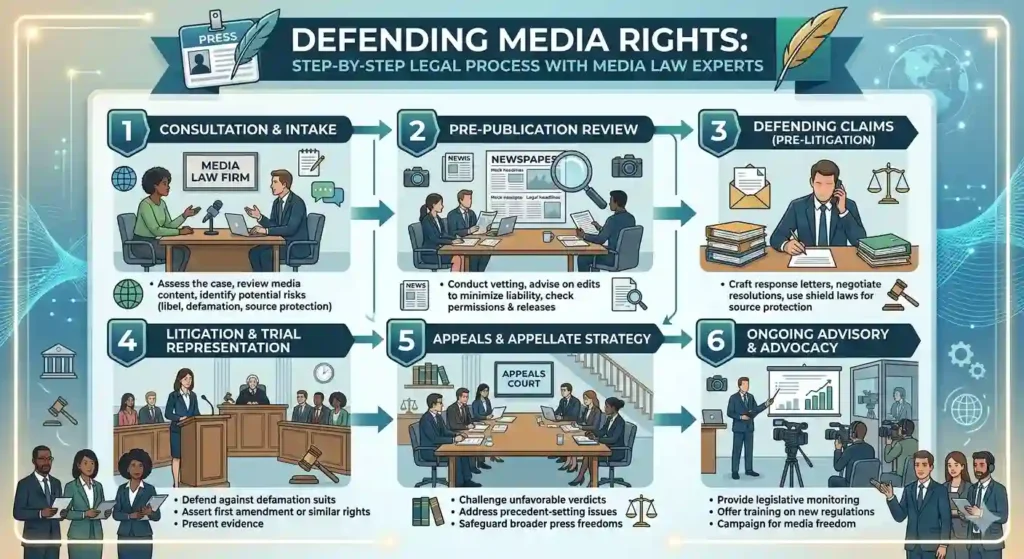
Legal Framework Governing Media Rights and Press Freedom in India
India’s media law framework draws from constitutional guarantees, statutory provisions, and judge-made doctrine simultaneously. Consequently, media professionals must navigate multiple intersecting legal layers when confronting legal threats. Article 19(1)(a) of the Constitution guarantees freedom of speech and expression, which the Supreme Court has consistently interpreted to include press freedom. Furthermore, the Bharatiya Nyaya Sanhita, 2023 (BNS) replaces IPC and redefines defamation, sedition-equivalent offences, and hate speech applicable to media content. The Bharatiya Nagarik Suraksha Sanhita, 2023 (BNSS) modernises criminal procedure affecting journalist arrests and bail rights. Additionally, the Information Technology Act, 2000 and IT (Intermediary Guidelines and Digital Media Ethics Code) Rules, 2021 govern digital publishers and OTT platforms. The Bharatiya Sakshya Adhiniyam, 2023 (BSA) determines how digital media content is admitted as court evidence. Moreover, the Press Council Act, 1978, Cable Television Networks Act, 1995, and Cinematograph Act, 2023 create sector-specific regulatory frameworks. Therefore, Virtuoso Legal Services analyses each statute meticulously before devising a defence strategy for media clients.
Constitutional Protections: Article 19 and the Right to Press Freedom
The Indian Constitution’s Article 19(1)(a) forms the bedrock of all media rights litigation in India. Consequently, any law or state action restricting press freedom must pass the reasonable restrictions test under Article 19(2). The Supreme Court in Romesh Thapar v. State of Madras (1950) first recognised press freedom as a fundamental right. Furthermore, in Bennett Coleman v. Union of India (1973), the court expanded press rights to include editorial independence and circulation freedom. The right to receive information — critical to journalism — flows directly from Article 19(1)(a) as interpreted by the Supreme Court. Additionally, Article 21 protects a journalist’s right to life and liberty against arbitrary arrest. The court in Shreya Singhal v. Union of India (2015) struck down broad internet censorship as unconstitutional. Therefore, constitutional writ petitions remain the most powerful remedy for media rights violations. Key constitutional remedies available to media professionals include:
- Writ of mandamus compelling authorities to restore blocked content
- Writ of certiorari quashing illegal censorship or takedown orders
- Writ of prohibition preventing government from exceeding statutory power
- Writ of habeas corpus for unlawfully arrested journalists
- Interim stay orders protecting media organisations during pending litigation
BNS 2023, BNSS 2023, and BSA 2023: Impact on Media Law Practice
The 2023 Bharatiya code trilogy fundamentally reshapes the criminal law landscape affecting Indian media. Therefore, every media professional and organisation must understand these new statutes thoroughly. BNS Section 356 redefines criminal defamation — replacing IPC Section 499 — with broadly similar elements but updated exceptions for journalists reporting on public interest matters. Furthermore, BNS Section 196 addresses promoting enmity, directly applicable to inflammatory media content. Critically, BNS Section 152 replaces the colonial sedition law with a narrower offence targeting acts endangering sovereignty, offering media professionals slightly broader protection. Under BNSS Section 479, courts must now impose stricter bail conditions for offences targeting media, creating stronger anticipatory bail rights for journalists. Additionally, BSA Section 65 makes electronic records — social posts, broadcast clips, digital articles — admissible as primary evidence. Moreover, BSA Section 57 simplifies admission of digital public documents in media-related proceedings. Consequently, Virtuoso Legal Services leverages BSA provisions to both defend journalists and establish defamation through digital evidence effectively.
IT Act 2000, IT Rules 2021, and Digital Media Regulation in India
The Information Technology Act, 2000 and its 2021 Rules create India’s primary digital media regulatory architecture. Consequently, every online news portal, OTT platform, and social media-based news operation must comply with this framework. IT Act Section 69A empowers government to direct blocking of online content on national security and public order grounds. Furthermore, IT Rules 2021 Part III establishes a three-tier content grievance mechanism specifically for digital news publishers and OTT platforms. Tier one requires self-regulation; tier two involves an industry-level self-regulatory body; tier three involves a government oversight mechanism. Additionally, digital news publishers must appoint a Grievance Officer accessible to the Indian public. The Supreme Court in Foundation for Media Professionals v. Union of India (2021) examined the constitutionality of these rules extensively. Therefore, challenges to blocking orders proceed under Article 226 before High Courts, or directly to the Supreme Court under Article 32. Relevant IT Act provisions for media include:
- Section 66A (struck down) — historical context for digital speech restriction
- Section 69A — government content blocking with judicial review available
- Section 79 — safe harbour protection for intermediary platforms hosting media
- Section 67 — obscenity offences applicable to digital media content
- IT Rules 2021, Rule 9 — grievance mechanism for digital news publishers
- IT Rules 2021, Rule 14 — oversight mechanism at government level
Media Law Threats, Legal Remedies, and Expert Defence Strategies
Media organisations across India face a rapidly expanding range of legal threats in 2026. Therefore, proactive legal strategy — not reactive crisis management — is essential for sustainable media operations. Criminal defamation prosecutions, SLAPP suits, content takedown orders, journalist arrests, and broadcasting regulation disputes are the predominant legal threats today. Furthermore, the rise of AI-generated content introduces new liability questions under existing media law frameworks. Additionally, platform accountability under IT Rules 2021 creates new compliance obligations for digital publishers. The Supreme Court in Arnab Ranjan Goswami v. Union of India (2020) reaffirmed that free speech protection must be robust even for controversial media voices. Moreover, courts have increasingly recognised SLAPP suits as an abuse of process deserving punitive costs against the filer. Consequently, Virtuoso Legal Services deploys a multi-forum, multi-statute defence strategy tailored to each media client’s specific threat profile and jurisdictional exposure across India. Our team combines constitutional litigation, criminal defence, and regulatory compliance into one integrated media law practice offering comprehensive protection.
Criminal Defamation Under BNS Section 356: Defence Strategies for Media
Criminal defamation under BNS Section 356 remains the most frequently weaponised law against Indian journalists and media houses. Therefore, understanding its elements and exceptions is critical for effective media law defence. The offence requires proof that the impugned statement was made intentionally to harm reputation. Furthermore, BNS Section 356 preserves ten exceptions protecting journalism — including statements of true facts in public interest and fair comment on public matters. Consequently, a well-crafted defence invoking these exceptions can secure acquittal or dismissal at the threshold stage. Additionally, the Supreme Court in Subramanian Swamy v. Union of India (2016) upheld criminal defamation’s constitutional validity, making statutory exception-based defences crucial. The following table summarises criminal defamation defences available to media professionals:
| Defence | Applicable Exception | Evidence Required |
|---|---|---|
| Truth in public interest | BNS S.356, Exception 1 | Documentary proof of facts published |
| Fair comment on public conduct | BNS S.356, Exception 3 | Public record of the conduct criticised |
| Report of court proceedings | BNS S.356, Exception 4 | Certified court records |
| Criticism of published works | BNS S.356, Exception 6 | Copy of the published work |
| Warning in public interest | BNS S.356, Exception 9 | Affidavit on public interest basis |
| Accuser lacks locus standi | CrPC/BNSS threshold | Proof complainant is not aggrieved |
SLAPP Suits Against Media: Identification, Defence, and Counter-Claims
Strategic Lawsuits Against Public Participation (SLAPP) suits are increasingly used to silence investigative journalism in India. Therefore, identifying SLAPP characteristics early allows swift and effective legal counter-measures. A SLAPP suit typically lacks legal merit but imposes enormous litigation costs on the targeted journalist or publication. Furthermore, courts have begun invoking CPC Section 35A to award compensatory costs against SLAPP filers as a deterrent. Additionally, the Delhi High Court in Tata Sons Ltd. v. Greenpeace International (2011) recognised the chilling effect of frivolous suits on free speech. The Supreme Court’s guidelines on abuse of process provide strong grounds for seeking dismissal of SLAPP suits at the admission stage. Moreover, defendants can file a counter-claim for malicious prosecution and abuse of process under CPC. Key indicators that a suit qualifies as a SLAPP include:
- Filed immediately after adverse investigative reporting about the plaintiff
- Demands disproportionately large damages with no real loss proof
- Filed in a jurisdiction most inconvenient for the defendant journalist
- Plaintiff is a powerful corporation, politician, or public official
- Complaint targets the publication act, not specific false factual claims
- No attempt to seek correction or right of reply before filing suit
Content Takedown Orders: Challenging Censorship Under IT Act and Constitution
Content takedown orders under IT Act Section 69A directly threaten journalistic freedom and public interest reporting. Therefore, media organisations must act swiftly to challenge unlawful blocking orders before courts. The Supreme Court in Shreya Singhal (2015) established that blocking orders must be narrowly tailored and procedurally compliant. Furthermore, IT Rules 2021 require that blocking orders provide reasons and afford the affected party an opportunity to be heard. Additionally, an affected publisher can file a writ petition under Article 226 before the High Court challenging the order’s legality. Courts examine whether the blocking satisfies the reasonable restrictions test under Article 19(2). Moreover, emergency interim stays are routinely granted where blocking causes irreversible harm to a news publisher. The challenge procedure involves these critical steps:
- Obtain or reconstruct the blocking order through RTI or court summons
- File writ petition under Article 226 before the relevant High Court
- Apply for urgent interim stay citing irreparable harm to press freedom
- Challenge the order on procedural and substantive constitutional grounds
- Seek permanent quashing of the order after full hearing on merits
- Claim costs and damages if blocking order was mala fide or arbitrary
Forums, Courts, and Regulatory Bodies for Media Law Disputes in India
India’s media law disputes require engagement with multiple forums at various stages. Therefore, selecting the correct forum significantly impacts case strategy, timelines, and outcomes. The following table identifies forums and their specific media law jurisdiction:
| Forum / Court | Jurisdiction | Media Law Function |
|---|---|---|
| Press Council of India | National — Print media | Ethical complaints, censure orders |
| News Broadcasters & Digital Association (NBDA) | National — TV/Digital | Self-regulatory broadcasting standards |
| Telecom Disputes Settlement & Appellate Tribunal (TDSAT) | National | Broadcasting licence and carriage disputes |
| District / Magistrate Court | District level | Criminal defamation under BNS S.356 |
| Civil Court / High Court | State level | Civil defamation, injunctions, damages |
| High Court (Article 226) | State level | IT Act challenges, press freedom writs |
| Supreme Court (Article 32/136) | National | Fundamental rights, SLP, curative petition |
| Central Information Commission | National | RTI appeals for journalistic information |
| Cyber Appellate Tribunal | National | IT Act adjudication appeals |
| Ministry of Information & Broadcasting | National | Broadcasting regulation, content codes |
Journalist Arrest and Anticipatory Bail: Legal Rights Under BNSS 2023
Journalist arrests represent one of the most acute threats to press freedom across India. Therefore, understanding arrest rights and anticipatory bail procedure under BNSS 2023 is essential for all media professionals. BNSS Section 482 governs anticipatory bail — allowing journalists facing imminent arrest to obtain pre-emptive protection from courts. Furthermore, the Supreme Court in Arnab Goswami v. State of Maharashtra (2020) held that courts must apply liberal bail standards to protect free speech. Additionally, BNSS Section 35 requires police to inform an arrested journalist of the grounds of arrest immediately. Courts grant anticipatory bail to journalists by examining whether:
- The FIR targets journalistic activity protected under Article 19(1)(a)
- The offence alleged carries custodial remand risk disproportionate to the complaint
- Arrest appears intended to punish reporting rather than address a genuine crime
- The complainant is a powerful entity likely misusing criminal process
- The journalist cooperated with investigation and does not pose flight risk
Government Departments Regulating Media in India
Several central government departments exercise regulatory authority over India’s media ecosystem. Therefore, media organisations must monitor and engage with these departments proactively. Understanding each department’s powers helps media lawyers identify appropriate intervention points quickly. The following table maps government departments to their media regulatory functions:
| Government Department | Media Regulatory Function |
|---|---|
| Ministry of Information & Broadcasting (MIB) | Broadcasting policy, content codes, OTT oversight |
| Ministry of Electronics & IT (MeitY) | IT Act enforcement, blocking orders, cyber law |
| Department for Promotion of Industry & Internal Trade (DPIIT) | FDI policy in print and digital media |
| Registrar of Newspapers for India (RNI) | Print publication registration, title disputes |
| Central Board of Film Certification (CBFC) | Film and OTT content certification |
| Telecom Regulatory Authority of India (TRAI) | Broadcasting carriage, channel distribution |
| Central Information Commission (CIC) | RTI appeals for media and public information |
| Enforcement Directorate (ED) | FEMA violations in media company ownership |
Civil Defamation Suits: Remedies and Defence Under CPC and BNS
Civil defamation claims against media organisations involve overlapping principles of tort law, CPC procedure, and BNS provisions. Therefore, defending a civil defamation suit requires a distinct strategy from criminal defamation defence. Plaintiffs in civil defamation suits must prove publication, identification, and reputational harm to succeed. Furthermore, media defendants can invoke the defence of justification — truth is an absolute defence in civil defamation under Indian law. Additionally, the defence of fair comment on matters of public interest protects opinion-based journalism from civil liability. The defence of privilege protects parliamentary and court reporting comprehensively. Moreover, CPC Order 39 allows courts to grant ex-parte injunctions against media, making an urgent stay application critical. Remedies available to defamed parties and defences for media include:
- Plaintiff remedies: damages, injunction, apology, correction order
- Justification defence: truth with or without public interest requirement
- Fair comment defence: opinion on public figures and institutions
- Privilege defence: court/parliamentary reporting protected absolutely
- Responsible journalism defence: evolving under Indian courts’ interpretation
- CPC Section 35A: punitive costs against frivolous defamation plaintiffs
OTT Platform Regulation: Compliance, Disputes, and Legal Defence
OTT platforms face an increasingly complex regulatory environment under India’s IT Rules 2021. Therefore, platforms like streaming services, podcast networks, and digital video providers need specialist legal counsel. IT Rules 2021 Part III imposes mandatory content classification, parental controls, and grievance officer obligations on OTT publishers. Furthermore, platforms must establish a three-tier grievance redressal mechanism or face regulatory action by MIB. Additionally, MIB can issue advisories, censure orders, and ultimately recommend blocking of non-compliant platforms. The Cinematograph Act, 2023 further expands certification requirements for certain OTT content categories. Notably, the Supreme Court is currently examining the constitutional limits of OTT regulation in pending cases. Virtuoso Legal Services assists OTT clients with:
- IT Rules 2021 compliance audit and governance framework setup
- Grievance Officer appointment and mechanism design
- Challenging MIB advisories or takedown orders before High Courts
- Content legal vetting to pre-empt regulatory complaints
- Defence against criminal complaints targeting OTT original content
- Representation before MIB and Inter-Departmental Committee hearings
RTI and Media Access to Information: Legal Rights and Remedies
The Right to Information Act, 2005 (RTI) is an indispensable investigative tool for Indian journalists and media organisations. Therefore, understanding RTI’s scope and enforcement mechanisms maximises its utility for journalistic investigations. Journalists can use RTI to access government contracts, policy decisions, regulatory orders, and official communications. Furthermore, denial of RTI can be challenged before the State Information Commission within 90 days of denial. Additionally, a second appeal lies before the Central Information Commission (CIC) for public authorities under central government jurisdiction. The CIC and State Commissions can impose penalties on Public Information Officers who wrongfully deny media access. Moreover, courts have held that RTI disclosures related to public interest journalism cannot be refused merely on commercial sensitivity grounds. Key RTI strategies for journalists include:
- Filing RTI applications targeting specific documents related to the investigation
- Challenging refusals before First Appellate Authority within 30 days
- Approaching State / Central Information Commission for second appeal
- Filing writ petition if Information Commissioner’s order is violated
- Using RTI disclosures as BSA-compliant documentary evidence in court
Police Stations and FIR Filing in Media Law Disputes
Police stations play a dual role in media law disputes — as enforcers of criminal complaints against media and as protectors of journalists facing threats. Therefore, media professionals must know when and how to engage law enforcement effectively. Journalists facing threats, physical attacks, or harassment can file FIRs at local police stations under BNS provisions. Furthermore, when complaints are filed against journalists, local police stations register FIRs under BNS defamation, sedition-equivalent, or IT Act provisions. Under BNSS Section 173, police must conduct preliminary enquiry before registering FIRs for offences punishable up to seven years, offering journalists an important buffer. Additionally, cyber crime police stations handle FIRs related to online defamation, fake social media accounts, and digital harassment of journalists. Available police-level remedies for media include:
- FIR at local police station for physical attacks on journalists
- Cybercrime police station complaint for online harassment of media professionals
- Approaching SHO for preventive action under BNSS Section 144 where threats exist
- Seeking BNSS Section 173 preliminary enquiry to prevent baseless FIR registration
- Challenging police inaction via High Court writ or superior officer complaint
Fake News and Misinformation: Legal Liability and Defence for Media
Fake news liability is an emerging and contested area of Indian media law in 2026. Therefore, distinguishing between good-faith error, negligent reporting, and deliberate misinformation is legally critical. Currently, no standalone fake news legislation exists in India, but multiple existing laws create liability. Furthermore, BNS Section 353 addresses making false statements to mislead the public or create fear. Additionally, IT Rules 2021 Rule 3(1)(b)(v) requires intermediaries to remove content that is factually false or misleading. The Press Council of India can censure print media publishing deliberate misinformation. Moreover, civil defamation suits remain the primary remedy for individuals harmed by false media reports. The following defences apply when media faces fake news allegations:
- Reasonable verification — journalist took reasonable steps to verify facts before publication
- Good faith reliance on credible official or source information at time of reporting
- Prompt correction published voluntarily upon discovering the error or inaccuracy
- No malicious intent — honest mistake without intent to harm the complainant
- Public interest in the subject matter outweighs minor inaccuracies in reporting
Broadcasting Disputes: TDSAT, TRAI, and MIB Legal Proceedings
Broadcasting disputes in India involve a specialised regulatory framework combining TRAI oversight, TDSAT adjudication, and MIB policy enforcement. Therefore, television channels, radio broadcasters, and cable operators face distinct legal challenges requiring sector expertise. The Telecom Disputes Settlement and Appellate Tribunal (TDSAT) resolves disputes between broadcasters, distribution platform operators, and consumers. Furthermore, TRAI issues tariff orders and channel bouquet regulations that broadcasters must challenge before TDSAT if they cause harm. Additionally, MIB exercises licensing authority and can suspend or cancel broadcasting licences for content code violations. The Cable Television Networks (Regulation) Act, 1995 prohibits transmission of content violating Programme and Advertisement Codes. Virtuoso Legal Services handles broadcasting disputes including:
- Challenging TRAI tariff orders before TDSAT for broadcasters
- Defending licence suspension proceedings before MIB and appellate courts
- Resolving carriage disputes between broadcasters and distribution operators
- Contesting MIB show-cause notices for content code violations
- Pursuing damages claims for wrongful channel de-listing by cable operators
Legal Support Services Offered by Virtuoso Legal Services for Media Clients
Virtuoso Legal Services delivers India’s most comprehensive media law practice, combining constitutional, criminal, civil, and regulatory expertise. Therefore, media organisations, individual journalists, digital publishers, and OTT platforms receive seamlessly integrated legal protection. Our media law team provides pre-publication content vetting, reducing legal risk before stories go live. Furthermore, we draft and negotiate journalist contracts, content licensing agreements, and media joint ventures. Additionally, we represent clients before all courts — from District Courts handling BNS defamation cases to the Supreme Court on fundamental rights matters. Our complete media law services include:
- Pre-publication legal review of investigative reports and content
- Criminal defamation defence under BNS Section 356 before all courts
- Civil defamation defence and counter-claim strategy in civil courts
- IT Act content takedown challenge via writ petitions before High Courts
- SLAPP suit identification and strategic early dismissal applications
- Journalist arrest, bail, and anticipatory bail proceedings under BNSS
- OTT compliance advisory and IT Rules 2021 governance framework
- RTI filing, appeals, and CIC representation for journalist investigations
- Broadcasting disputes before TDSAT, TRAI, and MIB proceedings
- Supreme Court SLP and constitutional petition for press freedom cases
Frequently Asked Questions – Media Law in India
1. What is criminal defamation under BNS 2023 for media professionals?
BNS Section 356 defines criminal defamation. Media professionals can face prosecution for published content harming reputation. Virtuoso Legal Services provides expert defence invoking statutory exceptions protecting public interest journalism.
2. Can a journalist be arrested for news reporting in India?
Yes, under BNS and IT Act. However, BNSS Section 173 requires preliminary enquiry before FIR for certain offences. Courts have granted anticipatory bail to journalists to prevent custodial harassment for reporting activity.
3. What is a SLAPP suit and how does it affect Indian media?
SLAPP suits are filed to silence journalists through litigation costs rather than legal merit. Indian courts dismiss SLAPP suits under CPC Section 35A and award punitive costs against powerful plaintiffs misusing legal process.
4. Which forum handles press freedom violations in India?
Press Council of India handles print media ethics. High Courts handle IT Act and writ matters. Supreme Court adjudicates fundamental press freedom cases. District courts try criminal defamation under BNS Section 356.
5. How can media companies challenge content takedown orders under IT Act?
Media companies can challenge IT Act Section 69A takedown orders via Article 226 writ before the High Court, arguing the order violates free speech under Article 19(1)(a) or lacks procedural compliance under IT Rules 2021.
6. What is the right to information and how does it protect media?
RTI Act 2005 empowers journalists to access government documents for investigations. Wrongful denial can be challenged before State Information Commissions and the Central Information Commission within prescribed timelines.
7. Can OTT platforms be regulated or censored under Indian law?
Yes. IT Rules 2021 regulate OTT content through a mandatory three-tier grievance system. OTT platforms can challenge arbitrary MIB censorship orders before High Courts citing Article 19(1)(a) free speech protection.
8. What remedies exist for fake news victims in India?
Victims of fake news can file civil defamation suits, BNS Section 356 criminal complaints, IT Act takedown requests, and Press Council of India complaints against recognised print media publishing false information.
9. How does BSA 2023 affect digital media evidence in court?
BSA 2023 Section 65 recognises electronic records — social media posts, news broadcasts, and emails — as admissible primary evidence, significantly strengthening both media defamation defence and prosecution in Indian courts.
10. What is the role of Virtuoso Legal Services in media law?
Virtuoso Legal Services provides complete media law representation — defamation defence, content regulation challenges, press freedom advocacy, OTT compliance, and digital rights litigation across all Indian courts and tribunals.
Read More
- Guiding Family Matters: Matrimonial Law Legal Opinion Services
- Maritime Matters Simplified: Marine Law Legal Experts
- Navigating Employment Laws: Labour Law Legal Opinion Services
- Protecting Young Lives: Juvenile Law Legal Experts
- Global Legal Solutions: International Law Legal Opinion Services
- Ministry of Information and Broadcasting