![Virtuoso Legal Services [Best Legal Opinion Services 24×7]](https://legalopinion.org.in/wp-content/uploads/2023/09/cropped-logo.png)

Guiding Family Matters: Matrimonial Law Legal Opinion Services
Guiding Family Matters – Matrimonial disputes are among the most emotionally taxing and legally complex matters any person can face. Therefore, obtaining a precise legal opinion from an experienced matrimonial lawyer is the essential first step. Virtuoso Legal Services provides expert legal opinion services across divorce, maintenance, custody, domestic violence, and matrimonial property disputes. Our advocates practise before Family Courts, High Courts, and the Supreme Court of India. Consequently, every client receives a structured, legally sound roadmap to resolve their family matter effectively.
Guiding Family Matters: Matrimonial Law Legal Opinion Services – Published by Virtuoso Legal Services
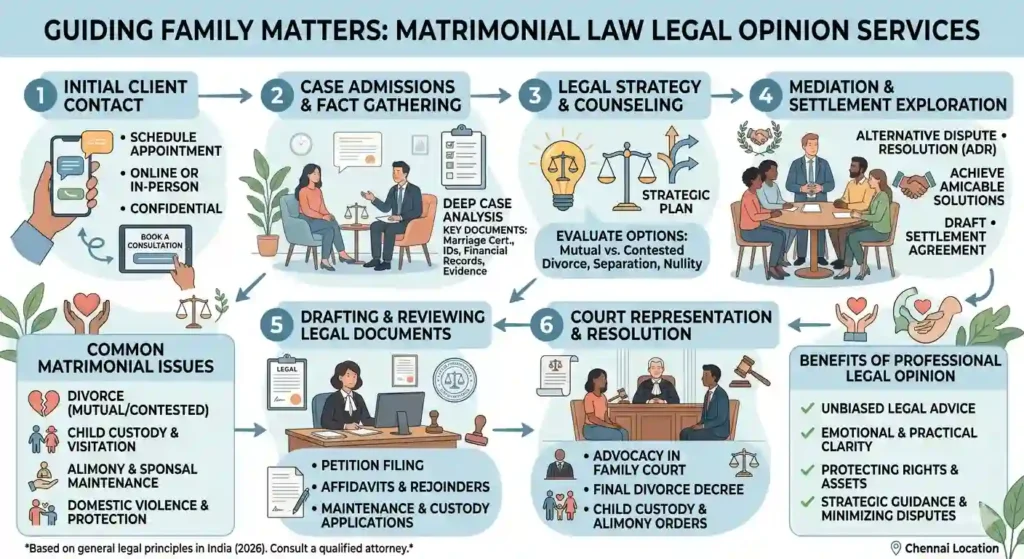
Understanding Matrimonial Law in India 2026: Legal Issues, Forums, and Governing Laws
Types of Matrimonial Legal Issues Requiring Expert Legal Opinion in India
Matrimonial law in India covers a diverse and emotionally charged range of legal disputes requiring professional guidance. Divorce proceedings, whether contested or by mutual consent, top the list of matrimonial matters across India. Furthermore, maintenance disputes under Section 125 CrPC (now BNSS Section 144) affect spouses and children significantly. Child custody and guardianship battles involve complex assessments of the child’s welfare and parental fitness. Additionally, matrimonial property disputes arise when joint assets are contested during or after separation proceedings. Domestic violence complaints under the Protection of Women from Domestic Violence Act, 2005 (PWDVA) demand urgent legal intervention. Cruelty-based divorce petitions and dowry harassment cases under BNS Section 85 further expand the dispute landscape. Therefore, Virtuoso Legal Services covers every matrimonial dispute category with thorough legal opinion and litigation support.
- Divorce (Contested): Grounds-based petitions under Hindu Marriage Act, Special Marriage Act
- Mutual Consent Divorce: Section 13B HMA — six-month cooling-off waiver available since 2023
- Maintenance & Alimony: BNSS Section 144, HMA Section 24 — interim and permanent maintenance
- Child Custody: Guardians and Wards Act, 1890 — welfare-of-child paramount standard
- Domestic Violence: PWDVA, 2005 — protection orders, residence orders, monetary relief
- Dowry Harassment: BNS Section 85 (cruelty), BNS Section 84 (dowry death) — criminal remedy
- Matrimonial Property: Stridhan recovery, joint property disputes during divorce proceedings
Courts, Tribunals, and Forums Handling Matrimonial Disputes Across India in 2026
India’s judicial system provides a structured network of forums specifically designed to adjudicate matrimonial disputes efficiently. Family Courts, established under the Family Courts Act, 1984, serve as the primary forum for matrimonial litigation across India. Consequently, every district with a population above one million must have at least one dedicated Family Court. Metropolitan Magistrate Courts handle domestic violence complaints and maintenance applications under BNSS provisions. Additionally, High Courts exercise supervisory and appellate jurisdiction over all Family Court decisions statewide. The Supreme Court hears Special Leave Petitions in high-stakes custody and matrimonial property matters involving constitutional questions. Furthermore, Lok Adalat sessions before the District Legal Services Authority (DLSA) resolve maintenance and matrimonial disputes through consensual settlements. Therefore, Virtuoso Legal Services guides clients to the most strategically appropriate forum based on each dispute’s specific facts and legal requirements.
| Forum / Court | Jurisdiction | Applicable Law | Relief Available |
|---|---|---|---|
| Family Court | District level — all matrimonial matters | Family Courts Act, 1984; HMA, 1955 | Divorce, custody, maintenance |
| Metropolitan Magistrate | Urban areas — DV, maintenance | PWDVA, 2005; BNSS Section 144 | Protection orders, interim maintenance |
| Sessions Court | District — criminal matrimonial | BNS 2023, BNSS 2023 | Bail, trial in dowry/cruelty cases |
| High Court | State — appeals, writ petitions | Article 226; HMA Section 28 | Transfer petitions, custody writs |
| Supreme Court of India | Pan-India — SLPs, constitutional | Article 136; Article 142 | Final custody, divorce dissolution |
| Lok Adalat (DLSA) | District — consensual settlement | Legal Services Authorities Act, 1987 | Binding settlement awards |
| Mediation Centre (HC) | State — pre-trial mediation | Section 89 CPC, 1908 | Negotiated settlement, consent terms |
BNS 2023 and BNSS 2023: How New Criminal Laws Reshape Matrimonial Legal Practice
The Bharatiya Nyaya Sanhita, 2023 (BNS) and Bharatiya Nagarik Suraksha Sanhita, 2023 (BNSS) significantly altered matrimonial criminal proceedings across India. Consequently, dowry harassment now attracts prosecution under BNS Section 85, replacing the repealed IPC Section 498A provisions. BNS Section 84 addresses dowry death, retaining the presumption of guilt against the husband and his relatives. Additionally, cruelty in marriage is defined more expansively under BNS to include mental and psychological harm. Under BNSS Section 144, maintenance applications require faster disposal timelines than previously mandated under CrPC. The BNSS also mandates audio-video recording of witness statements in sensitive matrimonial criminal trials. Furthermore, the Bharatiya Sakshya Adhiniyam, 2023 (BSA) allows electronic evidence — including WhatsApp messages — in divorce and cruelty proceedings. Therefore, Virtuoso Legal Services updates its legal opinions to incorporate these transformative procedural and substantive changes comprehensively.
| Old Provision | New BNS/BNSS/BSA Provision | Impact on Matrimonial Disputes |
|---|---|---|
| IPC Section 498A — Cruelty | BNS Section 85 | Expanded definition includes mental cruelty |
| IPC Section 304B — Dowry Death | BNS Section 84 | Presumption against husband retained |
| CrPC Section 125 — Maintenance | BNSS Section 144 | Faster disposal timelines mandated |
| Indian Evidence Act — Electronic Records | BSA Section 57 | WhatsApp, emails admissible in family courts |
| CrPC Section 438 — Anticipatory Bail | BNSS Section 482 | Modified bail conditions in cruelty FIRs |
Personal Laws Governing Matrimonial Disputes: Religion-Specific Legal Frameworks
India’s matrimonial law operates through multiple religion-specific personal laws, each with distinct procedures and remedies. Therefore, identifying the applicable personal law is the first step in every matrimonial legal opinion. Hindus, Sikhs, Buddhists, and Jains are governed by the Hindu Marriage Act, 1955 (HMA) for divorce and maintenance. Muslims are governed by the Muslim Personal Law (Shariat) Application Act, 1937 and the Muslim Women (Protection of Rights on Divorce) Act, 1986. Additionally, the Muslim Women (Protection of Rights on Marriage) Act, 2019 criminalises instant triple talaq as void and illegal. Christians follow the Indian Divorce Act, 1869, while Parsis are governed by the Parsi Marriage and Divorce Act, 1936. The Special Marriage Act, 1954 applies to inter-religious marriages and civil marriages across all communities. Consequently, Virtuoso Legal Services provides religion-specific legal opinions with full awareness of each personal law’s unique provisions.
Role of Police Stations in Matrimonial Disputes: FIR, DV Complaints, and Dowry Cases
Police stations serve as the entry point for criminal remedies in matrimonial disputes across every Indian city. Therefore, victims of dowry harassment, domestic violence, or matrimonial cruelty must approach the local police station immediately. Under BNSS Section 173, police must register cognizable matrimonial offences as FIRs without any delay or excuse. Women’s Help Desks and One Stop Centres, established in major police stations, assist domestic violence victims sensitively. Additionally, the Crime Against Women (CAW) Cell in metropolitan cities handles serious matrimonial offences with specialised investigators. Protection Officers under PWDVA, 2005 are appointed at the Sub-Divisional Magistrate level to facilitate domestic violence complaints. Furthermore, BNSS Section 482 allows anticipatory bail applications in dowry and cruelty cases before Sessions Courts. Virtuoso Legal Services assists clients in registering police complaints and managing criminal proceedings alongside Family Court matters effectively.
- Local Police Station: FIR under BNS Sections 84, 85 for dowry death and cruelty
- Women’s Help Desk: First contact point at police station for DV victims
- Crime Against Women (CAW) Cell: Specialised investigation of serious matrimonial crimes
- One Stop Centre (OSC): Integrated support — police, legal aid, shelter, medical assistance
- Protection Officer (SDM Office): PWDVA complaint filing and protection order facilitation
- Cyber Crime PS: Online harassment, stalking, and digital evidence collection in matrimonial matters
Dowry Harassment and Domestic Violence: Urgent Legal Remedies Under BNS and PWDVA
Dowry harassment and domestic violence remain two of the most pressing matrimonial legal issues in contemporary India. Consequently, victims must act swiftly and decisively to secure legal protection through multiple available remedies simultaneously. Under BNS Section 85, cruelty by husband or in-laws attracts imprisonment up to three years and a fine. The PWDVA, 2005 provides Protection Orders, Residence Orders, and Monetary Relief without requiring criminal prosecution. Additionally, Emergency Protection Orders under PWDVA can be granted by Magistrates within one working day of application. Filing a complaint with the Protection Officer triggers automatic preparation of a Domestic Incident Report (DIR). Furthermore, the Protection Officer must forward the DIR to the Magistrate immediately for order consideration. Therefore, Virtuoso Legal Services provides urgent legal opinion and representation to domestic violence victims seeking immediate protection orders.
Divorce Law in India 2026: Grounds, Procedures, and Contested vs Mutual Consent Cases
Divorce law in India varies based on the applicable personal law, but common grounds apply across most statutes. Consequently, cruelty, adultery, desertion, conversion, mental disorder, and leprosy serve as grounds across HMA, Indian Divorce Act, and Parsi Act. The Supreme Court in Shilpa Sailesh v. Varun Sreenivasan (2023) exercised Article 142 powers to grant divorce on irretrievable breakdown grounds directly. Therefore, the Supreme Court now provides a remedy where marriage has irreparably broken down but no statutory ground exists. Mutual consent divorce under HMA Section 13B requires two stages with a six-month cooling-off period between them. Additionally, the Supreme Court can waive the cooling-off period in deserving cases citing its extraordinary powers under Article 142. Contested divorce involves framing of issues, evidence, cross-examination, and final arguments before the Family Court judge. Virtuoso Legal Services prepares comprehensive divorce petitions and defence responses backed by thorough legal opinion and case strategy.
Child Custody and Guardianship: Welfare of the Child as the Paramount Legal Standard
Child custody disputes involve one of the most delicate balancing acts in all of Indian family law adjudication. Therefore, courts consistently apply the welfare-of-the-child standard as the overriding consideration in every custody decision. The Guardians and Wards Act, 1890 empowers courts to appoint guardians and determine custody arrangements comprehensively. Under HMA Section 26, Family Courts grant interim custody and visitation rights during pending divorce proceedings. Additionally, the Supreme Court in Roxann Sharma v. Arun Sharma held that younger children generally require maternal custody. Parental alienation, geographic relocation, and international abduction further complicate custody disputes significantly. Furthermore, courts appoint amicus curiae or child psychologists to assess each child’s preference and emotional well-being. Virtuoso Legal Services conducts thorough legal opinion analysis on custody matters, covering jurisdiction, applicable law, and evidence strategy comprehensively.
Legal Opinion Services, Remedies, and Expert Matrimonial Support by Virtuoso Legal Services
What Is a Matrimonial Legal Opinion and Why Does It Matter?
A matrimonial legal opinion is a structured, written professional assessment of your legal rights and remedies in a family dispute. Therefore, it provides the factual and legal foundation upon which all litigation strategy is built and executed. A comprehensive legal opinion identifies the applicable personal law, relevant forum, limitation periods, and available remedies. Consequently, clients avoid wasting time and money pursuing claims in incorrect forums or under inapplicable laws. Legal opinions from Virtuoso Legal Services cover divorce grounds analysis, maintenance quantum estimation, and custody prospects assessment. Additionally, we assess the strength of domestic violence complaints, dowry harassment FIRs, and matrimonial property recovery claims. A written legal opinion also serves as a reference document during mediation, negotiation, or settlement discussions. Therefore, every matrimonial matter, however straightforward it may appear, deserves an expert legal opinion before any court step is taken.
- Grounds Analysis: Assessing which divorce ground applies and its evidentiary strength
- Forum Identification: Determining correct court — Family Court, HC, Magistrate, or DLSA
- Limitation Assessment: Checking time limits for filing divorce, maintenance, or DV complaints
- Evidence Review: Evaluating documents, WhatsApp chats, medical records under BSA 2023
- Maintenance Quantum: Estimating interim and permanent maintenance entitlements accurately
- Risk Assessment: Identifying potential counterclaims and criminal complaint exposure
- Strategy Roadmap: Presenting step-by-step legal action plan tailored to your specific case
Maintenance and Alimony: Legal Rights and Calculation Principles Under Indian Law 2026
Maintenance law in India protects financially dependent spouses and children from economic hardship during and after separation. Therefore, understanding maintenance entitlements forms a central component of every matrimonial legal opinion prepared by Virtuoso Legal Services. Interim maintenance under HMA Section 24 is granted during pending divorce proceedings to the financially weaker spouse. BNSS Section 144 entitles wives, children, and parents to claim maintenance before the Metropolitan Magistrate across all religions. Additionally, permanent alimony under HMA Section 25 is determined based on income, lifestyle, assets, and duration of marriage. Muslim women are entitled to fair and reasonable provision under the Muslim Women (Protection of Rights on Divorce) Act, 1986. Furthermore, the Supreme Court in Rajnesh v. Neha (2021) standardised maintenance calculation criteria for uniformity across all Family Courts. Consequently, Virtuoso Legal Services provides precise, evidence-based maintenance quantum estimates in every client legal opinion.
| Type of Maintenance | Governing Law | Forum | Key Factors Considered |
|---|---|---|---|
| Interim Maintenance | HMA Section 24 | Family Court | Income, immediate needs, minor children |
| Permanent Alimony | HMA Section 25 | Family Court | Assets, lifestyle, marriage duration |
| Maintenance (All Religions) | BNSS Section 144 | Metropolitan Magistrate | Income, dependants, inability to maintain |
| Muslim Divorce Maintenance | Muslim Women Act, 1986 | Magistrate Court | Iddat period, fair provision |
| Child Maintenance | HMA Section 26; GWA 1890 | Family Court | Child’s needs, parental income, education |
Matrimonial Property Disputes: Stridhan, Joint Assets, and Recovery Remedies in 2026
Matrimonial property disputes often accompany divorce proceedings and require simultaneous civil and criminal legal strategies. Consequently, wives have an absolute right over Stridhan — gifts received before, during, and after marriage from any source. The Supreme Court in Pratibha Rani v. Suraj Kumar confirmed that Stridhan misappropriation constitutes criminal breach of trust. Therefore, recovery of Stridhan can proceed both through civil suit and criminal complaint under BNS Section 316. Joint property acquired during marriage is subject to equitable distribution principles in Indian divorce proceedings. Additionally, matrimonial home rights under PWDVA Section 17 allow wives to reside in the shared household regardless of ownership. Courts also pass mandatory injunctions to prevent husbands from alienating joint property during divorce proceedings. Virtuoso Legal Services provides clear legal opinions on Stridhan recovery strategy and matrimonial asset protection for every client.
Mediation and ADR in Matrimonial Disputes: Section 89 CPC and DLSA Lok Adalat Process
Alternative Dispute Resolution offers matrimonial disputants a private, faster, and less adversarial path to resolution. Therefore, Virtuoso Legal Services actively explores mediation and Lok Adalat options as part of every initial legal opinion. Section 89 CPC empowers Family Courts to refer matrimonial disputes to mediation at any stage of proceedings. Mediation centres attached to High Courts and Family Courts maintain trained mediators specialising in family disputes. Additionally, Lok Adalat sessions at the DLSA resolve maintenance, matrimonial property, and consent divorce matters through binding awards. Lok Adalat awards carry the force of a court decree and are not subject to any appeal thereafter. Furthermore, pre-litigation mediation prevents the emotional escalation that prolonged Family Court trials often produce unnecessarily. Consequently, Virtuoso Legal Services identifies whether your matrimonial dispute is amenable to early mediated settlement, saving time, costs, and emotional distress significantly.
Government Departments Supporting Matrimonial Dispute Resolution Across India
Multiple government departments play supportive roles in the resolution of matrimonial disputes across India. Therefore, understanding these institutional resources complements formal legal proceedings significantly for every affected family. The Ministry of Women and Child Development (WCD) oversees One Stop Centres, shelters, and Protection Officer appointments nationally. The National Commission for Women (NCW) investigates serious matrimonial rights violations and recommends remedial action. Additionally, State Women Commissions in Tamil Nadu, Maharashtra, Delhi, and Karnataka handle state-level matrimonial grievances. The Department of Legal Affairs and NALSA (National Legal Services Authority) provide free legal aid in matrimonial matters. Furthermore, District Legal Services Authorities (DLSAs) operate Lok Adalats and appoint mediators for matrimonial dispute resolution. The Child Welfare Committee (CWC) under POCSO assists in child custody cases involving child abuse allegations. Consequently, Virtuoso Legal Services integrates these institutional channels into its comprehensive matrimonial legal opinion and action plan.
- Ministry of WCD: One Stop Centres, shelter homes, Protection Officer coordination
- NCW / State Women Commissions: Grievance redressal, rights advocacy for married women
- NALSA / DLSA: Free legal aid, Lok Adalat, mediation for matrimonial matters
- Child Welfare Committee (CWC): Child protection in custody disputes involving abuse
- District Collector / SDM: Protection Officer appointments under PWDVA, 2005
- Cyber Crime Cell: Digital evidence — WhatsApp, emails — in cruelty and divorce cases
International Matrimonial Disputes: NRI Divorce, Hague Convention, and Jurisdiction Issues
International matrimonial disputes involving NRI spouses present unique jurisdictional and enforcement challenges for Indian courts. Consequently, understanding cross-border matrimonial law is essential for spouses whose partners reside abroad. Foreign divorce decrees may or may not be recognised by Indian courts depending on reciprocity and procedural compliance. The Supreme Court in Y. Narasimha Rao v. Y. Venkata Lakshmi held that foreign divorce decrees must comply with Indian personal law to be valid. Additionally, child custody disputes involving children removed to foreign countries engage the Hague Convention on International Child Abduction principles. India has not ratified the Hague Convention, making international custody recovery complex and litigation-intensive. Furthermore, NRI marriages registered abroad but governed by HMA allow the wife to file divorce in Indian courts under Section 19 HMA jurisdiction. Therefore, Virtuoso Legal Services provides specialised legal opinions on NRI matrimonial matters with full awareness of international private law principles.
Legal Remedies in Matrimonial Disputes: Civil, Criminal, and Constitutional Options
Indian matrimonial law provides an extensive matrix of civil, criminal, and constitutional remedies for aggrieved spouses. Therefore, Virtuoso Legal Services maps out all applicable remedies comprehensively in each client’s personalised legal opinion. Civil remedies include divorce decrees, custody orders, maintenance awards, and Stridhan recovery through civil suits. Criminal remedies include FIR registration, arrest, bail opposition, and trial under BNS Sections 84 and 85. Additionally, the PWDVA offers hybrid civil-criminal remedies — protection orders with criminal consequences for violation. Constitutional remedies through Article 226 writ petitions address illegal police inaction, discriminatory personal laws, and jurisdictional overreach. Furthermore, anticipatory bail under BNSS Section 482 protects respondents facing false or exaggerated matrimonial criminal complaints. Transfer petitions under Section 25 CPC allow wives to transfer matrimonial cases to courts closer to their residence. Consequently, Virtuoso Legal Services builds a multi-layered remedy strategy addressing every dimension of each matrimonial dispute comprehensively.
- Divorce Decree: Family Court — contested (grounds-based) or mutual consent under applicable personal law
- Interim Maintenance: HMA Section 24 or BNSS Section 144 — urgent financial relief during proceedings
- Protection Order: PWDVA Section 18 — prevents further domestic violence acts immediately
- Residence Order: PWDVA Section 19 — ensures wife’s right to reside in matrimonial home
- Child Custody Order: GWA / HMA Section 26 — interim and permanent custody arrangement
- Stridhan Recovery: Civil suit + BNS Section 316 criminal complaint — dual-track recovery approach
- Anticipatory Bail: BNSS Section 482 — protection against arrest in dowry and cruelty FIRs
- Transfer Petition: High Court / Supreme Court — transfer case to wife’s convenient jurisdiction
How Virtuoso Legal Services Delivers Expert Matrimonial Legal Opinion Support
Virtuoso Legal Services delivers structured, actionable matrimonial legal opinions through a rigorous, client-focused process. Therefore, every legal opinion engagement begins with a comprehensive one-on-one consultation to understand the full factual matrix. Our matrimonial law experts review all relevant documents — marriage certificate, income proofs, property papers, and correspondence. Consequently, we identify applicable personal law, correct forum, limitation periods, and available remedies with precision. We assess electronic evidence including WhatsApp chats, emails, and call records under the BSA 2023 standards. Additionally, our opinions address both spouses’ potential claims and counterclaims to avoid litigation surprises later. Written legal opinions are delivered within five working days covering all civil, criminal, and constitutional remedies. Furthermore, follow-up consultations refine the legal strategy as new facts emerge during proceedings. Virtuoso Legal Services combines deep personal law expertise with modern litigation techniques to protect every client’s family law rights comprehensively.
- Initial Consultation: Full factual assessment — marriage history, assets, children, disputes
- Document Review: Marriage certificate, financial records, property papers, correspondence
- Electronic Evidence Analysis: WhatsApp, emails, social media under BSA 2023
- Written Legal Opinion: Delivered within 5 working days — comprehensive, actionable
- Strategy Roadmap: Step-by-step action plan — civil, criminal, and ADR options
- Court Representation: Family Court, High Court, Magistrate, and Lok Adalat appearances
- Ongoing Advisory: Regular updates as case develops across multiple forums simultaneously
Digital Evidence in Matrimonial Cases: BSA 2023 Standards and Admissibility in 2026
The Bharatiya Sakshya Adhiniyam, 2023 (BSA) has transformed how digital evidence is used in Indian matrimonial proceedings. Consequently, WhatsApp conversations, voice messages, emails, and social media posts now serve as primary evidence in cruelty and divorce cases. BSA Section 57 makes electronic records admissible upon production of a certificate from a competent authority. Therefore, spouses seeking divorce on cruelty grounds must preserve and properly authenticate all digital communications. Courts have accepted screenshots of abusive texts and financial transactions in maintenance and Stridhan recovery cases. Additionally, call detail records and location data assist in establishing desertion and adultery in contested divorce proceedings. However, evidence obtained through illegal hacking or interception remains inadmissible and attracts criminal liability under the IT Act. Virtuoso Legal Services trains clients in lawful evidence preservation and submits properly authenticated digital evidence before Family Courts and High Courts effectively.
| Type of Digital Evidence | Matrimonial Use Case | BSA 2023 Section | Authentication Requirement |
|---|---|---|---|
| WhatsApp Messages | Cruelty, desertion proof | Section 57, 61 | Certificate + screenshot metadata |
| Emails | Financial disputes, adultery | Section 57 | Email header authentication |
| Bank Statements (Digital) | Maintenance quantum, Stridhan | Section 61 | Bank certificate under BSA |
| CCTV Footage | Domestic violence evidence | Section 57 | Chain of custody documentation |
| Social Media Posts | Adultery, lifestyle claims | Section 57 | Notarised screen capture |
Frequently Asked Questions: Matrimonial Law Legal Opinion Services — Virtuoso Legal Services 2026
Q1. What is a matrimonial legal opinion and when should I seek one?
A matrimonial legal opinion is a professional written assessment of your rights and remedies in a family dispute. Seek one before filing any court petition. It identifies applicable law, forum, and strategy. Virtuoso Legal Services delivers opinions within five working days.
Q2. Which court handles divorce cases in India?
Family Courts handle all divorce petitions under the Family Courts Act, 1984. Mutual consent divorce under HMA Section 13B takes approximately 6–18 months. High Courts hear appeals. Virtuoso Legal Services represents clients before all matrimonial courts across India efficiently.
Q3. What are the grounds for divorce under the Hindu Marriage Act?
Grounds include cruelty, adultery, desertion (2 years), conversion, mental disorder, leprosy, and venereal disease. The Supreme Court now also grants divorce on irretrievable breakdown under Article 142. Our legal opinion identifies your strongest applicable ground.
Q4. How is maintenance calculated in Indian matrimonial law 2026?
Courts consider both spouses’ income, assets, lifestyle, and children’s needs per Rajnesh v. Neha (2021) guidelines. BNSS Section 144 applies across all religions before Magistrates. Virtuoso Legal Services provides precise maintenance quantum estimates in every legal opinion prepared.
Q5. What remedies does PWDVA 2005 provide to domestic violence victims?
PWDVA provides Protection Orders, Residence Orders, Monetary Relief, Custody Orders, and Compensation Orders. Emergency orders are granted within one working day. Violation of protection orders attracts criminal imprisonment under the Act. We assist victims in filing complaints urgently.
Q6. Is triple talaq still valid in India after 2019?
No. The Muslim Women (Protection of Rights on Marriage) Act, 2019 criminalises instant triple talaq, making it void and illegal. Husbands pronouncing it face up to three years’ imprisonment. Affected wives can seek maintenance and custody simultaneously through courts.
Q7. Can WhatsApp messages be used as evidence in divorce proceedings?
Yes. BSA 2023 Section 57 makes electronic records including WhatsApp messages admissible in Indian courts. Proper authentication through metadata and a BSA certificate is required. Virtuoso Legal Services assists clients in legally preserving and authenticating digital matrimonial evidence.
Q8. What is Stridhan and how can a wife recover it after separation?
Stridhan is property gifted to the wife before, during, or after marriage from any source. Misappropriation constitutes criminal breach of trust under BNS. Recovery proceeds through civil suit and criminal complaint simultaneously. Virtuoso Legal Services recovers Stridhan through dual-track legal strategy.
Q9. How does the Supreme Court’s Article 142 power affect divorce cases?
Article 142 empowers the Supreme Court to grant divorce on irretrievable breakdown of marriage even without a statutory ground. Shilpa Sailesh v. Varun Sreenivasan (2023) confirmed this. This remedy applies when marriage is beyond repair. Our advocates advise on SLP eligibility accurately.
Q10. Why choose Virtuoso Legal Services for matrimonial legal opinions?
Virtuoso Legal Services combines deep personal law expertise with knowledge of BNS, BNSS, and BSA 2023. We deliver written legal opinions within five working days. Our advocates represent clients before all Indian family courts and tribunals. Contact us today for your confidential consultation.
Read More
- Maritime Matters Simplified: Marine Law Legal Experts
- Navigating Employment Laws: Labour Law Legal Opinion Services
- Protecting Young Lives: Juvenile Law Legal Experts
- Global Legal Solutions: International Law Legal Opinion Services
- Defending Intellectual Property: Intellectual Property Rights Legal Experts
- Ministry of Law and Justice