![Virtuoso Legal Services [Best Legal Opinion Services 24×7]](https://legalopinion.org.in/wp-content/uploads/2023/09/cropped-logo.png)

Your Legal Shield: Expert Legal Opinion Services
Expert Legal Opinion Services – A legal opinion explains how applicable law affects a proposed action, transaction, dispute, or compliance decision. Therefore, it helps clients identify risks before signing documents or taking irreversible steps. Virtuoso Legal Services provides reasoned opinions covering civil, criminal, corporate, property, family, tax, employment, regulatory, and commercial matters. Moreover, opinions can identify jurisdiction, limitation, evidence, contractual duties, and available remedies. Clients may include individuals, companies, NGOs, trusts, institutions, startups, investors, and NRIs. A well-prepared opinion examines facts, documents, applicable statutes, regulations, notifications, and relevant judicial principles. Consequently, clients receive practical guidance rather than abstract legal commentary. The opinion can recommend negotiation, compliance, representation, arbitration, mediation, litigation, or other appropriate remedies. Furthermore, early advice can reduce financial exposure and prevent avoidable proceedings. Legal opinions therefore function as a strategic shield for informed decision-making across India.
Your Legal Shield: Expert Legal Opinion Services – Virtuoso Legal Services
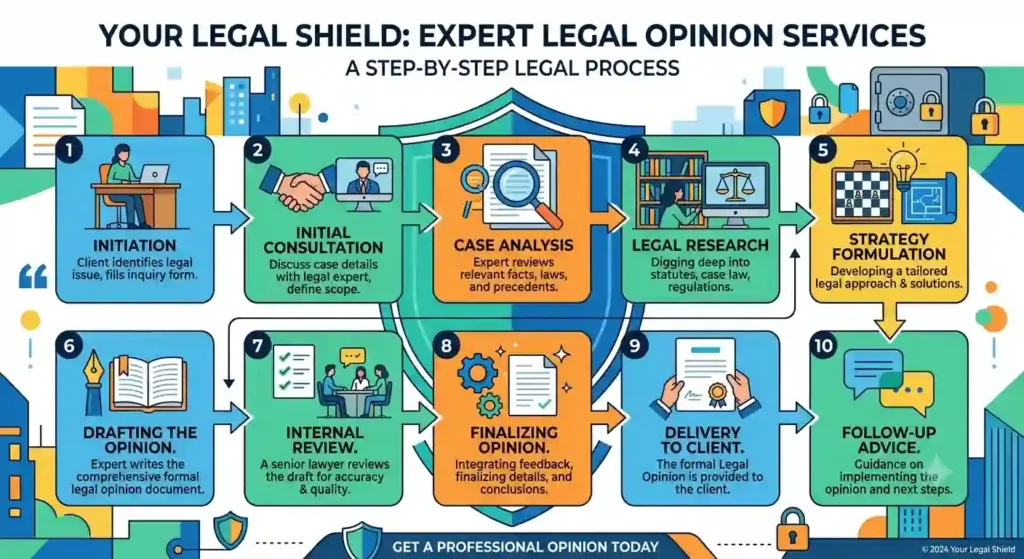
Identifying Legal Exposure
Legal risk often develops through unclear contracts, incomplete documentation, regulatory breaches, disputed ownership, or procedural mistakes. Accordingly, a legal opinion should identify the precise source of potential liability. Lawyers may examine statutory obligations, contractual clauses, licences, government notices, correspondence, financial records, and electronic communications. Furthermore, they can identify whether a proposed action may trigger civil, criminal, regulatory, or tax consequences. Current criminal matters require consideration of the Bharatiya Nyaya Sanhita, 2023 and Bharatiya Nagarik Suraksha Sanhita, 2023. Evidence strategy may also require consideration of the Bharatiya Sakshya Adhiniyam, 2023. Therefore, legal opinions should reflect current legislation rather than outdated terminology. The resulting advice can identify risks, rank priorities, and recommend corrective measures. Ultimately, preventive legal analysis helps clients act confidently while reducing exposure to expensive disputes.
Scope of Expert Legal Opinions
Civil and Property Matters
Property transactions require careful legal analysis because ownership, possession, approvals, encumbrances, and contractual rights can overlap. A legal opinion can examine title documents, sale agreements, leases, development arrangements, powers of attorney, and succession issues. Moreover, lawyers can identify registration, stamp-duty, zoning, land-use, and municipal concerns. Disputes may involve injunctions, declarations, possession, partition, specific performance, or compensation. The Code of Civil Procedure, 1908 can become relevant to civil litigation and procedural strategy. However, specialised legislation may provide alternative forums or remedies. Therefore, counsel should determine jurisdiction before recommending proceedings. Clients should also preserve original documents and verify records through appropriate authorities. Additionally, NRIs require careful advice concerning powers of attorney, property management, inheritance, and cross-border documentation. A preventive opinion can expose title defects before purchase completion. Consequently, professional property advice protects investments and reduces future litigation risks.
Corporate and Commercial Matters
Companies require legal opinions before entering significant contracts, restructuring operations, acquiring assets, or responding to regulatory concerns. Counsel can review shareholder agreements, employment contracts, vendor arrangements, financing documents, guarantees, and corporate approvals. Furthermore, opinions can address director duties, corporate authority, insolvency exposure, intellectual property, competition concerns, and statutory compliance. Commercial disputes may involve arbitration, commercial courts, tribunals, consumer forums, or ordinary civil courts. The correct forum depends upon the transaction, contract, parties, and governing legislation. Therefore, a legal opinion should identify dispute-resolution clauses before litigation begins. Companies should also obtain advice before making admissions or issuing termination notices. Additionally, board records and electronic communications should remain properly preserved. A timely opinion can prevent contractual breaches and improve negotiation positions. Consequently, businesses can make commercially sound decisions while managing legal exposure. Expert legal support remains valuable throughout transactions, disputes, compliance reviews, and corporate restructuring.
Regulatory and Compliance Protection
Government and Regulatory Matters
Regulatory Compliance Opinions
Regulatory compliance requires continuous attention because obligations can arise from Central, State, and local authorities. Lawyers can review licences, registrations, statutory filings, permits, notices, inspections, and operational practices. Moreover, compliance opinions can identify gaps before regulators impose penalties or commence proceedings. Relevant authorities may include MCA, GST authorities, Income Tax Department, RBI, SEBI, labour authorities, pollution-control bodies, municipal authorities, and sector regulators. The applicable authority depends upon the client’s activity and jurisdiction. Therefore, legal advice should map every relevant statutory obligation before recommending corrective action. Businesses should maintain evidence proving timely compliance and authorised decision-making. Additionally, NGOs and trusts may require specialised advice concerning registration, taxation, governance, and regulatory reporting. NRIs may face additional issues involving foreign exchange and cross-border transactions. A written legal opinion can establish a practical compliance roadmap. Consequently, clients can address regulatory risks systematically instead of reacting after receiving enforcement notices.
Employment and Workplace Disputes
Employment relationships create legal risks involving termination, wages, contracts, misconduct, workplace policies, confidentiality, and statutory benefits. A legal opinion can assess whether proposed employment action complies with applicable labour legislation and contractual obligations. Furthermore, employers should examine standing orders, internal policies, appointment terms, disciplinary procedures, and applicable government notifications. Employees may seek opinions concerning wrongful termination, unpaid benefits, harassment, discrimination, or contractual breaches. Appropriate forums can include labour authorities, industrial tribunals, civil courts, or other competent statutory bodies. However, forum selection depends upon employment status and the applicable legislation. Lawyers should also preserve emails, notices, attendance records, salary statements, and disciplinary documents. Consequently, evidence can become decisive during conciliation or litigation. Preventive legal opinions can also strengthen workplace policies before disputes arise. Thus, employers and employees can understand their rights and obligations before taking consequential action. Early advice often prevents escalation and unnecessary legal costs.
Data, Technology and Digital Risks
Digital businesses face legal exposure involving privacy, cybersecurity, electronic contracts, intellectual property, online defamation, and data handling. The Digital Personal Data Protection Act, 2023 establishes a statutory framework for digital personal-data processing. Therefore, businesses should obtain legal opinions concerning privacy notices, consent mechanisms, vendor arrangements, security practices, and data governance. Counsel can also examine website terms, software licences, intellectual-property rights, and platform agreements. Electronic evidence requires careful preservation when disputes or investigations arise. The BSA includes provisions governing judicial evidence and expressly addresses modern evidentiary requirements. Furthermore, cyber incidents may require coordinated technical and legal responses. Lawyers can advise on complaints, notices, contractual claims, regulatory responses, and litigation strategy. Consequently, technology-related legal opinions should combine statutory analysis with practical risk controls. Preventive advice helps organisations reduce exposure before digital incidents become expensive disputes.
Legal Opinions for Disputes and Remedies
Litigation and Dispute Strategy
Criminal and Police Matters
Criminal-Law Opinions
Criminal allegations require immediate legal analysis because investigations can affect liberty, reputation, employment, and business operations. The BNS now provides India’s principal substantive criminal-law framework. The BNSS governs criminal procedure and contains provisions concerning investigation, arrest, bail, trials, and related processes. Therefore, clients should obtain advice before making statements or responding to serious allegations. Counsel can assess whether alleged conduct satisfies statutory offence requirements. Lawyers can also advise regarding police complaints, FIRs, anticipatory bail, regular bail, discharge, quashing, and trial strategy. Nearby police stations may become relevant when territorial jurisdiction determines complaint or investigation processes. However, every contractual disagreement does not constitute a criminal offence. A legal opinion can distinguish civil liability from criminal culpability. Consequently, clients can choose proportionate remedies while avoiding unnecessary escalation. Prompt advice also helps preserve evidence and protect procedural rights during investigation.
Evidence and Documentation
Strong legal opinions depend upon reliable facts and complete documentation. Lawyers should examine contracts, notices, invoices, emails, messages, photographs, recordings, certificates, government communications, and electronic records. Furthermore, the BSA provides the current statutory evidence framework for applicable judicial proceedings. Counsel should therefore consider authenticity, relevance, admissibility, custody, and preservation when assessing evidence. Clients should avoid deleting, modifying, or concealing potentially relevant records. Moreover, chronological document indexing can reveal contradictions and strengthen legal strategy. Companies should maintain board minutes and authorised approvals for significant decisions. Individuals should preserve agreements, receipts, correspondence, and official communications. NGOs and trusts should maintain governance records, financial documents, and regulatory filings. NRIs should preserve notarised, apostilled, or consular documents where applicable. Consequently, evidence-focused legal opinions provide stronger foundations for negotiations and proceedings. Proper documentation can also reduce factual disputes and improve settlement prospects.
Choosing the Correct Forum
Courts, Tribunals and Authorities
Different legal disputes require different forums, and incorrect filing can waste valuable time. Civil disputes may reach competent civil or commercial courts, subject to jurisdiction and statutory exclusions. Employment disputes may involve labour authorities or industrial tribunals. Tax disputes may proceed through statutory appellate authorities and tribunals. Consumer disputes may reach Consumer Commissions where statutory requirements apply. Arbitration matters generally follow the Arbitration and Conciliation Act, 1996 and its designated court mechanisms. Moreover, specialised regulators may possess exclusive or primary jurisdiction over particular issues. Therefore, legal opinions should identify forum, territorial jurisdiction, pecuniary limits, limitation, and available appellate remedies. Counsel should also consider alternative dispute resolution before commencing lengthy litigation. Mediation can provide a negotiated resolution where parties remain willing to settle. Consequently, forum analysis forms a central part of responsible legal advice. Choosing correctly at the beginning can significantly reduce procedural objections and litigation costs.
Remedies and Strategic Options
Legal opinions should provide actionable remedies rather than merely identify legal problems. Depending upon the circumstances, available remedies may include negotiation, legal notices, mediation, arbitration, injunctions, declarations, damages, specific performance, appeals, revisions, or judicial review. Criminal matters may require bail, discharge, quashing, or defence strategies. Regulatory matters may require representations, compliance corrections, appeals, or statutory applications. Furthermore, interim relief may protect property, evidence, funds, or contractual rights during proceedings. Lawyers should rank remedies according to urgency, legal strength, cost, and commercial consequences. A written opinion can explain both advantages and limitations of each option. Therefore, clients can select remedies based upon informed risk assessment. Counsel should also identify limitation periods and mandatory pre-litigation requirements. Consequently, prompt advice prevents valuable remedies from becoming unavailable. Strategic legal opinions transform complicated legal issues into practical decision-making frameworks for clients.
Preventive Legal Support
Opinion, Review and Risk Management
Contract Review and Legal Due Diligence
Contracts frequently create legal exposure because parties overlook ambiguous terms, hidden obligations, and weak enforcement mechanisms. A legal opinion can examine warranties, indemnities, termination clauses, dispute-resolution provisions, liability limits, payment obligations, and governing law. Furthermore, due diligence can identify ownership defects, regulatory restrictions, litigation exposure, and undisclosed liabilities. Companies should conduct legal reviews before acquisitions, investments, major procurements, and strategic partnerships. Individuals should seek advice before signing substantial property, loan, employment, or settlement documents. NGOs and trusts can review donor agreements, leases, service contracts, and governance arrangements. NRIs may require additional examination of cross-border documentation and authority structures. Therefore, preventive review should occur before commitments become difficult to reverse. Lawyers can highlight clauses requiring negotiation or additional safeguards. Consequently, clients can improve contractual certainty while reducing future disputes. Expert legal opinion services provide an important checkpoint before commercially significant decisions.
Notices, Representations and Settlement
Legal notices often shape the future course of a dispute. A poorly drafted notice may create unnecessary admissions, weaken negotiation positions, or trigger avoidable litigation. Therefore, counsel should verify facts, contractual provisions, limitation, jurisdiction, and requested relief before issuing correspondence. Replies require similar care because admissions may later become evidence. Moreover, settlement proposals should clearly define obligations, timelines, confidentiality, releases, and consequences of default. Mediation can assist parties seeking commercially sensible resolutions without prolonged litigation. Arbitration may provide another option where a valid arbitration agreement exists. Counsel can also prepare representations to government departments, regulators, municipalities, and statutory authorities. Consequently, preventive legal advice can resolve disputes before formal proceedings become necessary. Clients should preserve delivery records and responses associated with important notices. A well-planned communication strategy protects rights while keeping settlement opportunities open. Early professional review therefore remains one of the most cost-effective legal safeguards.
Cross-Border and NRI Legal Opinions
NRIs frequently require Indian legal opinions concerning property, inheritance, family disputes, investments, taxation, contracts, and business interests. Cross-border matters can involve Indian laws alongside foreign procedural or documentation requirements. Therefore, counsel should identify jurisdiction, applicable law, authority documents, and enforcement considerations at the outset. Powers of attorney require careful drafting because representatives may otherwise exceed intended authority. Property transactions require title verification and compliance with applicable foreign-exchange requirements. Succession matters may involve wills, probate, nominations, family arrangements, and property located across jurisdictions. Furthermore, NRIs may need representation before Indian courts, tribunals, government departments, or police authorities. Lawyers can coordinate document execution and representation through appropriate lawful channels. Consequently, remote ownership does not eliminate the need for active legal supervision. A comprehensive opinion can reduce cross-border misunderstandings and prevent costly procedural errors. Virtuoso Legal Services can provide India-focused legal analysis for clients managing interests from overseas.
Individuals, Companies, NGOs and Institutions
Legal opinion services should reflect the client’s structure, objectives, exposure, and regulatory environment. Individuals may need advice concerning property, family, employment, criminal, consumer, or succession matters. Companies may require corporate, commercial, tax, employment, intellectual-property, and regulatory opinions. NGOs and trusts often need governance, compliance, taxation, funding, property, and contractual advice. Institutions may require procurement, employment, regulatory, litigation, and risk-management opinions. Furthermore, each client may face different forums and limitation periods. Lawyers should therefore avoid generic opinions that ignore the client’s factual circumstances. A useful opinion identifies facts, issues, law, analysis, risks, remedies, and recommended action. It should also distinguish established law from areas involving legal uncertainty. Consequently, clients receive realistic guidance rather than unsupported assurances. Preventive legal advice works best when counsel understands both the law and the client’s practical objectives. Expert opinions can therefore become an important component of long-term legal risk management.
Comprehensive Legal Risk Protection
Building a Preventive Legal Strategy
Virtuoso Legal Services as Your Legal Shield
Virtuoso Legal Services provides expert legal opinion support designed to prevent disputes and strengthen informed decision-making. Our approach begins with factual review, document examination, issue identification, and jurisdiction analysis. We then assess applicable Central and State legislation, regulations, notifications, contracts, and relevant judicial principles. Furthermore, our opinions identify practical remedies and recommend proportionate risk-control measures. Services can cover civil, criminal, property, family, corporate, commercial, employment, taxation, regulatory, technology, and dispute-resolution matters. We also assist individuals, companies, NGOs, trusts, institutions, investors, and NRIs. Where litigation becomes necessary, counsel can coordinate strategy for courts, tribunals, authorities, police stations, arbitration, and mediation. Current criminal matters require attention to BNS, BNSS, and BSA provisions. Consequently, timely legal opinions can reduce uncertainty before clients commit resources. Our objective remains practical: identify risks early, explain legal options clearly, and protect clients through informed action.
Frequently Asked Questions
1. What is an expert legal opinion?
An expert legal opinion provides a reasoned assessment of applicable law, risks, rights, liabilities, jurisdiction, evidence, and available remedies for a specific situation.
2. Why obtain a legal opinion before acting?
Preventive advice can identify contractual, regulatory, financial, civil, or criminal risks before decisions create irreversible consequences or expensive litigation.
3. Can companies obtain legal opinions on compliance?
Yes. Companies can obtain opinions covering contracts, corporate governance, taxation, employment, regulatory compliance, intellectual property, data protection, disputes, and transactions.
4. Do NRIs need Indian legal opinions?
Yes. NRIs often require Indian advice concerning property, inheritance, family matters, investments, contracts, powers of attorney, litigation, taxation, and regulatory compliance.
5. Can a legal opinion prevent litigation?
Often, yes. Early advice can identify negotiation opportunities, correct compliance failures, strengthen documentation, and recommend mediation before formal litigation becomes necessary.
6. Which laws can a legal opinion cover?
Depending on the matter, advice can cover CPC, BNS, BNSS, BSA, commercial laws, property laws, tax laws, corporate legislation, employment laws, and regulatory statutes.
Read More
- Navigating Legal Waters: Comprehensive Legal Opinion Services
- Advocating for Justice: Legal Opinion Services in Chennai
- Ensuring Workplace Safety: Workmen Compensation Act Legal Experts
- Planning for the Future: Will Legal Opinion Services
- Navigating Investment Ventures: Venture Capital Legal Experts
- Department of Justice, Ministry of Law and Justice