![Virtuoso Legal Services [Best Legal Opinion Services 24×7]](https://legalopinion.org.in/wp-content/uploads/2023/09/cropped-logo.png)
Frustration of Contract in India: When Does Section 56 Make a Contract Void?
Doctrine of Frustration Under Section 56: When Is a Contract Rendered Void in India? Section 56 of the Indian Contract Act, 1872 provides the statutory foundation for contractual frustration. The doctrine applies when supervening events make performance impossible or unlawful. However, frustration does not operate as a general escape from an inconvenient bargain. The event must fundamentally affect the contractual obligation. Therefore, courts examine the contract, its purpose, circumstances, and consequences together.
The Supreme Court has treated Section 56 as a rule of positive Indian law. It has also rejected a narrow test based only upon physical impossibility. Consequently, impracticability or uselessness can matter when an event destroys the contractual foundation. Businesses therefore need careful contract interpretation before declaring an agreement void. Moreover, force majeure clauses may require analysis under Section 32 instead. The distinction can materially affect contractual termination, restitution, damages, arbitration, and litigation. This article explains the doctrine using current Indian contract law principles. It also examines courts, tribunals, government authorities, evidence, and practical legal remedies.
⚖️ Section 56 Core Rule
A subsequent event can make a contract void when performance becomes impossible or unlawful through circumstances beyond the promisor’s control.
📜 Section 32
Contractual force majeure and contingent events may fall under Section 32 rather than statutory frustration.
🚫 Not Mere Hardship
Higher cost, lower profit, or commercial inconvenience does not automatically establish frustration.
🔍 Judicial Test
Courts examine whether the supervening event strikes at the root of the contractual bargain.
🏛️ Forums
Commercial Courts, civil courts, arbitral tribunals, High Courts, and appropriate statutory forums may become relevant.
📂 Evidence
Contracts, government orders, correspondence, digital records, technical reports, and financial documents can become critical.
🛡️ Legal Remedies
Potential remedies include restitution, declaration, damages, injunction, arbitration, specific relief, negotiation, and statutory proceedings.
The Statutory Foundation of Contractual Frustration
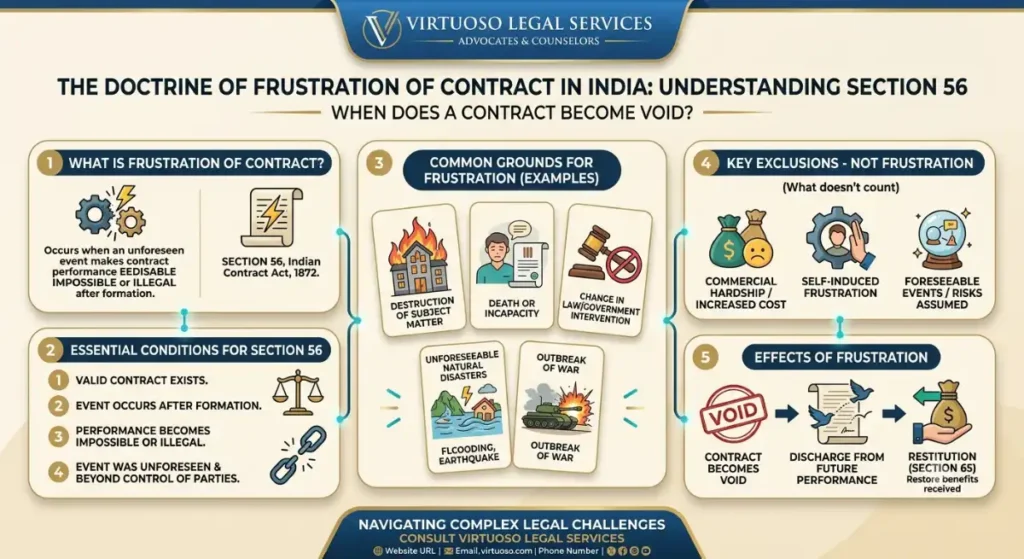
The Doctrine of Frustration Under Section 56
Section 56 of the Indian Contract Act, 1872 governs supervening impossibility and subsequent unlawfulness. It applies when an agreed act becomes impossible or unlawful after contract formation. Therefore, frustration can discharge contractual obligations without requiring an express termination clause. The doctrine does not operate merely because performance becomes difficult, costly, delayed, or commercially unattractive. Instead, the supervening event must fundamentally affect the contractual obligation.
The Supreme Court has treated Section 56 as a rule of positive Indian law. In Satyabrata Ghose, the Court rejected a narrow physical impossibility test. It explained that impracticability or uselessness can matter when the contractual foundation disappears. However, courts examine the contract’s object, surrounding circumstances, and consequences together. A party cannot ordinarily invoke frustration after voluntarily assuming a foreseeable commercial risk. Moreover, contractual force majeure wording may direct the court toward Section 32 instead. Thus, Section 56 requires disciplined factual analysis rather than a convenient exit strategy.
What Section 56 Actually Provides
Section 56 contains three connected ideas concerning impossible and unlawful performance. First, an agreement to perform an act impossible in itself remains void from inception. Second, a valid contract becomes void when performance subsequently becomes impossible or unlawful through an uncontrollable event. Third, the provision addresses compensation where a promisor knew or reasonably should have known about impossibility. Therefore, lawyers must distinguish initial impossibility from supervening impossibility.
The second category commonly generates modern frustration disputes involving government orders, legal prohibitions, destruction, or extraordinary events. However, the event must actually prevent or fundamentally alter the promised performance. Increased expenditure alone normally does not satisfy that requirement. Moreover, the court examines whether the promisor could prevent the relevant event. The statutory language therefore requires close attention to causation and responsibility. A party should identify the precise date when performance became impossible or unlawful. That date can affect termination notices, restitution, limitation issues, damages, and litigation strategy.
The Supreme Court’s Modern Test for Frustration
The Supreme Court has repeatedly explained that Section 56 does not require literal physical impossibility. Satyabrata Ghose v. Mugneeram Bangur remains the foundational authority for this proposition. The Court stated that performance may become impossible when it becomes impracticable or useless against the contract’s fundamental object. However, the supervening event must strike at the root of the contractual arrangement. Energy Watchdog v. CERC later reinforced the distinction between contractual force majeure and statutory frustration. Where a contract contains a force majeure clause, Section 32 may govern interpretation of that clause. Therefore, courts first examine the parties’ contractual allocation of risk. They then assess whether the specified event actually occurred and triggered the clause. If no contractual mechanism applies, Section 56 may become relevant. Moreover, courts avoid rewriting bargains merely because market conditions deteriorate. Consequently, frustration remains an exceptional doctrine requiring evidence, contractual interpretation, and careful judicial assessment.
What Makes the Supervening Event Legally Significant?
A later event must affect the contractual foundation rather than merely increase performance difficulty. Courts examine the bargain that the parties actually made at contract formation. They consider the promised performance, contractual purpose, surrounding circumstances, and consequences of the later event. Therefore, the court asks whether the original obligation remains substantially the same obligation. If performance retains its essential character, frustration generally becomes difficult to establish. However, an event may destroy the commercial or legal foundation underlying the specific bargain.
Examples can include a new prohibition that prevents the promised act or destruction of essential subject matter. Even then, the court requires a close factual connection between the event and the obligation. Moreover, the party invoking Section 56 should show that the event was not caused by its own conduct. A party cannot manufacture impossibility through voluntary acts and then claim frustration. Accordingly, evidence should establish the event, its timing, its direct impact, and its unavoidable character.
Government Action and Change in Law
Government action can sometimes make contractual performance unlawful under Section 56. A statutory prohibition, regulatory order, licence cancellation, or binding governmental direction may prevent the promised act. However, not every administrative inconvenience creates frustration.
The legal effect depends upon the precise order, statutory authority, duration, territorial scope, and contractual obligation. Therefore, counsel should obtain the complete notification, order, circular, licence condition, or regulatory communication. The analysis should identify whether the government action actually prohibits performance. A temporary restriction may produce a different result from permanent legal impossibility. Moreover, the contract may contain a force majeure or change-in-law clause allocating this risk. Section 32 can become relevant where the parties expressly addressed an uncertain future event.
If a contractual clause governs the event, courts generally interpret that bargain before invoking Section 56. Consequently, businesses should not label every regulatory obstacle as frustration. Legal review should establish whether the event destroys performance or merely changes the compliance pathway.
Is Increased Cost or Reduced Profitability Enough?
Increased cost, reduced profitability, or adverse market conditions usually do not establish frustration by themselves. Contracting parties commonly assume commercial risks involving prices, supply, demand, currency, and financing. Therefore, courts generally avoid converting ordinary commercial hardship into statutory discharge. The Supreme Court’s frustration jurisprudence requires a substantial impact upon the contractual obligation.
A supplier facing higher input costs may still possess the legal and physical ability to deliver. Likewise, a developer facing reduced margins may still perform the promised construction. However, an event that legally prohibits performance presents a different question. Similarly, destruction of an essential subject matter may fundamentally change the bargain. Moreover, a contract may expressly allocate price or market risks through escalation, adjustment, or force majeure clauses.
Counsel should therefore examine risk allocation before asserting frustration. Financial records can demonstrate the actual effect of the event. Yet financial loss alone does not establish Section 56 impossibility. The legal inquiry remains focused on contractual performance and its fundamental basis.
Section 32 and Section 56 Must Be Distinguished
Firstly, Section 32 of the Indian Contract Act addresses contingent contracts involving uncertain future events. Section 56 addresses agreements impossible in themselves and contracts that later become impossible or unlawful. Therefore, the two provisions may appear similar while performing different legal functions. Where parties expressly provide for an uncertain event, the contractual mechanism can govern the consequences. Energy Watchdog confirms that an express force majeure clause generally falls within Section 32.
The court must then interpret the clause and determine whether its conditions have occurred. However, Section 56 operates independently where supervening impossibility or unlawfulness arises outside such contractual allocation. This distinction matters because courts cannot simply replace negotiated risk allocation with general frustration principles. Moreover, the wording of the contract may identify notice requirements, mitigation duties, suspension periods, and termination rights. Counsel should therefore read the force majeure clause before drafting a Section 56 notice. Proper classification can materially change the available remedies and litigation forum.
Force Majeure Clauses and Contractual Risk Allocation
A force majeure clause can define events that excuse, suspend, or terminate contractual performance. Common clauses address natural disasters, war, government restrictions, epidemics, strikes, transport disruption, and regulatory action. However, courts interpret such clauses according to their actual wording. Energy Watchdog explains that contractual force majeure falls within Section 32 when the clause governs an uncertain event. Therefore, the party invoking the clause must establish that the specified event falls within its scope. It must also satisfy notice, causation, mitigation, and timing requirements where applicable. Moreover, a general hardship clause may not equal a force majeure clause.
A clause covering impossibility may operate differently from one covering substantial delay. Consequently, contract drafting should define triggers, evidence requirements, notice periods, and termination consequences. Businesses should preserve correspondence showing timely invocation of contractual rights. They should also document reasonable mitigation steps after the event. Accordingly, force majeure analysis should begin with contract interpretation before moving to Section 56 frustration.
What Evidence Helps Prove Frustration?
A frustration claim depends heavily upon contemporaneous evidence showing the supervening event and its contractual consequences. The original agreement remains the starting point because courts must understand the parties’ bargain. Counsel should preserve amendments, schedules, specifications, correspondence, and negotiated risk provisions. Government orders, statutory notifications, licences, regulatory communications, and inspection reports can establish legal impediments. Financial records may demonstrate increased costs, but they require careful interpretation. Technical reports can explain destruction, unavailability, or physical impossibility affecting essential subject matter. Moreover, emails and meeting records may show when the parties learned about the event. Electronic records can also establish notice dates and mitigation efforts.
The Bharatiya Sakshya Adhiniyam, 2023 governs current evidentiary questions involving electronic records. Therefore, businesses should preserve relevant digital material with appropriate authenticity safeguards. A clear chronology can connect the event to the contractual obligation. Consequently, evidence should prove more than inconvenience. It should demonstrate why the supervening event fundamentally changed or legally prevented performance.
How Courts Analyse the Contractual Foundation
The Role of Contractual Purpose
Contractual purpose often determines whether a later event truly frustrates performance. Courts examine the commercial and legal object that the parties pursued through their bargain. Therefore, the same event may affect different contracts differently. A temporary closure might frustrate a short event contract while leaving a long-term supply arrangement substantially intact. Similarly, destruction of a unique venue may affect an event agreement more severely than a general services contract. However, courts cannot invent a purpose that the written contract does not support. The surrounding circumstances can assist interpretation where the contractual language requires context. Moreover, parties should distinguish an important commercial expectation from an essential contractual purpose.
A disappointed expectation does not automatically equal frustration. Counsel should identify the promised performance and the objective conditions supporting that promise. This approach helps courts assess whether the supervening event strikes at the contract’s foundation. Accordingly, drafting should clearly record essential assumptions and risk allocations. Such clarity can reduce later disputes over whether an event fundamentally changed the bargain.
Temporary Impossibility and Delay
A temporary event does not automatically frustrate a contract. Courts examine whether the delay destroys the commercial purpose or merely postpones performance. Therefore, the duration of the interruption matters alongside the nature of the obligation. A short delay may be tolerable under a long-term agreement. Conversely, delay may defeat a contract tied to a fixed event, season, tender, or regulatory deadline. Section 55 may also become relevant where time constitutes an essential term. However, Section 55 and Section 56 address different legal situations and should not be conflated. Counsel should identify the contractual deadline, extension mechanism, notice provisions, and consequences of delay. Moreover, the parties may have agreed to suspend performance during specified force majeure periods. Such provisions can change the analysis substantially.
Evidence should therefore establish when the delay began and whether performance remained commercially meaningful. A party should not terminate solely because performance became inconvenient for a short period. Instead, it should assess whether the contractual object remains achievable after the interruption.
Impossibility Caused by Destruction or Unavailability
Destruction or permanent unavailability of essential subject matter can support a frustration argument. The event must affect something fundamental to the promised performance. For example, a contract tied to a unique property may face different consequences after compulsory acquisition or destruction. However, substitute performance may remain possible in some arrangements. Therefore, courts examine whether substitution changes the essential bargain. The contract’s wording can identify whether the subject matter has unique characteristics or commercial alternatives. Moreover, ownership risk, insurance arrangements, and contractual allocation clauses may affect the analysis.
A party should establish that the relevant subject matter became unavailable through circumstances outside its control. It should also establish that reasonable alternatives cannot preserve the original obligation. Technical reports, government records, insurance documents, and site evidence may become relevant. Consequently, frustration analysis requires factual proof rather than broad statements about impossibility. The court ultimately determines whether the supervening event destroyed the foundation of performance. That inquiry remains fact-sensitive and contract-specific.
Unlawfulness and Regulatory Prohibition
Section 56 expressly addresses contracts that subsequently become unlawful because of an uncontrollable event. A later law, binding regulation, or government order can therefore create statutory impossibility. However, the legal prohibition must actually affect the promised act. A regulatory requirement that merely increases compliance costs may not make performance unlawful. Therefore, counsel should identify the exact provision creating the prohibition.
The analysis should also consider commencement, territorial application, exemptions, permissions, and transitional arrangements. Moreover, parties should examine whether a licence, approval, or exemption remains legally available. If lawful performance remains possible through an agreed mechanism, frustration may not follow automatically. Conversely, a mandatory prohibition can fundamentally alter the contractual obligation.
Businesses should obtain certified copies of relevant government notifications and regulatory orders. They should also record communications with licensing and regulatory departments. Consequently, regulatory evidence can become central in court proceedings. The appropriate forum may include a civil court, commercial court, arbitral tribunal, or High Court. Forum selection depends upon the contract, statute, and procedural posture.
Frustration in Commercial and Infrastructure Contracts
Commercial and infrastructure contracts frequently contain detailed risk allocation provisions. Parties may address delays caused by approvals, land acquisition, funding, weather, regulatory changes, or government action. Therefore, courts generally begin with the contractual machinery before applying Section 56. A project agreement may provide extension rights, suspension periods, compensation mechanisms, or termination events. These provisions can determine whether an alleged frustrating event actually triggers contractual relief. However, an event outside the clause may still raise a statutory frustration issue. Counsel should map the event against every relevant clause and statutory provision. Moreover, infrastructure disputes often involve arbitration clauses and specialised contractual dispute boards.
The Arbitration and Conciliation Act, 1996 may therefore govern the procedural route. NCLT or NCLAT jurisdiction may arise separately when insolvency or company-law issues become involved. Accordingly, lawyers should identify all concurrent forums before commencing proceedings. A commercial court or arbitral tribunal may require different pleadings and evidence. Proper forum strategy can prevent fragmented litigation and inconsistent findings.
Frustration and Real Estate or Property Agreements
Real estate agreements can raise frustration issues after acquisition, zoning changes, title restrictions, or governmental prohibitions. However, ordinary price movements rarely establish statutory frustration. Courts examine whether the property remains legally and practically transferable under the original bargain. Therefore, parties should inspect title records, planning permissions, acquisition notifications, zoning orders, and development approvals. A temporary approval delay may not destroy the contract’s foundation. Conversely, compulsory acquisition or permanent legal prohibition may create a materially different situation. Moreover, specific performance principles may become relevant when one party seeks enforcement instead of termination.
The Specific Relief Act, 1963 can therefore operate alongside the Contract Act. Civil courts and commercial courts may hear disputes according to jurisdiction and valuation. Arbitration clauses can shift contractual disputes to an arbitral tribunal. Consequently, property lawyers should examine Section 56 together with contractual remedies and specific performance law. Evidence of government action should be preserved from the earliest stage. This approach helps distinguish genuine frustration from ordinary property transaction difficulty.
Frustration and Government Contracts
Government contracts require careful examination because public law duties can affect private contractual performance. A government notification may restrict an activity, alter permissions, or prohibit a particular transaction. However, parties must distinguish a contractual risk from a legal impossibility. Therefore, the exact government order and statutory source require immediate examination. Public procurement contracts may also contain detailed force majeure, termination, and dispute resolution provisions. Such clauses can allocate risks that parties might otherwise attempt to address under Section 56. Moreover, government contracts may involve specialised tender conditions and administrative remedies.
The appropriate forum can depend upon the contract, arbitration clause, statutory scheme, and public law element. A writ petition under Article 226 may arise in suitable cases involving public authorities. Yet ordinary contractual disputes do not automatically become writ proceedings. Consequently, lawyers should assess whether the dispute concerns contractual rights or public law obligations. Proper classification helps determine whether a civil court, arbitral tribunal, commercial court, or High Court should act.
Frustration, Arbitration, and Commercial Dispute Resolution
Many commercial contracts contain arbitration clauses that determine the forum for disputes involving frustration. Arbitration does not eliminate Section 56; instead, the tribunal may apply the governing substantive law. Therefore, counsel should review the arbitration agreement, seat, governing law, notice procedure, and institutional rules. The Arbitration and Conciliation Act, 1996 provides the principal procedural framework for Indian-seated arbitrations. However, the tribunal must still determine whether Section 56 applies to the disputed contractual obligation.
Force majeure clauses may require separate contractual interpretation under Section 32. Moreover, parties should consider interim measures when evidence, assets, or performance rights require protection. Section 9 proceedings can become relevant before or during arbitration in appropriate circumstances. Section 17 provides tribunal-based interim relief within the statutory framework. Consequently, litigation strategy should coordinate contractual notices with arbitration timelines. A party should preserve its substantive frustration argument without accidentally waiving contractual rights. Early legal advice can also prevent inconsistent positions across arbitration and court proceedings.
CPC, Commercial Courts, and Civil Remedies
The Code of Civil Procedure, 1908 remains relevant to civil proceedings arising from contractual frustration disputes. Commercial disputes may also fall within the Commercial Courts Act, 2015 when statutory conditions are satisfied. Therefore, parties should identify the proper civil forum before filing a declaration, recovery claim, or damages action. A plaintiff may seek appropriate relief concerning termination, restitution, damages, injunctions, or contractual rights. However, the availability of each remedy depends upon the facts and governing legislation.
Firstly, Section 65 of the Contract Act may become relevant where a contract becomes void and a party has received an advantage. Secondly, Section 73 can become relevant to compensation for breach where frustration does not discharge the contract. Consequently, lawyers should avoid pleading frustration and breach as identical concepts. The court may need to determine when and why performance ceased. Moreover, limitation periods require separate analysis under the Limitation Act, 1963. A carefully drafted plaint should establish the contract, supervening event, legal consequence, relief, and jurisdiction. Proper procedural framing can materially affect the dispute’s outcome.
| Provision | Core Issue | Typical Contract Dispute Question |
|---|---|---|
| Section 32 | Contingent contracts | Did the agreed uncertain event occur or become impossible? |
| Section 55 | Time of performance | Did delay defeat an essential contractual term? |
| Section 56 | Supervening impossibility | Did a later event destroy the contractual foundation? |
| Section 65 | Restitution | What advantage must be restored after the contract becomes void? |
| Section 73 | Compensation | Is damages relief available for an established breach? |
Remedies, Evidence, Forums, and Practical Legal Strategy
Restitution, Compensation, and Financial Consequences
A contract becoming void under Section 56 can create consequences concerning benefits already received. Section 65 addresses restoration of advantages received under agreements discovered void or contracts that become void. Therefore, parties should calculate payments, benefits, delivered goods, completed work, and recoverable amounts. Frustration does not automatically mean that every financial consequence disappears. The precise restitution position depends upon the statutory framework and facts. Moreover, a party may have separate claims under the contract or another applicable law.
Counsel should distinguish restitution from damages for breach because frustration generally operates differently from wrongful non-performance. If one party caused the supervening event, the statutory frustration defence may also face serious difficulty. Consequently, financial analysis should accompany the legal analysis from the beginning. Businesses should preserve invoices, bank records, delivery documents, tax records, and performance certificates. Such evidence can help quantify benefits and losses. Courts may also examine mitigation and causation where compensation claims arise. Therefore, a complete Section 56 strategy must address both discharge and financial consequences.
BNS, BNSS, BSA, and Contract Disputes
The BNS, BNSS, and BSA do not replace Section 56 of the Indian Contract Act. They become relevant when contractual disputes also generate allegations of cheating, criminal breach of trust, forgery, or other offences. Therefore, lawyers must keep civil contractual liability separate from criminal allegations. A failed contract does not automatically establish a criminal offence. However, fraudulent conduct existing from the beginning may create criminal-law consequences beyond the contractual dispute. The BNS governs substantive offences within its scope, while BNSS governs criminal procedure.
The BSA governs current evidentiary questions, including electronic records. Consequently, emails, digital invoices, messages, and electronic approvals may become important in connected proceedings. Police stations may receive complaints where parties allege criminal conduct, subject to jurisdiction. Economic Offences Wing investigations may arise in complex financial allegations. Nevertheless, the existence of an FIR does not itself establish frustration or breach. Each proceeding requires its own statutory analysis. Counsel should therefore coordinate civil, commercial, arbitration, and criminal strategies without confusing their legal tests.
Police Complaints and Jurisdictional Authorities
Contract disputes sometimes reach local police stations when one party alleges fraud or dishonest conduct. However, police involvement does not transform every breach into a criminal offence. The alleged conduct must satisfy the ingredients of a cognisable offence under applicable criminal law. Therefore, counsel should examine the complaint before advising a party about criminal proceedings. Chennai disputes may involve the jurisdictional police station or specialised Economic Offences Wing, depending upon the allegations. Regulatory matters may also involve GST authorities, SEBI, Registrar of Companies, or other departments. The appropriate authority depends upon the subject matter and statutory jurisdiction. Moreover, parties should preserve the original contract and relevant communications before making allegations.
A premature criminal complaint can complicate an otherwise commercial dispute. Conversely, genuine fraud may require prompt criminal and civil remedies. Consequently, legal assessment should distinguish contractual frustration from dishonest conduct. Counsel should also evaluate territorial jurisdiction, cause of action, and applicable procedural provisions. This structured approach helps avoid parallel proceedings that lack a clear legal foundation.
Tribunals, Forums, and Appropriate Legal Remedies
Frustration disputes can involve courts, arbitral tribunals, and specialised statutory forums. The appropriate forum depends upon the contract, arbitration clause, statutory jurisdiction, and nature of relief. Civil courts may determine contractual declarations, damages, restitution, and related remedies. Commercial courts may handle qualifying commercial disputes under the Commercial Courts Act. Arbitral tribunals may decide disputes where a valid arbitration agreement covers the controversy.
High Courts may exercise writ, supervisory, appellate, or inherent jurisdiction in appropriate circumstances. NCLT and NCLAT may become relevant where insolvency or company-law issues independently arise. Therefore, lawyers should not select a forum solely because the dispute concerns frustration. The relief sought and governing legal framework control forum selection. Available remedies may include declaration, restitution, damages, injunction, specific performance, termination, arbitration, or statutory review. Moreover, interim relief can protect assets, documents, or contractual rights while the dispute continues. Consequently, early forum analysis can reduce jurisdictional objections and procedural delay.
Documentation, Notice, and Risk Management
Documentation often determines whether a frustration claim survives serious judicial scrutiny. Companies should preserve the signed contract, schedules, amendments, notices, invoices, approvals, and correspondence. They should also preserve government orders, regulatory communications, technical reports, and evidence of the intervening event. Therefore, a chronological evidence file should begin as soon as the event occurs. Contractual notice provisions should receive particular attention because force majeure clauses often impose strict timelines.
A party should state the event, affected obligation, expected duration, and contractual basis clearly. However, it should avoid unsupported declarations that performance has automatically become impossible. Legal review should precede any irreversible termination notice where substantial commercial value remains. Moreover, businesses should document reasonable mitigation steps and alternative performance options. These records can demonstrate whether the party acted responsibly after the event. Electronic evidence should remain intact under appropriate retention procedures. Consequently, risk management and litigation preparation should operate together. A structured evidence trail can reduce factual disputes and improve the quality of legal advice.
Legal Support for Frustration and Contract Disputes
Virtuoso Legal Services – Expert Legal Solutions 24×7 can assist clients with complex contractual frustration issues. Legal support can begin with contract review, risk mapping, and identification of the alleged frustrating event. Counsel can then examine Section 56, Section 32, Section 65, Section 73, and related provisions. The team can review force majeure clauses, termination provisions, arbitration agreements, and governing-law clauses. Further support can cover legal notices, negotiations, mediation, arbitration, civil litigation, and interim relief. Where contractual disputes involve alleged fraud, counsel can separately assess BNS and BNSS implications.
Evidence review can also address electronic records under the BSA. Depending upon the dispute, representation may involve civil courts, commercial courts, arbitral tribunals, High Courts, or specialised forums. Therefore, clients can receive a coordinated strategy across contractual and connected proceedings. Businesses should obtain advice before declaring frustration or terminating high-value agreements. Early review can identify contractual alternatives that preserve commercial relationships. It can also prevent avoidable admissions and procedural mistakes.
Key Questions Before Invoking Section 56
A party should answer several factual and legal questions before invoking frustration. First, what exact event occurred after contract formation? Second, when did that event affect the promised performance? Third, did the event make performance impossible, unlawful, or fundamentally different? Fourth, could the promisor prevent or avoid the event? Fifth, does the contract contain a force majeure or change-in-law clause? Sixth, does Section 32 govern the agreed risk allocation? Seventh, what evidence establishes the event and its consequences? Eighth, what benefits have the parties already exchanged? Ninth, which forum has jurisdiction over the dispute? Tenth, what remedies remain available if Section 56 fails? Therefore, parties should not rely on a generic frustration notice. A structured legal assessment can distinguish frustration from breach, hardship, delay, or commercial loss. Moreover, it can identify restitution, damages, injunction, arbitration, or specific performance issues. Consequently, careful preliminary analysis often prevents expensive and avoidable litigation mistakes.
- Identify the exact supervening event and its date.
- Compare the event against the contractual force majeure clause.
- Determine whether Section 32 or Section 56 applies.
- Preserve government orders and electronic evidence.
- Assess restitution under Section 65.
- Separate frustration from breach and damages claims.
- Check arbitration, commercial court, and civil jurisdiction.
- Review any connected BNS, BNSS, or BSA issues.
Legal Remedy Roadmap for a Frustrated Contract
Contractual frustration requires a remedy strategy that matches the legal basis and procedural stage. Parties may begin with a contractual notice explaining the supervening event and relevant clause. They may then pursue negotiation, mediation, or settlement where commercial relationships remain valuable. If disputes continue, an arbitration clause may require reference to an arbitral tribunal. A civil or commercial court may become appropriate where no arbitration agreement exists.
Specific performance issues may arise where one party seeks enforcement rather than discharge. Restitution can become relevant where a contract becomes void after benefits change hands. Damages require separate analysis because frustration differs from ordinary breach. Injunctions may protect property, documents, or contractual rights during proceedings. High Court remedies can arise where public law or statutory jurisdiction supports intervention. Therefore, counsel should create a remedy matrix before filing proceedings. The matrix should identify the forum, limitation period, evidence, relief, and procedural requirement. Such planning can reduce duplicated litigation and inconsistent contractual positions.
Practical Legal Strategy for Businesses and Individuals
Businesses and individuals should treat frustration as a legal conclusion rather than an assumption. The first step involves preserving the complete contractual record. The second step involves identifying the precise supervening event and its legal effect. The third step involves reviewing force majeure, termination, change-in-law, and dispute-resolution provisions. The fourth step involves assessing statutory consequences under Sections 32, 56, 65, and 73. The fifth step involves identifying the correct court, tribunal, or regulatory forum. Therefore, legal advice should precede unilateral termination of significant contracts. Moreover, counsel should examine whether the event actually destroyed performance or merely increased its difficulty. Financial, technical, regulatory, and electronic evidence should support the analysis.
If criminal allegations arise, lawyers should separately evaluate BNS, BNSS, and BSA consequences. Where arbitration applies, contractual notices should preserve arbitral rights. Consequently, early legal review can protect commercial relationships and litigation positions. Virtuoso Legal Services provides contract review, legal opinions, dispute resolution, arbitration, and litigation support for these issues.
When a Party Should Seek Immediate Legal Advice
A party should seek immediate legal advice after receiving a termination notice based upon alleged frustration. Early review becomes especially important where the contract involves substantial financial commitments. It also matters when government action, regulatory prohibition, or compulsory acquisition affects performance. Counsel should inspect the agreement before accepting the opposing party’s description of the event. Moreover, the lawyer should identify whether Section 32 or Section 56 actually governs. Evidence preservation should begin before relevant electronic records disappear.
Parties should also preserve notices, invoices, technical reports, and government communications. Therefore, early advice can protect against wrongful termination and avoidable admissions. If arbitration applies, counsel should calculate contractual and statutory timelines promptly. If litigation has begun, counsel should assess jurisdiction, limitation, pleadings, and interim relief. Connected criminal allegations require separate analysis under current criminal laws. Consequently, timely legal support can prevent a contractual dispute from expanding unnecessarily. A focused legal opinion can also identify settlement opportunities before expensive litigation develops.
How Legal Opinions Can Prevent Frustration Disputes
A detailed contract law opinion can identify frustration risks before a dispute becomes contentious. Counsel can examine force majeure wording, termination rights, notice periods, and risk allocation. The review can also test hypothetical events against Section 32 and Section 56. Therefore, businesses can understand which events may trigger contractual relief. Lawyers can identify documentation requirements and recommended evidence preservation procedures. They can also examine governing law, arbitration clauses, jurisdiction, and limitation periods. Moreover, contract drafting can define regulatory changes and government actions more precisely.
Clear drafting can reduce disputes over whether an event falls within a force majeure clause. It can also specify suspension periods, mitigation duties, and termination consequences. Consequently, preventive legal advice may be more efficient than post-dispute litigation. Virtuoso Legal Services provides legal opinions and contract advisory support across corporate and commercial matters. The firm’s published service profile includes contract drafting, legal opinions, dispute resolution, and litigation support. Therefore, clients can seek advice before signing, performing, suspending, or terminating significant agreements.
Frustration, Breach, Termination, and Rescission
Firstly, Frustration, breach, termination, and rescission represent different legal concepts. Secondly, Frustration concerns a supervening event that makes contractual performance impossible or unlawful. Breach generally concerns failure to perform an existing contractual obligation without a valid legal excuse. Termination may arise from contractual rights, statutory provisions, breach, or an agreed event. Rescission can involve statutory consequences depending upon the legal basis and circumstances. Therefore, parties should not use these terms interchangeably in legal notices.
A notice declaring frustration should identify the statutory and contractual foundation carefully. Moreover, a wrongful termination may expose the terminating party to separate claims. Courts may examine whether the contract actually became void before accepting termination consequences. Consequently, chronology becomes critical when determining the legal status of the agreement. Counsel should establish when the supervening event occurred and when performance became impossible. Evidence should also establish whether the party caused or contributed to the event. Proper legal classification can substantially change available remedies and financial exposure.
Frustration and Specific Performance
Specific performance disputes require separate analysis when one party seeks enforcement after an alleged frustrating event. The Specific Relief Act governs the statutory framework for specific performance in India. Therefore, courts must examine whether the contractual obligation remains legally and practically enforceable. A party cannot ordinarily demand specific performance of an obligation that Section 56 has rendered void. However, disagreement about frustration may itself become the central issue in litigation. Counsel should therefore determine whether performance remains possible before seeking enforcement.
Property contracts, development agreements, supply contracts, and commercial transactions may present different factual questions. Moreover, contractual remedies and specific relief principles can interact with arbitration provisions. The court or tribunal may need to decide whether the supervening event actually discharged the obligation. Consequently, parties should preserve evidence concerning performance capability and legal restrictions. A detailed legal opinion can assess both the frustration defence and the opposing specific-performance claim. This dual analysis helps prevent incomplete litigation strategy. It also assists clients in evaluating settlement and commercial restructuring options.
Frustration and Limitation Considerations
Limitation can become important when parties seek remedies following contractual frustration. The relevant limitation period depends upon the specific relief claimed and applicable statutory provision. Therefore, lawyers must identify whether the dispute concerns declaration, recovery, damages, specific performance, arbitration, or another remedy. The date of the supervening event may become factually significant. However, limitation does not automatically run from the contract’s original formation for every possible claim. Counsel should examine the cause of action and statutory limitation rule applicable to the proceeding. Moreover, contractual notices can create important evidence concerning when a dispute crystallised.
Parties should preserve proof of delivery and receipt for every significant notice. Consequently, delay in obtaining legal advice can create procedural risk. The Limitation Act, 1963 should therefore form part of the litigation assessment. Arbitration claims may also involve contractual timelines alongside statutory limitation principles. A careful chronology should record contract formation, performance milestones, frustrating event, notices, termination, and subsequent correspondence. This chronology helps counsel select appropriate remedies within applicable limitation periods.
Frustration and Insolvency or Corporate Distress
Corporate distress can complicate contractual frustration disputes. A company may experience financial pressure after a project becomes impossible or commercially impaired. However, financial distress alone does not establish Section 56 frustration. Therefore, lawyers must separate inability to pay from legal or factual impossibility of performance. Where insolvency proceedings arise, the Insolvency and Bankruptcy Code may introduce additional procedural considerations. NCLT and NCLAT jurisdiction may then become relevant to corporate insolvency questions. Yet contractual frustration remains governed by its own statutory and contractual framework. Consequently, counsel should avoid assuming that insolvency automatically terminates contractual obligations.
The underlying agreement, insolvency process, and applicable orders require separate analysis. Moreover, contractual counterparties may have rights affected by insolvency proceedings. Evidence concerning performance, payments, security, and termination should therefore be preserved. Businesses should obtain coordinated advice when contract disputes overlap with insolvency. This can prevent inconsistent positions before commercial courts, arbitral tribunals, and NCLT. A structured strategy should address both contractual discharge and corporate restructuring consequences.
Contract Drafting Lessons from Section 56 Disputes
Section 56 disputes demonstrate why precise contractual drafting remains commercially important. Parties should define force majeure events with sufficient clarity. They should also address government restrictions, legal changes, regulatory actions, and prolonged interruption. Therefore, drafting should specify notice periods, evidence requirements, mitigation duties, suspension rights, and termination triggers. The agreement should clarify whether the parties intend to allocate particular risks expressly. Arbitration clauses should identify the governing law, seat, procedure, and appropriate institution where relevant. Payment provisions should address work completed before suspension or termination. Moreover, restitution and refund mechanics can reduce uncertainty after termination.
Businesses should avoid broad language that creates unnecessary disputes over ordinary commercial hardship. A carefully drafted contract can distinguish increased cost from genuine impossibility. It can also define acceptable delay periods and alternative performance arrangements. Consequently, preventive drafting can reduce reliance upon uncertain litigation outcomes. Virtuoso Legal Services can assist with contract drafting, review, negotiation, and risk allocation. Legal review remains particularly valuable for high-value or long-term commercial agreements.
Conclusion: When Section 56 Can Make a Contract Void
Frustration under Section 56 requires a supervening event that fundamentally affects contractual performance. Mere inconvenience, increased expense, reduced profitability, or ordinary market difficulty does not automatically void a contract. Therefore, courts examine the contract, its purpose, risk allocation, surrounding circumstances, and the precise effect of the later event. Where performance becomes unlawful through an uncontrollable legal prohibition, Section 56 may become directly relevant. Where parties allocated an uncertain event through a force majeure clause, Section 32 may govern instead. Moreover, restitution and compensation consequences require separate statutory analysis.
Parties should preserve contracts, government orders, correspondence, electronic records, and evidence showing the event’s impact. The BNS, BNSS, and BSA may become relevant only when connected criminal allegations arise. CPC, commercial courts, arbitration law, and the Specific Relief Act may govern associated civil remedies. Consequently, frustration remains a fact-specific doctrine requiring careful legal assessment. Virtuoso Legal Services – Expert Legal Solutions 24×7 can assist with contract review, notices, arbitration, litigation, and related legal remedies.
Read More
- Legal Opinion on Contractual Agreements: Everything You Need to Know 💫
- Resolve with Confidence: Contract Legal Opinion Services
- General Warranty Deed: Best Legal Services ⚖️
- Unlocking the Power of Legal Opinions in Labor Law: Virtuoso Legal Services 🔍
- Legal Opinion on Labor Laws and Employment Contracts 📚
| Legal Issue | Potential Legal Route | Typical Forum |
|---|---|---|
| Force majeure dispute | Contractual notice, arbitration, declaration | Arbitral Tribunal / Court |
| Supervening impossibility | Section 56 defence or declaration | Civil / Commercial Court / Tribunal |
| Restitution | Section 65 claim | Civil / Commercial Court / Tribunal |
| Specific performance dispute | Specific Relief proceedings | Competent Civil / Commercial Court |
| Connected criminal allegation | Complaint, defence, bail, quashing where applicable | Police / EOW / Criminal Courts / High Court |
| Corporate insolvency overlap | IBC remedies | NCLT / NCLAT |
When does Section 56 make a contract void?
Section 56 may make a contract void when a later uncontrollable event makes performance impossible or unlawful and destroys the contractual foundation.
Is increased cost enough to prove frustration?
Usually no. Increased cost, reduced profit, or ordinary commercial hardship generally does not establish frustration without fundamental impact on contractual performance.
How does Section 32 differ from Section 56?
Section 32 governs contractual contingencies. Section 56 addresses subsequent impossibility or unlawfulness outside the parties’ contractual risk allocation.
Can government action frustrate a contract?
Yes, where government action legally prevents promised performance. Courts examine the exact order, statutory effect, contract terms, duration, and alternatives.
What remedies follow contractual frustration?
Depending on the facts, remedies can include restitution, declarations, damages, injunctions, arbitration, specific relief, negotiation, or statutory remedies.
Should a party issue a legal notice before claiming frustration?
The contract may require notice. Even otherwise, prompt legal review helps preserve evidence, identify the correct statutory basis, and avoid wrongful termination.
Legal Disclaimer: This article provides general legal information and does not constitute case-specific legal advice. Contractual frustration depends upon the exact agreement, facts, evidence, applicable statute, and procedural stage. Readers should obtain professional legal advice before terminating contractual obligations or commencing proceedings.