![Virtuoso Legal Services [Best Legal Opinion Services 24×7]](https://legalopinion.org.in/wp-content/uploads/2023/09/cropped-logo.png)

Fair Exchange: Exchange Deed Legal Opinions
Introduction
An exchange deed transfers ownership between parties without treating money as the principal consideration. Therefore, Indian property law treats an exchange differently from an ordinary sale. Section 118 of the Transfer of Property Act, 1882 defines this transaction as mutual transfer. Each party gives one property and receives another property in return. However, the legal validity depends upon clear title, lawful authority, proper execution, and registration. A careful legal opinion should examine every document before either party accepts the transaction. It should also identify mortgages, court disputes, family claims, government restrictions, and revenue defects. Moreover, Chennai property exchanges require attention to registration procedures and planning records. Tamil Nadu authorities may maintain important records concerning title, land use, and development permissions. Consequently, professional legal support can reduce disputes arising after execution. A sound exchange deed legal opinion should explain risks, remedies, responsibilities, and completion steps clearly.
Exchange Deed Legal Foundation
Meaning and statutory basis of property exchange
Definition of exchange under Section 118
Section 118 of the Transfer of Property Act defines an exchange through reciprocal ownership transfers. Two persons must mutually transfer ownership of one thing for ownership of another thing. Neither property should represent money alone within the statutory definition. Therefore, exchanging land for land generally falls within this provision. Similarly, exchanging one house for another may qualify when ownership moves reciprocally. However, a transaction involving property transferred purely for money normally constitutes a sale. The distinction matters because different legal provisions can govern each transaction. Section 118 also requires the transfer to follow the method applicable to a sale. Consequently, immovable property exchanges generally require proper conveyancing and registration. A legal opinion should identify the precise nature of consideration before approving the proposed deed. The opinion should also compare the transaction terms with existing title documents. This approach helps prevent incorrect descriptions that may create registration or litigation problems.
Reciprocal transfer and lawful consideration
A genuine exchange requires reciprocal obligations between the parties. Each party should identify the property being transferred and the property being received. Therefore, the deed should describe both properties separately and accurately. It should include survey numbers, subdivision details, boundaries, measurements, municipal numbers, and relevant registration details. Moreover, the deed should explain the agreed exchange value where appropriate. Parties should avoid vague descriptions of consideration because ambiguity can create future disputes. The exchange should also identify whether any balancing payment exists between the parties. Such payment can affect the legal characterization and fiscal treatment of the transaction. Accordingly, advocates should examine the commercial structure before preparing the final instrument. The parties should also verify whether either property has existing charges or restrictions. A proper exchange deed legal opinion should state these findings in understandable language. This process supports informed consent and strengthens the evidentiary value of the transaction.
Core title questions before exchanging property
Ownership chain and title defects
Title verification forms the central part of any exchange deed legal opinion. The advocate should trace ownership through prior registered instruments and supporting records. Therefore, the investigation should examine parent deeds, previous conveyances, partition deeds, settlement deeds, wills, and court orders. The review should identify whether every transfer occurred through legally recognized instruments. Moreover, advocates should examine whether any predecessor lacked capacity to transfer ownership. Minor interests, family claims, succession issues, and pending partition disputes require particular attention. A title defect can affect the property received after the exchange. Section 119 of the Transfer of Property Act addresses deprivation caused by defects in another party’s title. Consequently, the deed should contain appropriate title representations and contractual protections. The opinion should distinguish curable defects from fundamental ownership problems. For example, a missing supporting document may require retrieval rather than rejection. However, a competing registered title may require litigation before completion. This distinction helps clients understand practical risk.
Encumbrances, revenue records and possession
Encumbrance verification should form another essential stage of the property exchange review. The advocate should obtain appropriate encumbrance records covering the relevant search period. Therefore, the investigation can identify registered mortgages, attachments, releases, leases, and other recorded interests. Revenue records should also be compared against the registered title documents. These records can include patta, chitta, adangal, TSLR, FMB, or related records. However, revenue entries do not independently establish perfect title. They provide important supporting information about possession and administrative records. Physical inspection can also reveal occupation, boundary disputes, access issues, or unauthorized construction. Moreover, advocates should check whether tenants, licensees, family members, or third parties occupy the property. The following review should be completed before final execution:
- Verify the ownership chain.
- Check registered encumbrances and attachments.
- Compare survey and boundary details.
- Examine possession and access.
- Search pending litigation.
- Verify relevant revenue records.
These checks create a stronger factual foundation for the legal opinion.
Due Diligence and Drafting
Registration and stamp compliance
Registration of an immovable property exchange
Registration remains a critical requirement when an exchange transfers rights in immovable property. Section 118 links exchange transfers with the method prescribed for sales. The Registration Act, 1908 also requires registration for qualifying instruments affecting immovable property. Therefore, parties should not rely upon informal exchange arrangements for ownership transfer. An unregistered instrument can create serious evidentiary and title difficulties. Section 49 of the Registration Act restricts the legal effect of documents requiring registration. Consequently, advocates should determine registration requirements before execution. The deed should be presented before the competent registering authority having jurisdiction. Parties should also verify identity documents, execution requirements, photographs, witnesses, and applicable registration procedures. Moreover, the document should accurately state property descriptions and consideration details. Tamil Nadu transactions require compliance with applicable state registration and stamp provisions. Therefore, current fee calculations should be verified before presentation. A legal opinion should expressly identify registration conditions and outstanding compliance requirements.
Tamil Nadu registration and stamp considerations
Tamil Nadu property exchanges require careful coordination with the Registration Department. The Inspector General of Registration supervises the registration administration across the State. Therefore, advocates should identify the competent Sub-Registrar Office before preparing execution arrangements. Stamp duty must also be calculated according to the applicable statutory schedule. The applicable valuation method can depend upon the property and transaction structure. Consequently, parties should obtain current official valuation and fee information before execution. Advocates should avoid relying on outdated online calculators or informal estimates. The deed should also disclose relevant property particulars consistently across supporting records. Differences in survey numbers or boundaries can create presentation objections. Moreover, parties should preserve the registered document and certified copies after completion. Mutation and revenue updates may require separate administrative action after registration. The following authorities can become relevant depending on the property:
| Authority | Common relevance |
|---|---|
| Registration Department | Registration and document records |
| Sub-Registrar Office | Deed presentation and registration |
| Revenue Department | Patta and land records |
| CMDA | Planning matters within its jurisdiction |
| Local Body | Building and municipal records |
A lawyer should coordinate these records before issuing a final opinion.
Legal opinion workflow for exchange deeds
Documents required for a property exchange opinion
A detailed legal opinion begins with complete document collection. Therefore, clients should provide every title document available for both properties. The advocate should review documents belonging to both parties separately. The following document set commonly supports the investigation:
- Current title deed and parent documents.
- Encumbrance certificate and registration extracts.
- Patta and applicable revenue records.
- Survey sketches and field measurement records.
- Property tax and utility records.
- Building approvals where applicable.
- Existing loan or mortgage documents.
- Court orders and litigation records.
- Identity and authority documents.
- Earlier family settlement or succession documents.
Additional records may become necessary when the property has unusual characteristics. For example, inherited property may require death certificates and succession evidence. Similarly, company-owned property requires constitutional documents and authorization records. Therefore, the legal opinion should identify missing records before giving final approval. This method prevents premature conclusions based upon incomplete evidence.
Searches, litigation checks and institutional verification
Property searches should extend beyond the documents directly supplied by the parties. Therefore, advocates should independently compare registered records wherever practical. Litigation searches should examine pending civil suits, appeals, execution proceedings, and relevant tribunal matters. Courts may include the jurisdictional District Court, City Civil Court, High Court, or other competent forum. Moreover, property disputes can involve revenue authorities or statutory tribunals. The advocate should examine whether any order restricts alienation or possession. Searches should also consider acquisition notifications and planning restrictions when relevant. Chennai properties may require additional review of CMDA or local planning records. CMDA functions include planning and development regulation within the Chennai Metropolitan planning area. Therefore, planning permissions can affect development-related representations in an exchange deed. However, planning approval does not itself establish ownership. The legal opinion should keep title, possession, planning, and construction issues separate. This structure improves clarity and prevents overstatement of any authority’s records.
Risk classification and opinion conclusions
A useful legal opinion should classify risks rather than simply approve or reject a transaction. Therefore, advocates can describe findings as clear, curable, conditional, disputed, or unacceptable. A clear finding indicates that reviewed records presently support the proposed transfer. A curable issue may require an additional document, correction, release, or administrative update. A conditional issue may require a specific undertaking before registration. A disputed issue can involve competing ownership claims or pending litigation. An unacceptable issue may prevent safe completion until the underlying defect is resolved. Moreover, every qualification should identify the document or fact supporting the conclusion. Clients should receive practical instructions instead of vague warnings. The opinion should also identify documents that require certified copies or independent verification. Accordingly, a strong opinion becomes a transaction-management tool. It helps parties understand their legal position before they become bound by the exchange. It also supports future advocates if disputes later arise.
Drafting and completion of the exchange deed
Essential clauses and property schedules
An exchange deed should clearly identify the parties, properties, reciprocal transfers, and completion obligations. Therefore, each property schedule should contain complete and consistent identification details. Boundaries should correspond with survey records and physical possession. The deed should state how each party acquired the property being exchanged. It should also identify existing encumbrances and confirm their discharge arrangements. Moreover, representations should address ownership, authority, possession, litigation, and government claims. The document should establish responsibility for taxes, dues, registration expenses, and incidental charges. Completion clauses should specify the date and manner of handing over possession. The parties should also agree on consequences for breach or failure to cooperate. Where appropriate, the deed should provide indemnity protection for title-related losses. However, clauses should not attempt to contract away statutory rights without legal justification. A carefully drafted schedule can reduce disputes about identity and extent. Consequently, drafting should follow title verification rather than precede it.
Representations, warranties and indemnities
Representations and warranties provide important contractual protection in an exchange transaction. Therefore, each party should disclose material facts concerning ownership and property condition. The deed can address mortgages, litigation, attachments, leases, acquisition notices, and statutory restrictions. It should also identify whether any third party possesses contractual or proprietary rights. Moreover, the parties can specify indemnification for losses caused by particular breaches. Section 119 provides statutory protection when a party loses received property because of defective title. Accordingly, the deed should preserve statutory rights unless lawful contractual terms provide otherwise. Advocates should avoid broad warranties that cannot be supported by documentary evidence. Each representation should relate to a fact capable of verification. Consequently, the final legal opinion should compare warranties with actual searches. If a known defect exists, the deed should disclose it rather than conceal it. This approach reduces later allegations of deception, suppression, or fraudulent inducement.
Possession, mutation and post-registration completion
Registration does not eliminate every post-completion administrative task. Therefore, parties should complete possession, mutation, tax, and record updates after registration. The deed should specify the possession handover process and relevant completion evidence. A possession memorandum can help establish the date and condition of delivery. Revenue mutation should also be pursued according to the applicable administrative procedure. However, mutation generally supports revenue administration rather than independently creating title. Property tax records should be updated with the relevant local authority. Building records should also be reviewed where the property contains constructed structures. Moreover, utility accounts may require separate name changes. Chennai properties may involve CMDA, Greater Chennai Corporation, or other local authorities. Consequently, the lawyer should prepare a post-registration compliance checklist. This prevents parties from assuming that registration automatically updates every government record. A complete exchange deed legal service should continue until essential completion actions are documented.
Disputes, Remedies and Chennai Forums
Dispute remedies and forum strategy
Civil remedies under CPC
Civil disputes arising from exchange deeds commonly involve title, possession, validity, breach, or enforcement. Therefore, the appropriate civil court depends upon subject matter, territorial jurisdiction, pecuniary jurisdiction, and applicable procedural law. The Code of Civil Procedure, 1908 governs major aspects of civil litigation. A claimant may seek declaration, possession, injunction, cancellation, damages, or other appropriate relief. Order VII requires proper pleading of material facts and reliefs. Moreover, Order XXXIX can support applications for temporary injunctions in suitable circumstances. Courts may restrain further alienation where legal requirements are satisfied. However, interim relief depends upon facts, evidence, urgency, and judicial discretion. The advocate should identify the correct defendants and necessary parties before filing. The plaint should also accurately describe the disputed property. Therefore, survey details and registered documents become essential litigation evidence. A civil litigation strategy should also consider limitation before commencing proceedings. Early legal advice can prevent avoidable procedural objections.
Specific relief, cancellation and injunctions
The Specific Relief Act, 1963 provides important civil remedies for property disputes. Therefore, advocates may consider possession, specific performance, declaration, cancellation, or injunction depending on the facts. A party challenging an invalid exchange deed may require cancellation or declaratory relief. Another party may seek enforcement where contractual obligations remain incomplete. Section 31 addresses cancellation of instruments in appropriate circumstances. Section 34 addresses declaratory relief concerning legal character or property rights. Sections 38 and 39 address forms of injunction relief. However, the exact relief depends upon the legal relationship and evidence available. Courts also consider whether an alternative remedy exists. Consequently, drafting must connect each factual allegation with a legally available remedy. A plaintiff should avoid combining incompatible reliefs without proper legal analysis. Moreover, limitation periods require separate examination before filing. A legal opinion should therefore include a limitation assessment. This assessment can significantly affect the recommended litigation route.
Criminal issues, BNS and BNSS remedies
Some exchange disputes may involve alleged deception, forged documents, dishonest inducement, or fraudulent concealment. Therefore, criminal law can become relevant when facts disclose a legally cognizable offence. The Bharatiya Nyaya Sanhita, 2023 contains provisions concerning cheating and related property offences. Section 318 addresses cheating through deception and dishonest inducement. However, every contractual breach does not automatically constitute cheating. Criminal liability requires facts satisfying the statutory ingredients. The Bharatiya Nagarik Suraksha Sanhita, 2023 governs criminal procedure. Section 173 permits information concerning cognizable offences to be given to a police officer. It also recognizes electronic communication for such information, subject to statutory requirements. Therefore, a complainant should preserve deeds, messages, payment records, and other relevant evidence. The Bharatiya Sakshya Adhiniyam, 2023 governs evidence, including electronic and digital records. Accordingly, advocates should preserve original electronic records and reliable copies. Criminal and civil proceedings may address different legal issues and require separate analysis.
Courts, forums and jurisdiction
Property exchange disputes usually belong before competent civil courts unless another statute assigns jurisdiction elsewhere. Therefore, advocates should identify the property’s location and the nature of relief. The High Court may exercise appellate or supervisory jurisdiction in appropriate matters. The District Court or City Civil Court may handle original civil proceedings according to jurisdiction. Revenue authorities may handle mutation and related administrative records. Registration authorities handle registration functions but do not generally replace civil courts for substantive title adjudication. Moreover, planning authorities address planning permissions rather than final title ownership. Consumer forums usually do not provide the principal route for private title disputes between property owners. Tribunals may become relevant when a separate statutory dispute falls within their jurisdiction. Consequently, forum selection should follow the precise legal issue. The following forum mapping can assist preliminary analysis:
| Legal issue | Possible forum or authority |
|---|---|
| Title declaration | Competent civil court |
| Possession dispute | Civil court |
| Registration objection | Registration authorities and competent court |
| Revenue mutation | Revenue authorities |
| Planning permission | CMDA or local planning authority |
| Criminal deception | Police and criminal courts |
| Civil appeal | Appellate court |
Forum selection should always follow current jurisdictional rules and case-specific facts.
Chennai and Tamil Nadu practical legal support
Registration, revenue and planning authorities
A Chennai exchange deed may require coordination with several government departments. Therefore, lawyers should identify each authority according to the property’s location and characteristics. The Tamil Nadu Registration Department handles registration administration and related records. Revenue authorities maintain land records and mutation-related processes. CMDA handles planning functions within the Chennai Metropolitan planning area. Local bodies may maintain property tax, building, and civic records. Consequently, title verification should not confuse the functions of these departments. For example, a planning approval does not independently establish ownership. Similarly, a revenue entry does not automatically resolve a competing registered title. The lawyer should reconcile records instead of relying on one government entry. Moreover, current rules and charges should be confirmed before transaction completion. This approach helps reduce registration objections and post-registration administrative problems. A Chennai property lawyer can coordinate these investigations through a documented legal workflow.
Police stations and complaint escalation
Where an exchange dispute includes alleged forgery or cheating, police remedies may require prompt action. Chennai Police operates through multiple police districts and police stations. Therefore, complaints should be directed through the appropriate station or competent supervisory channel. The relevant police station can depend upon jurisdiction and the alleged offence. Greater Chennai Police materials recognize registration of complaints and FIR-related functions within police stations. Under BNSS Section 173, information concerning cognizable offences may be communicated to police officers. Electronic communication is also recognized under the statutory procedure. However, complainants should preserve documentary evidence before approaching authorities. This can include registered deeds, certified records, correspondence, payment evidence, and digital communications. Nearby Chennai police stations include Adyar, Alwarpet, Abhiramapuram, and other stations serving their respective areas. The appropriate station should be identified from the property’s location or alleged offence circumstances. Legal counsel can assist with complaint drafting and escalation where necessary.
Professional legal support workflow
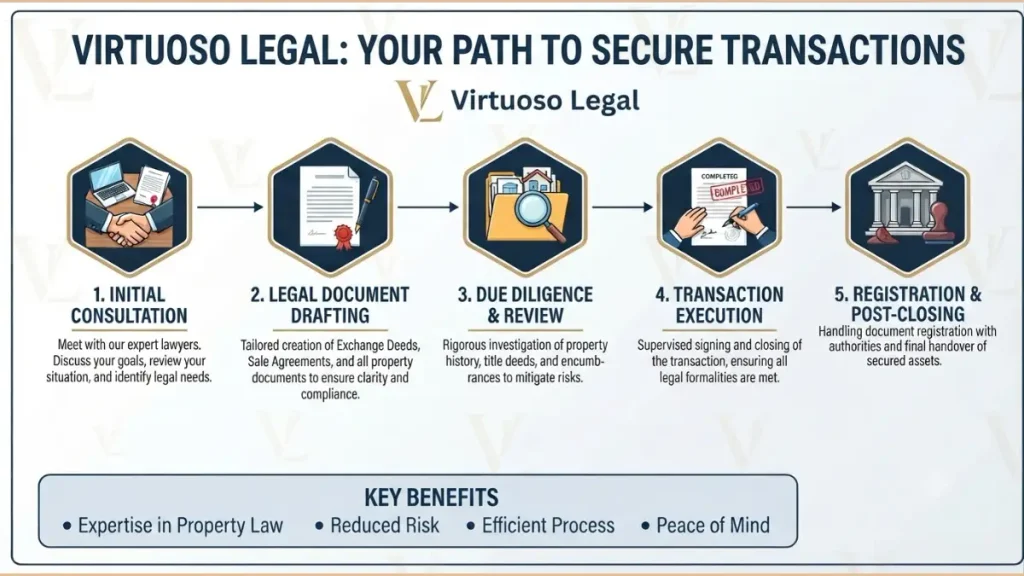
A professional exchange deed service should combine title investigation, drafting, registration guidance, and dispute planning. Therefore, the lawyer should begin by identifying the client’s objectives and transaction structure. Next, the lawyer should collect documents relating to both properties. The title team should then conduct registration, revenue, litigation, and planning checks. Afterward, the advocate should classify defects and explain their practical consequences. The deed should then reflect verified facts and negotiated protections. Moreover, execution should proceed only after unresolved risks receive written instructions. Registration should be followed by possession and mutation assistance. If a dispute emerges, the same document trail can support civil or criminal proceedings. Accordingly, clients benefit from maintaining one organized transaction file. The file should include certified documents, correspondence, search reports, legal opinions, and registration records. Virtuoso Legal can structure legal assistance around these stages for property exchange matters. Clients should obtain case-specific advice before relying on any general legal information.
Frequently Asked Questions
What is an exchange deed in Indian property law?
An exchange deed records reciprocal ownership transfers between parties. Section 118 of the Transfer of Property Act governs the legal concept. Registration is generally essential for immovable property exchanges.
Is registration compulsory for an exchange deed?
Yes, an exchange transferring rights in immovable property generally requires registration. The Registration Act and Transfer of Property Act govern the requirement. Exact compliance depends upon transaction facts.
What happens if exchanged property has defective title?
Section 119 provides protection when defective title causes deprivation of received property. Depending on circumstances, the affected party may seek compensation or return of transferred property.
Can an exchange deed be challenged in court?
Yes, appropriate civil proceedings may challenge validity, title, fraud, coercion, or other defects. Available remedies can include declaration, cancellation, possession, injunction, or damages.
Can police action follow a fraudulent exchange deed?
Police action may arise where facts disclose offences such as cheating or forgery. The BNS and BNSS govern relevant offences and criminal procedure. A contractual breach alone is not automatically criminal.
Why obtain a legal opinion before exchanging property?
A legal opinion identifies title defects, encumbrances, litigation, registration risks, and missing documents. It also recommends safeguards before execution. This process can reduce costly disputes after registration.