![Virtuoso Legal Services [Best Legal Opinion Services 24×7]](https://legalopinion.org.in/wp-content/uploads/2023/09/cropped-logo.png)

Heartwarming Bonds: Adoption Deed Legal Guidance
Introduction: Building Families Through Legally Secure Adoption
Adoption creates a lasting parent-child relationship with important legal consequences. Therefore, families should understand the correct adoption route before signing documents. In India, adoption may proceed under the Hindu Adoptions and Maintenance Act, 1956. Alternatively, the Juvenile Justice framework provides a statutory route for eligible adoptions. The applicable route depends upon religion, relationship, child status, and adoption circumstances. Consequently, an adoption deed should never replace mandatory statutory procedures. A carefully prepared adoption document can preserve evidence about consent, identity, and the adoption event. However, its legal effect depends upon the governing adoption law. Under HAMA, Section 16 creates an evidentiary presumption for qualifying registered adoption documents. Under the JJ framework, the District Magistrate issues adoption orders under prescribed procedures. Accordingly, legal guidance should examine documents, eligibility, consent, registration, and the child’s welfare. Families should also protect inheritance, identity, education, passport, and succession interests after adoption. Virtuoso Legal can assist with structured adoption deed guidance and related legal documentation.
Understanding the Legal Foundation of Adoption Deeds
Why Adoption Deeds Matter in Indian Family Law
Adoption Deeds and Legal Identity
An adoption deed records important facts surrounding an adoption and the parties involved. It can identify the biological parents, adoptive parents, child, date, and circumstances. Additionally, it can record declarations concerning consent and the parties’ understanding. Under HAMA, a registered document recording adoption can support a statutory presumption. However, the deed must satisfy the requirements of the applicable adoption law. A poorly drafted deed can create uncertainty over identity, consent, authority, or property consequences. Therefore, legal professionals should verify the underlying adoption before preparing final documentation. A useful adoption deed should ordinarily address these areas:
- Full names and verified identity details of relevant parties.
- Child’s date and place of birth, where appropriate.
- Statements concerning eligibility and lawful consent.
- Details concerning the giving and taking of the child.
- Signatures, witnesses, supporting records, and registration particulars.
Furthermore, the document should avoid language that contradicts mandatory adoption procedures. It should also distinguish adoption from guardianship, foster care, custody, or informal family arrangements. That distinction protects families from future disputes involving parental status or succession.
HAMA Adoption Requirements
The Hindu Adoptions and Maintenance Act governs adoptions meeting its statutory scope. The Act contains requirements concerning the capacity of persons adopting and giving children. It also addresses the child’s eligibility and certain conditions concerning adoption. Consequently, lawyers should examine Sections 5 through 17 before preparing a HAMA adoption deed. Section 16 gives a specific evidentiary benefit to qualifying registered documents. However, registration does not cure an adoption that violates substantive statutory requirements. Similarly, a deed cannot create legal validity through wording alone. The parties should establish eligibility before executing the document. Key considerations commonly include:
- Whether the parties fall within HAMA’s statutory scope.
- Whether the adopter possesses the required capacity.
- Whether the person giving the child has lawful authority.
- Whether the child satisfies statutory eligibility requirements.
- Whether statutory conditions concerning existing children apply.
Therefore, professional review should precede execution and registration. This approach can reduce future challenges concerning adoption validity, inheritance, identity, and family status.
JJ Act Adoption Framework
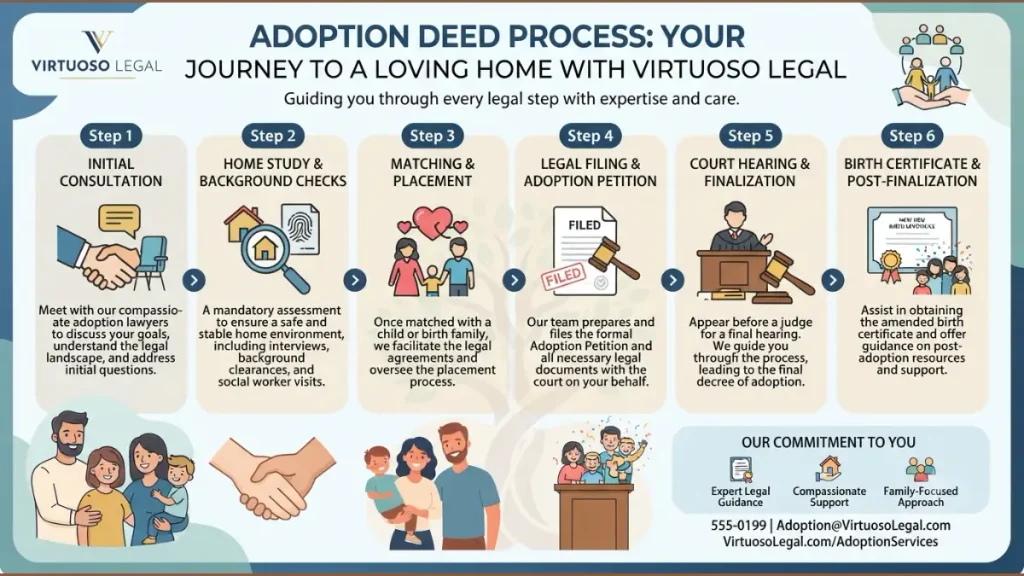
The Juvenile Justice Act provides another statutory adoption framework with specific procedures. The framework covers eligible orphan, abandoned, and surrendered children, among other prescribed categories. It also contains provisions for relative and step-child adoptions. Adoption Regulations 2022 prescribe additional procedures and documentation. District Magistrates now perform important functions concerning adoption orders under the amended framework. Official guidance states that fresh adoption applications proceed before the District Magistrate. Therefore, families should not treat a privately executed deed as the complete legal process. The process may involve:
- Registration through the designated adoption system.
- Document verification and suitability assessment.
- Specialised Adoption Agency involvement where applicable.
- Adoption Committee processes for prescribed cases.
- District Magistrate scrutiny and adoption order.
- Post-adoption documentation and official records.
Thus, legal guidance should first identify the statutory route. Afterwards, counsel can determine whether an adoption deed has any necessary or supporting role.
Adoption Deed Drafting and Registration Considerations
Essential Clauses in an Adoption Deed
A well-drafted adoption deed should clearly state the legal foundation for adoption. It should identify every relevant person without ambiguity or inconsistent spellings. The document should also describe the circumstances supporting the adoption. Furthermore, it should avoid unnecessary promises concerning property that require separate legal instruments. Clauses should reflect actual facts rather than create artificial compliance. The deed should also preserve evidence concerning signatures, witnesses, and execution. Depending upon the circumstances, lawyers may include provisions addressing:
| Clause | Purpose |
|---|---|
| Parties | Establishes identities and relationships |
| Adoption declaration | Records the intended legal transaction |
| Consent | Documents relevant consent and authority |
| Child particulars | Establishes accurate identity |
| Consideration declaration | Records absence of prohibited consideration |
| Governing law | Identifies the applicable statutory framework |
| Witnesses | Supports execution evidence |
| Registration | Records registration details where applicable |
Moreover, the deed should remain consistent with birth records and other identity documents. Any discrepancy should receive correction before execution. This prevents avoidable difficulties with schools, passports, banks, insurance, and succession records.
Registration and Evidentiary Value
Registration requires careful consideration because different adoption situations create different legal consequences. Section 16 of HAMA provides an important presumption for a qualifying registered adoption document. The Registration Act also contains provisions governing registrable documents and registration consequences. However, registration does not automatically validate every adoption deed. The document must still comply with the governing substantive law. Therefore, families should obtain legal advice before presenting the document. Lawyers should also verify applicable state registration procedures and fees. A registration review generally examines:
- Correct identity documents and photographs.
- Applicable stamp and registration requirements.
- Execution before the appropriate registering authority.
- Witness details and signatures.
- Consistency between supporting documents.
- Preservation of the registered document and certified copies.
Consequently, proper registration can strengthen documentary proof where the law recognizes that effect. Still, families should distinguish evidentiary value from substantive validity.
Practical Adoption Process, Documentation and Family Protection
Preparing Documents for a Secure Adoption
Identity and Relationship Documents
Adoption matters require accurate records because family status affects numerous public and private systems. Therefore, parties should collect documents before drafting the final deed or application. These records may establish age, identity, address, marital status, and relationship. They may also establish the child’s existing legal status. In JJ Act cases, additional records may arise through the prescribed adoption system. The exact documents depend upon the adoption category and governing procedure. Common records may include:
- Aadhaar or another accepted identity document.
- Birth certificate and age proof.
- Marriage certificate where applicable.
- Address and residence proof.
- Photographs and prescribed declarations.
- Consent documents where legally required.
- Court, authority, or agency records where applicable.
Furthermore, lawyers should compare names across every document. Even small spelling differences can create administrative difficulties later. Consequently, correcting inconsistencies early often prevents expensive future applications. Legal counsel should also protect confidential child information during document handling. Adoption records involve sensitive personal information and deserve careful privacy controls.
Consent and Giving-Taking Requirements
Consent remains an important issue in many adoption disputes. Under HAMA, the Act identifies who can give a child in adoption. It also specifies circumstances affecting consent and capacity. Therefore, lawyers should establish authority before recording declarations in an adoption deed. A deed should not manufacture consent after the fact. Instead, it should accurately document legally valid actions and circumstances. In appropriate HAMA cases, evidence concerning actual giving and taking can become significant. Section 16 provides a presumption when statutory conditions concerning the registered document exist. Lawyers should therefore examine:
- Identity of the person giving the child.
- Legal capacity and authority of that person.
- Identity and capacity of the adopter.
- Relevant consent requirements.
- Evidence concerning the adoption event.
- Registration and execution evidence.
Additionally, counsel should investigate allegations involving coercion, fraud, impersonation, or concealed material facts. Such issues can materially affect later litigation. Early documentation review can therefore protect both the child and the adults involved.
Child Welfare and Confidentiality
Child welfare remains central to statutory adoption procedures. The JJ framework specifically requires scrutiny of the child’s welfare and prescribed safeguards. District Magistrate guidance includes document verification and consideration of the child’s consent where applicable. Therefore, legal support should treat adoption as a child-centred process. Lawyers should avoid unnecessary disclosure of sensitive family information. They should also ensure that documents use respectful and accurate language. Where a child has reached an applicable age, statutory consent requirements deserve particular attention. Privacy protection should continue after adoption because records can remain relevant throughout adulthood. A practical protection plan may include:
- Restricting unnecessary circulation of adoption documents.
- Using secure storage for original records.
- Maintaining certified copies for official applications.
- Limiting public disclosure of sensitive child information.
- Updating records only through lawful administrative processes.
Moreover, families should preserve historical documents even after obtaining updated certificates. Those records may become useful during inheritance, citizenship, passport, or litigation proceedings.
Adoption Disputes and Available Legal Remedies
Common Adoption Legal Issues
Adoption disputes can arise from documentation failures, competing claims, or allegations concerning consent. Some disputes involve the validity of the adoption itself. Others concern inheritance, custody, identity, or family relationships after adoption. Therefore, lawyers should classify the dispute before selecting a remedy. A civil dispute may require pleadings, documentary evidence, and interim relief. A criminal allegation may involve police investigation under the BNSS. Forged adoption documents can create serious consequences under the BNS. Section 336 of the BNS addresses forgery involving false documents or electronic records. Consequently, legal analysis should separate genuine documentation mistakes from intentional wrongdoing. Common issues include:
| Legal issue | Possible legal response |
|---|---|
| Adoption validity | Declaratory or appropriate family proceedings |
| Consent dispute | Evidence review and statutory challenge |
| Forged deed | Criminal complaint and related proceedings |
| Identity discrepancy | Administrative correction |
| Inheritance conflict | Succession or property proceedings |
| Custody dispute | Appropriate child and family proceedings |
Accordingly, early legal classification can prevent the wrong remedy from being pursued.
Civil Procedure and Family Court Remedies
Civil adoption disputes may involve declarations, injunctions, evidence, and related family relief. The Code of Civil Procedure, 1908 remains a foundational procedural statute for civil litigation. India Code identifies CPC as a central enactment. Family Courts operate under the Family Courts Act, 1984 in jurisdictions where the legislation applies. However, the precise forum depends upon the relief sought and applicable jurisdictional rules. Therefore, lawyers should examine territorial jurisdiction and subject-matter jurisdiction before filing. Potential remedies can include:
- Declaration concerning legal status where legally maintainable.
- Injunction against unlawful interference.
- Custody or visitation relief where applicable.
- Property or succession proceedings following adoption.
- Appeals or revisions where the governing law permits.
Furthermore, CPC principles can interact with special family legislation. Counsel should therefore identify the special statute before relying upon general procedure. Proper forum selection can reduce objections, delays, and duplicate proceedings.
Criminal Complaints and Forged Adoption Records
False adoption documents can create separate criminal issues when deliberate deception or forgery occurs. The BNS replaced the former Indian Penal Code framework from July 2024. India Code lists the BNS as Act 45 of 2023. Section 336 addresses forgery and distinguishes several circumstances. Therefore, lawyers should preserve original documents and relevant electronic communications. The BNSS now governs criminal procedure for applicable offences. India Code lists BNSS as Act 46 of 2023. A complaint strategy may involve:
- Collecting the original adoption deed.
- Obtaining certified registration records.
- Preserving relevant messages and emails.
- Identifying witnesses and document custodians.
- Approaching the appropriate police station.
- Seeking further legal remedies when required.
Additionally, the Bharatiya Sakshya Adhiniyam governs evidence under the current evidentiary framework. It expressly addresses documentary and electronic records. Thus, evidence preservation should begin immediately.
Forums, Government Departments and Professional Legal Support
District Magistrate and Adoption Authorities
The District Magistrate now has an important statutory role in JJ Act adoption orders. Adoption Regulations 2022 prescribe the format and procedural framework. Official guidance states that the District Magistrate should scrutinise applications and issue adoption orders after required verification. Consequently, families should understand the distinction between an adoption order and a private deed. The Central Adoption Resource Authority also plays a central regulatory role. Therefore, legal professionals may coordinate document preparation with the relevant adoption authorities. The applicable authorities can include:
| Authority | Adoption-related function |
|---|---|
| Central Adoption Resource Authority | National adoption framework and regulation |
| District Magistrate | Adoption-order functions under JJ framework |
| District Child Protection Unit | Document and child-protection processes |
| Specialised Adoption Agency | Prescribed adoption services |
| Registrar or Sub-Registrar | Registration matters where applicable |
| Police authorities | Criminal complaints concerning suspected offences |
Furthermore, jurisdiction and adoption category determine which authority becomes relevant. Legal counsel should confirm the correct authority before filing documents.
Police Stations and Complaint Strategy
Police involvement does not form part of every adoption process. However, suspected forgery, cheating, coercion, impersonation, or document manipulation may require criminal action. Therefore, families should avoid treating every family disagreement as a criminal offence. Lawyers should first assess the available evidence and legal ingredients. If an offence appears to exist, the complaint should identify facts clearly. Supporting documents should remain organized and authentic. Under the BNSS, criminal procedure now operates under the post-2024 statutory framework. Depending upon the facts, legal support may include:
- Complaint preparation and evidence organization.
- Representation before the jurisdictional police station.
- Escalation through lawful statutory mechanisms.
- Appropriate proceedings before competent courts.
- Protection against misuse of criminal process.
Additionally, Chennai families should identify the police station having appropriate jurisdiction. Lawyers can help determine jurisdiction from the relevant address and alleged transaction. That approach prevents unnecessary movement between unrelated police stations.
Evidence Under the Bharatiya Sakshya Adhiniyam
Adoption disputes often depend heavily upon documentary evidence. The Bharatiya Sakshya Adhiniyam, 2023 now governs evidence under India’s updated evidence framework. It recognizes documents and electronic records within its statutory structure. Therefore, emails, messages, scanned documents, registration records, and electronic communications may become relevant. However, relevance does not automatically establish admissibility or authenticity. Parties should preserve original records whenever possible. They should also maintain certified copies of important government documents. Evidence preparation should include:
- Original adoption deed and registration receipt.
- Birth certificates and identity records.
- Adoption-order records where applicable.
- Correspondence with authorities or agencies.
- Relevant photographs or event records.
- Electronic communications with proper preservation.
Consequently, a lawyer should create an evidence chronology before filing proceedings. This chronology can reveal inconsistencies and clarify disputed events. It also assists counsel when preparing pleadings, affidavits, complaints, or written submissions.
Adoption, Succession and Property Rights
Adoption can significantly affect family relationships and succession consequences. Under HAMA, adoption creates statutory consequences concerning the adopted child’s position within the adoptive family. Therefore, families should review wills, nominations, property records, insurance, and financial arrangements. However, an adoption deed should not casually transfer property without examining separate property laws. The Registration Act contains specific provisions for documents affecting immovable property. Consequently, property transfers should receive separate drafting advice. Families should consider:
| Area | Review point |
|---|---|
| Will | Update testamentary intentions |
| Property | Examine title and succession effects |
| Bank accounts | Review nomination and operational records |
| Insurance | Update beneficiary information |
| Investments | Review nomination and ownership details |
| School records | Update parent information lawfully |
| Passport | Align identity records |
Furthermore, families should preserve evidence explaining changes in official records. Consistency reduces future disputes among family members. Professional advice can also identify issues involving ancestral property and existing succession arrangements.
Professional Legal Guidance for Adoption Deed Protection
A Structured Legal Review for Families
Pre-Execution Legal Due Diligence
Pre-execution review allows lawyers to identify defects before the parties sign. This stage should establish the applicable adoption statute and procedural route. It should also verify identity, capacity, consent, and child eligibility. Therefore, lawyers should not begin with drafting alone. They should first prepare a legal fact matrix. The matrix should compare every fact against the statutory requirements. A structured review may follow these steps:
- Identify the proposed adoption category.
- Determine the governing statutory framework.
- Verify every party’s identity and legal capacity.
- Review consent and authority.
- Examine child eligibility.
- Review supporting documents.
- Draft the deed or application documents.
- Complete registration or statutory proceedings where required.
- Preserve certified records.
Additionally, counsel should identify possible conflicts involving existing children or family members. Early review can also reveal whether another statutory route applies. Consequently, legal due diligence provides a stronger foundation for the adoption process.
Post-Adoption Record Management
Legal work should continue after adoption because families must update multiple records. An adoption order or valid adoption document can affect official identity and family records. Therefore, parents should maintain a secure adoption file. The file should contain originals, certified copies, receipts, orders, and relevant correspondence. Families should also update records through appropriate government procedures. Depending upon the circumstances, records may include birth registration, school records, passport documents, insurance, and financial accounts. A practical record-management system can include:
- One secure physical file for original documents.
- One encrypted digital archive for scanned copies.
- A document index identifying every record.
- Certified copies for frequent administrative use.
- Professional contact details for future legal needs.
Moreover, families should avoid altering original records without lawful authority. Any correction should follow the prescribed administrative process. This practice protects documentary continuity throughout the child’s life.
Remedies for Adoption-Related Disputes
The appropriate remedy depends upon the legal issue and governing statute. Therefore, no single remedy applies to every adoption dispute. Lawyers may consider civil, family, administrative, or criminal proceedings. They should also assess urgent interim protection where a child’s welfare faces immediate risk. Courts may exercise different powers depending upon the proceeding. Consequently, the first task involves identifying the legal right requiring protection. Common legal remedies can include:
| Dispute | Possible legal support |
|---|---|
| Adoption validity | Appropriate declaratory proceedings |
| Custody conflict | Family or child-welfare proceedings |
| Record discrepancy | Administrative correction |
| Forged document | Criminal complaint and prosecution |
| Property dispute | Civil or succession proceedings |
| Registration issue | Appropriate registration remedy |
| Procedural error | Statutory challenge or review |
Furthermore, limitation periods and procedural requirements can affect available remedies. Legal advice should therefore occur promptly after discovering a dispute. Delay can complicate evidence and create additional administrative problems.
Why Virtuoso Legal Can Assist
Virtuoso Legal can provide structured assistance for families navigating adoption deed documentation. Legal support should begin by identifying the correct adoption framework. Counsel can then examine documents, consent, identity, registration, and related family consequences. Where disputes arise, the legal strategy should match the appropriate forum. That forum may involve a District Magistrate, registering authority, Family Court, civil court, High Court, or police authority. Therefore, representation should remain issue-specific rather than rely upon one standard template. Support can cover:
- Adoption deed drafting and document review.
- HAMA compliance assessment.
- JJ Act and Adoption Regulations guidance.
- Registration and certified-copy assistance.
- Adoption dispute and evidence preparation.
- Succession and property consequence review.
- Criminal complaint support for suspected document offences.
- Court and authority representation where appropriate.
Additionally, lawyers should protect confidentiality throughout the engagement. Adoption matters often involve sensitive family histories. A careful legal process can help families preserve accurate records while protecting the child’s interests.
Frequently Asked Questions About Adoption Deed Legal Guidance
Is an Adoption Deed Always Mandatory?
An adoption deed is not universally mandatory for every Indian adoption route. HAMA and the JJ framework operate through different legal requirements. Therefore, families should identify their statutory route before signing documents. A JJ adoption generally follows the prescribed adoption-order process.
Does Registration Automatically Validate an Adoption?
Registration does not automatically cure defects in an adoption. Under HAMA, a qualifying registered adoption document can create an evidentiary presumption. However, substantive statutory requirements must still exist. Therefore, lawyers should verify eligibility, authority, consent, and other conditions.
Can an Adoption Deed Affect Property Rights?
An adoption can create important succession consequences under applicable personal law. However, an adoption deed should not automatically transfer separate immovable property. Property transfers may require separate instruments and registration. Families should obtain property-specific legal advice before changing title.
What Happens If an Adoption Deed Is Forged?
A forged adoption deed can create serious civil and criminal consequences. The BNS addresses forgery involving false documents and electronic records. Therefore, parties should preserve originals and related evidence. Legal counsel can assess police complaints and appropriate court remedies.
Which Authority Handles JJ Act Adoption Orders?
The District Magistrate handles adoption-order functions under the current JJ Act framework. Adoption Regulations 2022 prescribe relevant procedures and formats. The applicable adoption agency and District Child Protection Unit may also perform prescribed functions.
Can Adoption Disputes Reach Higher Courts?
Yes, appropriate adoption disputes can reach higher courts through legally available proceedings. The exact route depends upon the original forum, statute, relief, and procedural posture. Therefore, lawyers should assess jurisdiction, maintainability, limitation, and available statutory remedies.
Important legal note: Adoption law depends upon the child’s status, parties, religion, relationship, statutory route, and facts. This article provides general legal information and does not replace case-specific advice. The BNS, BNSS, and BSA have applied since the commencement of the new criminal-law framework in 2024.