![Virtuoso Legal Services [Best Legal Opinion Services 24×7]](https://legalopinion.org.in/wp-content/uploads/2023/09/cropped-logo.png)

Generational Blessings: Gift Deed Legal Consultations
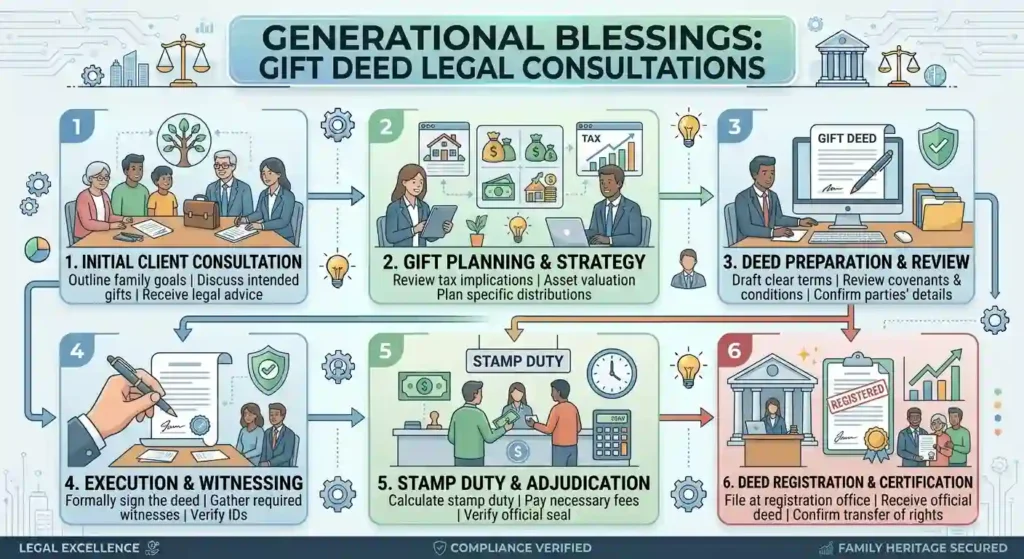
Gift Deed Legal Consultations – A gift deed transfers existing property voluntarily without consideration from donor to donee. Section 122 of the Transfer of Property Act, 1882 defines this transaction. Acceptance must occur during the donor’s lifetime and capacity to transfer. Therefore, the deed should clearly identify both parties and their legal relationship. It should describe the property accurately through title and survey particulars. Additionally, the document should confirm voluntary execution without monetary consideration. Family members commonly use gift deeds for intergenerational property planning. Parents may transfer homes, land, apartments, or other assets to children. Likewise, grandparents may transfer property to grandchildren for long-term family security. Virtuoso Legal Services provides gift deed legal consultations covering drafting, title verification, registration, and disputes. Proper advice can prevent future challenges involving ownership, coercion, fraud, or defective documentation.
Generational Blessings: Gift Deed Legal Consultations – Virtuoso Legal Services
Essential Elements of a Valid Gift
A valid gift requires identifiable property, a competent donor, acceptance, and lawful transfer. The donor must possess transferable rights over the property being gifted. Additionally, the donee must accept the gift during the donor’s lifetime. For immovable property, Section 123 requires a registered instrument. The donor must sign the instrument, and at least two witnesses must attest it. Therefore, informal family arrangements may not create equivalent legal rights. The deed should identify the property boundaries, extent, title documents, and existing encumbrances. Furthermore, parties should verify identity documents and address particulars before execution. Any existing mortgage, litigation, tenancy, or restriction requires careful legal examination. Virtuoso Legal Services reviews these issues before recommending registration. This approach helps families avoid incomplete transfers and costly ownership disputes. Proper drafting also clarifies possession, conditions, rights, and responsibilities connected with the gifted property.
Movable and Immovable Property
Gift rules differ according to whether the asset involves movable or immovable property. Section 123 provides separate methods for completing these transfers. Immovable property requires a registered gift instrument signed and properly attested. Movable property may transfer through a registered instrument or delivery. Therefore, jewellery, vehicles, securities, and other movable assets require different documentation strategies. Real estate requires detailed title descriptions and registration before the competent authority. Additionally, state stamp laws determine applicable stamp duty and registration charges. Families should not assume that nominal consideration makes a transaction a gift. A genuine gift remains voluntary and without consideration under Section 122. Moreover, the donor should understand the legal consequences before execution. Virtuoso Legal Services can assess the asset, ownership structure, and intended beneficiary. This legal consultation helps select suitable documentation and avoid inappropriate transfer methods.
Registration and Stamp Duty
Registration plays a central role in transferring immovable property through a gift deed. Section 17 of the Registration Act, 1908 makes instruments gifting immovable property compulsorily registrable. Section 49 addresses consequences arising from non-registration of documents requiring registration. Therefore, an unregistered immovable property gift generally cannot accomplish the intended legal transfer. Parties must execute the deed before the appropriate registering authority. Additionally, applicable state stamp legislation determines stamp duty and registration expenses. Family relationships may influence concessional rates under particular state laws. However, parties should verify current rates before calculating transaction costs. The registering office may require identity documents, photographs, witnesses, title records, and prescribed forms. Consequently, preparation should precede the appointment to reduce registration delays. Virtuoso Legal Services can review documentation and registration requirements before execution.
Family Property and Succession
Gifts Within Families
Family gifts can simplify succession planning when the donor owns transferable property absolutely. Parents frequently gift assets to children to provide immediate ownership and family security. Similarly, spouses, siblings, grandparents, and other relatives may become donors or donees. However, family affection does not remove statutory requirements for valid transfers. Therefore, parties should examine title, ownership, possession, and competing rights beforehand. A donor should understand that a completed gift can restrict later unilateral revocation. Section 126 permits revocation only within specified circumstances or agreed events. Additionally, property disputes may arise when excluded heirs challenge transactions. Courts may examine allegations involving fraud, coercion, undue influence, incapacity, or absence of acceptance. Virtuoso Legal Services evaluates these risks before preparing family gift documentation. Legal advice becomes especially important when significant ancestral or jointly held assets are involved.
Ancestral and Coparcenary Property
Ancestral and coparcenary property requires greater legal scrutiny before any proposed gift. A person cannot automatically gift property merely because family members consider it inherited. Rights may arise through succession, partition, coparcenary status, or other legal sources. The Hindu Succession Act, 1956 governs important succession questions for Hindus. Section 6 addresses devolution of interests in Mitakshara coparcenary property. Therefore, families should establish the donor’s precise share before preparing a gift deed. A title search should examine partition deeds, succession documents, previous transfers, and revenue records. Additionally, competing coparcenary claims may affect the proposed transaction. Gifts involving joint family property can generate litigation when affected rights remain unresolved. Virtuoso Legal Services can conduct legal title analysis before recommending execution. This preventive approach helps families avoid defective transfers and later partition disputes.
Rights of Heirs and Beneficiaries
Gift planning should consider existing and potential succession rights surrounding the property. A donor’s transferable ownership remains central to determining whether the proposed gift can stand. However, heirs may challenge transactions where legal defects affect validity. Courts can examine evidence concerning capacity, consent, undue influence, fraud, and execution. Therefore, older donors should receive particularly careful legal guidance before substantial transfers. Medical circumstances may require additional evidence concerning mental capacity when disputes appear foreseeable. Furthermore, families should distinguish a gift from a will because their legal effects differ. A gift transfers ownership during the donor’s lifetime after satisfying legal requirements. A will generally operates through testamentary succession after death. Virtuoso Legal Services can compare these options according to family circumstances. Appropriate planning can reduce ambiguity and minimise future succession litigation.
Gifts by NRIs and Overseas Families
NRIs can require specialised legal assistance when gifting Indian immovable property. The transaction may involve Indian property law, registration procedures, taxation, foreign exchange considerations, and documentation. Therefore, the donor’s residency status should be assessed before execution. Powers of attorney require careful drafting when an NRI cannot attend registration personally. The attorney must act within the authority granted through the document. Additionally, property located in India remains subject to Indian registration requirements. Family relationships abroad do not remove local property-law obligations. Foreign documents may require appropriate authentication, notarisation, apostille, or consular procedures. Furthermore, banks and tax advisers may need transaction information for related compliance. Virtuoso Legal Services can coordinate documentation for NRIs and overseas beneficiaries. This assistance reduces practical difficulties involving distance, identification, execution, and registration.
Tax and Financial Considerations
Gift deed planning should consider tax and financial consequences alongside property-law requirements. Income-tax treatment depends upon the nature of the asset, relationship, transaction circumstances, and applicable provisions. Therefore, parties should obtain current tax advice before finalising substantial gifts. Stamp duty and registration charges create separate transaction costs under applicable state law. Additionally, future sale consequences can depend upon acquisition history and applicable tax rules. Families should preserve original title documents and registered deed copies securely. Where property generates rental income, ownership changes can also affect reporting responsibilities. Foreign residents may require additional financial and exchange-control analysis. Consequently, legal planning should coordinate property, tax, and regulatory considerations. Virtuoso Legal Services can identify legal issues requiring specialist tax or financial consultation. A coordinated approach helps families understand the practical consequences before transferring valuable assets.
Gift Deed Execution and Remedies
Drafting and Registration Process
Title Verification Before Drafting
Title verification should precede every significant gift deed involving immovable property. Lawyers should examine the parent deed, subsequent transfers, encumbrances, and relevant revenue records. Additionally, pending litigation should receive careful review before the donor proceeds. A title search can identify mortgages, attachments, leases, competing claims, or registration inconsistencies. Therefore, families should avoid relying solely upon informal possession or old documents. The donor must establish a transferable legal interest before promising the property. Where property came through inheritance, succession documents require detailed examination. Joint ownership requires identification of each owner’s precise transferable share. Furthermore, agricultural property may involve additional state-specific restrictions and revenue requirements. Virtuoso Legal Services conducts legal due diligence before drafting suitable gift documentation. Early title verification reduces the risk of registration problems and future ownership litigation.
Drafting Clauses and Conditions
A carefully drafted gift deed should clearly express the donor’s intention and the donee’s acceptance. Property identification must include survey numbers, boundaries, extent, location, and relevant title references. Additionally, the deed should address possession and existing encumbrances where appropriate. Conditions should remain legally enforceable and should not contradict statutory requirements. Section 126 recognises limited circumstances for suspension or revocation of gifts. Therefore, donors should avoid clauses creating unilateral cancellation rights without lawful foundation. Witness details, execution clauses, declarations, and registration particulars require careful preparation. Furthermore, parties should disclose relevant facts rather than relying upon generic templates. Virtuoso Legal Services customises gift deeds according to property type and family circumstances. Proper drafting can reduce ambiguity and support the document during future judicial scrutiny.
Registration Before the Sub-Registrar
After drafting, parties must complete registration through the competent Sub-Registrar for immovable property gifts. The Registration Act requires registration of instruments gifting immovable property. Therefore, execution should follow the applicable appointment and identification procedures. Parties should carry required identity documents, photographs, title papers, witnesses, and prescribed supporting records. Additionally, stamp duty must generally be addressed before or during registration according to state procedure. The registering officer may verify execution, identity, and statutory requirements. Once registration completes, parties should obtain and preserve the registered instrument. Mutation in revenue or municipal records may require separate follow-up after registration. Consequently, registration should not be treated as the final administrative step. Virtuoso Legal Services can assist with document preparation, registration coordination, and post-registration legal follow-up.
Disputes and Legal Remedies
Revocation and Cancellation Issues
A completed gift cannot ordinarily be revoked merely because the donor changes personal preferences. Section 126 permits revocation in specified circumstances recognised by law. Parties may also agree upon revocation linked to a specified event independent of donor discretion. Therefore, generic cancellation clauses can create legal uncertainty. Courts may examine whether the statutory requirements for revocation actually exist. Fraud, coercion, undue influence, incapacity, or other contract-related grounds may create separate challenges. Additionally, disputes can arise when donors allege that acceptance never occurred. Evidence surrounding execution, possession, communications, and family circumstances can become important. Virtuoso Legal Services can evaluate cancellation claims and available civil remedies. Depending upon facts, proceedings may involve declarations, cancellation, injunctions, or other appropriate relief.
Civil Courts and Injunctions
Gift deed disputes generally require careful identification of the appropriate civil or statutory forum. Parties may seek declaratory relief where ownership or validity remains disputed. Cancellation or setting aside may become relevant when a defective deed allegedly affects legal rights. Additionally, injunctions can protect property from unlawful transfer, interference, or dispossession. The Code of Civil Procedure, 1908 governs civil procedure in appropriate proceedings. Evidence concerning execution, capacity, consideration, possession, and title can become central to litigation. Furthermore, limitation periods require careful assessment before filing any challenge. Virtuoso Legal Services can examine jurisdiction, limitation, pleadings, evidence, and interim relief requirements. Appropriate remedies depend upon the precise facts and relief sought. Courts may also examine registered documents alongside surrounding circumstances and admissible evidence.
Criminal Allegations and Evidence
Gift deed disputes can sometimes involve allegations of forgery, cheating, criminal breach, impersonation, or coercive conduct. Such allegations require separate analysis from ordinary civil ownership disputes. BNS governs substantive criminal offences, while BNSS governs criminal procedure. BSA governs evidence applicable to criminal proceedings. Therefore, parties should preserve original deeds, registration records, communications, identity documents, and other relevant evidence. Police stations may become relevant when facts disclose a cognisable criminal offence. However, parties should not use criminal complaints merely to pressure opponents in civil property disputes. Legal counsel can assess whether police action, complaint proceedings, or civil remedies better fit the facts. Virtuoso Legal Services can coordinate civil and criminal legal strategies when allegations overlap.
Tribunal, Revenue and Registration Remedies
Property disputes may involve registration authorities, revenue officials, tribunals, or courts depending upon the issue. Mutation disputes can require proceedings before competent revenue authorities under applicable state law. Registration objections may require remedies under the Registration Act and relevant rules. Additionally, specialised tribunals can have jurisdiction over particular statutory disputes. Therefore, parties should avoid filing before forums lacking jurisdiction. Lawyers should identify the correct authority, limitation period, appeal route, and required evidence. Administrative remedies can sometimes resolve record corrections without prolonged civil litigation. However, title disputes may require adjudication by competent civil courts. Virtuoso Legal Services provides forum-specific legal strategy for property and gift deed disputes. This approach helps clients pursue effective remedies while avoiding unnecessary procedural delays.
Professional Gift Deed Legal Support
Virtuoso Legal Services provides comprehensive legal consultation for family property transfers and gift deed transactions. Our lawyers can review title documents, ownership rights, family relationships, and intended beneficiaries. Additionally, we can draft clauses addressing possession, acceptance, conditions, and applicable restrictions. We also assist with registration preparation and post-registration documentation. Dispute support can cover cancellation claims, injunctions, declarations, title disputes, and regulatory proceedings. NRIs can receive coordinated assistance for Indian property gifts involving overseas execution. Furthermore, older donors can obtain careful legal guidance concerning capacity and voluntary consent. Where allegations arise, we can coordinate civil, criminal, revenue, and registration remedies. Our approach focuses on preventing disputes before families complete substantial property transfers. Consequently, clients receive practical advice suited to their property, jurisdiction, and objectives.
Practical Gift Planning
Documents and Compliance Checklist
A gift deed transaction should begin with a structured document and compliance review. Essential records commonly include title deeds, identity documents, address proof, photographs, and property particulars. Additionally, parties should collect encumbrance information and relevant revenue or municipal records. Where inheritance created ownership, succession documents should also receive legal review. NRIs may require additional authentication and power-of-attorney documentation. Therefore, document requirements should reflect the donor’s status and property location. Registration expenses should be calculated using current state rules before execution. Parties should also preserve the registered deed and evidence of acceptance. Where appropriate, mutation applications should follow registration promptly. Virtuoso Legal Services can prepare a transaction-specific checklist and identify missing records. This structured process reduces delays, registration objections, and future title disputes.
Why Legal Consultation Matters
Gift deeds can create lasting ownership consequences, making professional legal consultation valuable before execution. A poorly drafted document can trigger family disputes, registration problems, or expensive litigation. Therefore, parties should obtain advice before signing rather than after problems arise. Lawyers can identify title defects, restrictions, competing claims, and unsuitable conditions. Additionally, they can compare gifting with wills, settlements, partitions, or other lawful planning methods. Family circumstances may influence the most suitable property-transfer strategy. Older donors may require additional safeguards demonstrating informed and voluntary decisions. NRIs may need specialised assistance concerning execution and registration from abroad. Virtuoso Legal Services combines property-law review with practical documentation and dispute prevention. Ultimately, informed planning can preserve family relationships while strengthening legal certainty.
Frequently Asked Questions
1. Is registration mandatory for an immovable property gift?
Yes. Section 123 requires a registered instrument, donor signature, and attestation by two witnesses for gifting immovable property.
2. Can a donor cancel a gift deed anytime?
Generally, no. Section 126 permits revocation only under specified lawful circumstances or agreed events meeting statutory requirements.
3. Can an NRI gift Indian property?
Yes, subject to applicable Indian property, registration, foreign-exchange, taxation, and documentation requirements. Professional review remains advisable before execution.
4. Can ancestral property be gifted to children?
It depends upon ownership and transferable rights. A title review should establish whether the donor owns an independent transferable interest.
5. Which court handles gift deed disputes?
Jurisdiction depends upon the dispute and property location. Civil courts commonly address title, cancellation, declaration, and injunction claims.
6. Can Virtuoso Legal Services draft my gift deed?
Yes. Virtuoso Legal Services can assist with title review, drafting, registration preparation, NRI transactions, dispute prevention, and appropriate legal remedies.
Read More
- Unlocking Dreams: Expert Sale Deed Legal Opinions
- Your Legal Shield: Expert Legal Opinion Services
- Navigating Legal Waters: Comprehensive Legal Opinion Services
- Advocating for Justice: Legal Opinion Services in Chennai
- Ensuring Workplace Safety: Workmen Compensation Act Legal Experts
- Ministry of Law and Justice – Legislative Department