![Virtuoso Legal Services [Best Legal Opinion Services 24×7]](https://legalopinion.org.in/wp-content/uploads/2023/09/cropped-logo.png)

Family Unity: Relinquishment Deed Emotional Support
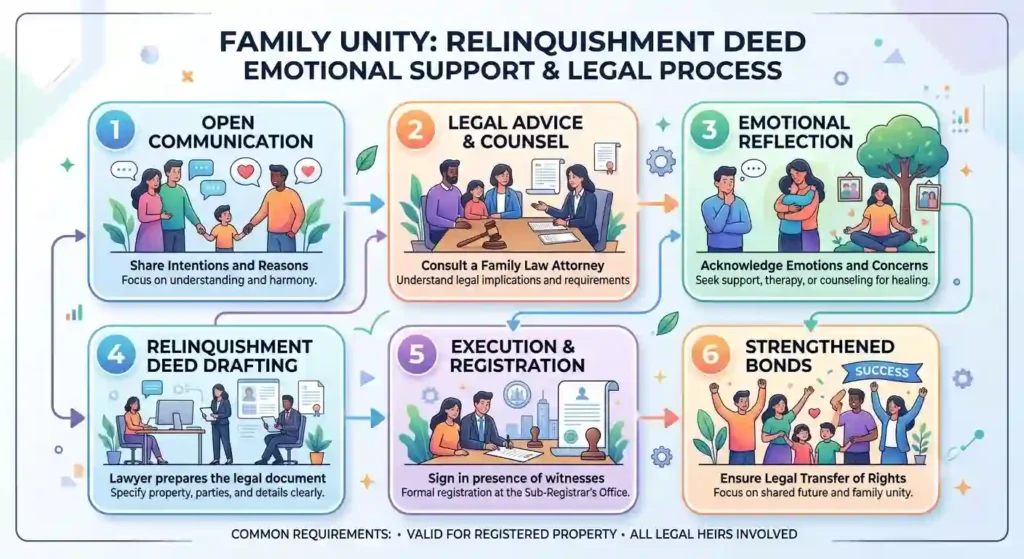
Relinquishment Deed Emotional Support – A relinquishment deed transfers one person’s rights in jointly held property to another eligible co-owner. Family members often consider this option during inheritance discussions, partition arrangements, or property settlements. However, emotions can strongly influence decisions involving ancestral or inherited assets. Therefore, relatives should understand their legal rights before signing any document. A voluntary decision requires informed consent without coercion, undue influence, fraud, or misrepresentation. Emotional pressure can create later disputes about validity, consideration, ownership, or registration. Legal counsel can explain consequences without encouraging unnecessary family confrontation. Moreover, independent advice can help each party understand what rights they surrender. Virtuoso Legal Services assists families with deed drafting, review, registration, negotiations, and dispute resolution. The objective remains balanced legal guidance while preserving family relationships wherever possible.
Family Unity: Relinquishment Deed Emotional Support – Virtuoso Legal Services
When Relinquishment Becomes Relevant
Relinquishment commonly arises when several legal heirs jointly inherit immovable property. One heir may voluntarily surrender their undivided interest in favour of another co-owner. However, the transaction must satisfy applicable property, succession, registration, and stamp-duty requirements. The deed should clearly identify the property, parties, rights, and nature of transfer. Furthermore, the parties should verify title documents and existing encumbrances before execution. Relevant situations may include:
- Family inheritance settlements.
- Partition arrangements among co-heirs.
- Distribution of ancestral property.
- Settlement between siblings.
- Property consolidation among co-owners.
- Resolution of ownership disagreements.
The exact legal effect depends upon the property nature, applicable personal law, title documents, and deed wording. Therefore, professional review can prevent unintended surrender of valuable rights.
Legal Validity and Registration Requirements
A relinquishment deed concerning immovable property generally requires careful compliance with registration law. The Registration Act, 1908 governs registration requirements for instruments affecting immovable property. Applicable stamp laws also determine stamp duty and registration charges. Consequently, parties should verify the current requirements in the concerned State. Tamil Nadu property transactions require particular attention to registration procedures and applicable departmental requirements. The document should accurately describe parties, property boundaries, ownership interests, and transfer intentions. Additionally, execution should occur voluntarily and with proper identification and witnessing. Registration does not cure fraud, coercion, defective title, or lack of legal capacity. Therefore, legal counsel should conduct title and document checks before execution. Proper preparation reduces future disputes concerning ownership, possession, inheritance, and family claims.
Consent Without Emotional Coercion
Family harmony should never depend upon forcing someone to surrender property rights. A relinquishment decision should arise from genuine and informed consent. Emotional discussions can become difficult when parents, siblings, spouses, or children hold different expectations. Therefore, parties should separate family emotions from legal consequences before signing documents. Independent legal advice can help a person understand the value and effect of relinquishment. Where necessary, families can use mediation to encourage respectful discussion and practical settlements. Counsel should identify concerns involving pressure, threats, deception, or manipulation. Such circumstances may affect the enforceability of an agreement or deed. Additionally, vulnerable family members may require extra time before making decisions. A calm process can protect both legal interests and family relationships. Consequently, emotional support should accompany, rather than replace, sound legal advice.
Rights of people
People can hold inheritance or ownership rights depending upon applicable succession laws and individual circumstances. Gender should not determine whether a person understands or voluntarily surrenders property rights. Hindu succession matters may involve the Hindu Succession Act, 1956, including rights arising through family property. However, personal law differs according to circumstances and community. Therefore, counsel must examine the applicable succession regime before advising on relinquishment. Married status alone does not automatically determine ownership of inherited property. Similarly, residence outside India does not automatically eliminate Indian property rights. Each heir should obtain an independent understanding of their entitlement. Furthermore, a person should review previous partition deeds, wills, settlements, and title records. Legal advice can clarify whether relinquishment actually serves the person’s interests before execution.
NRI Family Property Considerations
NRIs frequently face additional complications when relinquishing rights in Indian immovable property. Distance can make document verification, execution, registration, and communication more difficult. Therefore, NRIs should arrange appropriate legal representation before signing property documents. Depending upon circumstances, powers of attorney may require careful drafting, authentication, and registration. Tax consequences can also arise from transferring property rights. Foreign exchange regulations may become relevant where transactions involve an NRI or person resident outside India. Consequently, parties should obtain coordinated property, tax, and foreign-exchange advice. The Reserve Bank of India regulates several foreign-exchange matters under FEMA. Legal counsel can also coordinate with local registration authorities and family members. A structured process reduces travel requirements and prevents misunderstandings concerning consent. Proper planning also protects NRIs from accidental relinquishment of valuable inheritance rights.
Tax and Financial Consequences
A relinquishment transaction can create tax consequences depending upon its structure and surrounding facts. Income-tax treatment requires examination of the transfer, consideration, relationship between parties, and applicable exemptions. Therefore, parties should obtain tax advice before finalising the deed. Stamp duty and registration charges also vary according to applicable State rules. Additionally, valuation issues can influence financial and tax considerations. Counsel should coordinate with tax professionals when necessary. Parties should avoid assuming that a family transaction automatically carries no tax implications. Instead, they should document the transaction’s genuine purpose and supporting family arrangements. Financial records should also establish payments, if any, and their lawful basis. Consequently, legal and tax review should occur before execution rather than after registration.
Remedies Against Fraud or Undue Influence
A person may challenge a relinquishment deed where facts establish fraud, coercion, undue influence, misrepresentation, incapacity, or other legally recognised defects. The appropriate remedy depends upon evidence, limitation, property status, and procedural requirements. Potential remedies may include:
- Declaration concerning validity or rights.
- Cancellation of an allegedly defective instrument.
- Injunction against further transfer.
- Partition or separate possession proceedings.
- Recovery of possession where legally appropriate.
- Mediation or negotiated family settlement.
The Specific Relief Act and civil procedure principles may become relevant to appropriate proceedings. Courts examine evidence carefully before granting discretionary relief. Therefore, affected parties should preserve original documents, communications, payment records, and witness details.
Civil Courts and CPC Remedies
Property disputes concerning relinquishment deeds may require proceedings before competent civil courts. The Code of Civil Procedure provides procedural mechanisms for civil litigation, subject to specialised statutory provisions. Plaintiffs may seek declarations, cancellation, injunctions, partition, possession, or other appropriate relief. Courts determine jurisdiction based upon factors including property location, valuation, cause of action, and applicable law. Therefore, jurisdiction should receive careful attention before filing a case. Interim injunctions may protect property from further alienation during litigation. However, courts require parties to establish appropriate grounds for interim relief. Counsel should prepare pleadings around clear facts and legally sustainable causes of action. Evidence should support allegations rather than rely solely upon family disagreements. Consequently, strategic civil litigation can protect ownership rights while avoiding unnecessary escalation.
Criminal Issues and Police Complaints
Some property disputes may involve allegations of forgery, cheating, criminal intimidation, or document fabrication. Such allegations require separate examination under applicable criminal law. The Bharatiya Nyaya Sanhita, 2023 now governs offences that previously fell under the Indian Penal Code framework. The Bharatiya Nagarik Suraksha Sanhita, 2023 governs criminal procedure following its commencement. The Bharatiya Sakshya Adhiniyam, 2023 governs general Indian evidence law. However, a property disagreement does not automatically become a criminal offence. Therefore, parties should avoid using criminal complaints merely to pressure relatives into settlements. Where genuine cognizable offences exist, appropriate complaints may reach the police station having jurisdiction. Legal counsel can assess whether civil remedies, criminal remedies, or both remain legally appropriate.
Mediation for Preserving Family Relationships
Mediation can provide families with a practical alternative to prolonged property litigation. A neutral mediator can help relatives discuss ownership concerns, financial expectations, and settlement possibilities. Moreover, mediation can preserve communication when relationships remain important after the dispute. Lawyers can participate while protecting each party’s legal interests. Settlement terms should clearly record property rights, obligations, timelines, and future claims. Parties should also understand whether the proposed settlement requires registration or court approval. Therefore, emotional reconciliation should accompany legally enforceable documentation. Mediation cannot validate a transaction that violates mandatory law. However, it can help families reach lawful arrangements without repeated courtroom conflict. Virtuoso Legal Services can support negotiation, mediation preparation, settlement drafting, and documentation review. This approach often provides families with greater control over outcomes.
Documents Required Before Execution
Proper documentation helps families understand ownership before preparing a relinquishment deed. Counsel should examine title documents, previous deeds, succession records, encumbrance certificates, tax receipts, and identity documents. Additionally, death certificates and legal-heir records may become relevant in inheritance situations. Wills, partition deeds, settlement deeds, and previous family arrangements should also receive careful review. Property descriptions must match official records to prevent registration complications. Furthermore, parties should verify existing mortgages, attachments, litigation, or third-party interests. A document checklist may include:
- Parent title and previous conveyances.
- Encumbrance certificate.
- Revenue and property-tax records.
- Death and legal-heir documents.
- Existing wills or settlement instruments.
- Identity and address documents.
A complete record enables counsel to identify ownership gaps before execution.
Registration and Tamil Nadu Property Procedures
Tamil Nadu property transactions require attention to the applicable registration process and departmental requirements. The Registration Department handles registration of qualifying instruments affecting immovable property. Parties should verify the applicable Sub-Registrar Office based upon property jurisdiction. Current stamp duty and registration charges should also receive confirmation before execution. Online services may assist with document preparation, appointment processes, and registration information. However, parties should not rely on informal estimates for statutory charges. Legal counsel can review the draft before submission and identify potentially problematic clauses. Furthermore, accurate property measurements and descriptions reduce registration objections. Once registered, parties should retain certified copies and related payment records securely. Therefore, proper procedural planning can reduce delays and prevent future disputes over execution.
Emotional Support and Independent Legal Advice
Property decisions can trigger grief, resentment, fear, guilt, or family pressure. Legal counsel should recognise these realities without replacing professional emotional or psychological support. A lawyer’s role remains explaining rights, risks, options, and legal consequences clearly. Family members should receive enough time to consider important decisions. Moreover, independent advice can reduce accusations that one person influenced another unfairly. Where emotions become overwhelming, parties may consider appropriate professional counselling alongside legal consultation. Lawyers can then focus on documentation and legal strategy. This balanced approach protects decision-making without unnecessarily damaging family relationships. Virtuoso Legal Services promotes informed consent, transparent communication, and legally sound family property solutions. Ultimately, a valid relinquishment should reflect a genuine decision made after understanding its lasting consequences.
Virtuoso Legal Services: Family Property Assistance
Virtuoso Legal Services provides legal assistance for relinquishment deeds, family settlements, partition disputes, inheritance matters, and property litigation. Counsel can review ownership records, identify legal risks, draft documents, and coordinate registration requirements. Additionally, the firm can assist with mediation and negotiated family settlements. Where disputes escalate, lawyers can prepare civil proceedings and appropriate interim applications. Criminal-law consultation can also address genuine allegations involving forgery or cheating. The firm’s approach focuses on lawful remedies while respecting sensitive family relationships. Clients can receive guidance concerning jurisdiction, evidence, limitation, documentation, registration, and forum selection. Therefore, early advice can prevent costly mistakes and preserve available remedies. Families should seek professional review before signing any relinquishment document. A carefully planned legal process can protect property rights while supporting a constructive path toward family unity.
Frequently Asked Questions
What is a relinquishment deed?
A relinquishment deed allows a co-owner or heir to voluntarily surrender eligible rights in immovable property to another entitled person.
Can a relinquishment deed be cancelled?
A court may grant cancellation or related relief when legally recognised grounds such as fraud or coercion are established.
Can women relinquish inherited property?
Yes. Women can voluntarily relinquish eligible property rights after understanding their entitlement and legal consequences.
Can NRIs execute relinquishment deeds?
Yes. NRIs can execute suitable property documents, subject to applicable registration, FEMA, execution, authentication, and tax requirements.
Can family pressure invalidate a deed?
Severe coercion or undue influence may provide grounds for challenge. Courts examine evidence and surrounding circumstances carefully.
Where can property disputes be challenged?
Depending upon the dispute, remedies may involve competent civil courts, registration authorities, mediation forums, or police authorities.