![Virtuoso Legal Services [Best Legal Opinion Services 24×7]](https://legalopinion.org.in/wp-content/uploads/2023/09/cropped-logo.png)
Liberty Restored: Release Deed Legal Solutions
Release Deed Legal Solutions – A release deed transfers or relinquishes an existing right, interest, or claim in property. Usually, a co-owner releases their share in favour of another co-owner. Therefore, the document can simplify ownership and prevent future disputes. A release deed differs from an ordinary sale because consideration and transaction structure may differ. Additionally, parties should establish their existing title before preparing the document. The deed should identify the property, parties, released share, consideration, and resulting rights. Furthermore, parties should verify applicable stamp duty and registration requirements. In India, the Registration Act, 1908 governs compulsory registration of specified property instruments. State stamp laws determine applicable stamp duty and concessions. Consequently, legal review remains important before execution. Virtuoso Legal Services assists clients with drafting, reviewing, registering, and enforcing release deeds. Proper advice can prevent defective transfers and future ownership disputes.
Liberty Restored: Release Deed Legal Solutions – Virtuoso Legal Services
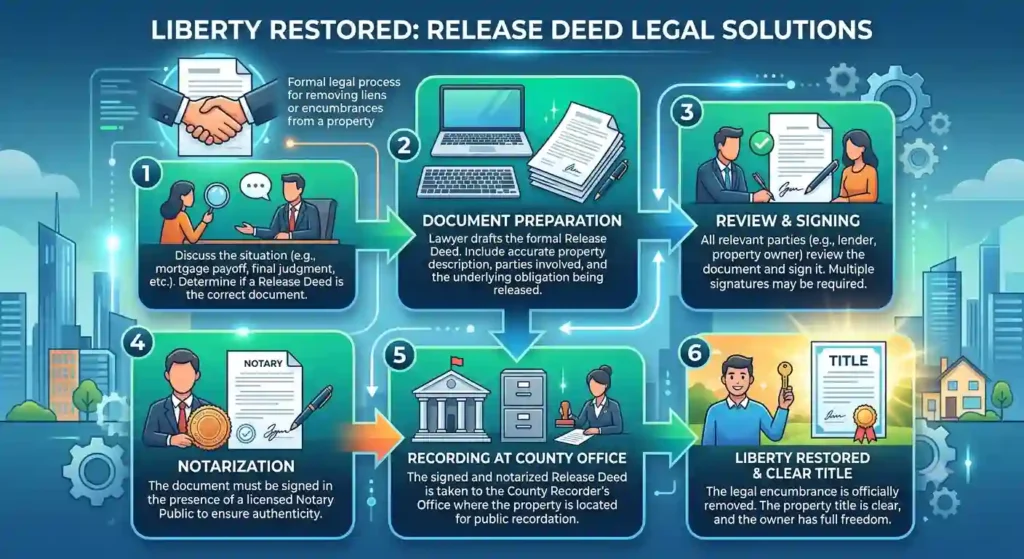
When Should Parties Use One?
A release deed works best when an existing property interest needs lawful relinquishment. Common situations include family settlements, inherited property, partition arrangements, and co-owner restructuring. Therefore, parties should first determine whether the releasor actually possesses transferable rights. A legal title search can reveal mortgages, litigation, attachments, previous transfers, or competing claims. Additionally, inherited properties may require examination of succession documents and previous partition arrangements. Furthermore, all relevant co-owners should receive appropriate legal consideration. A release without proper authority can generate later challenges. Consequently, parties should avoid using generic templates without title verification. The deed should clearly identify the released interest and beneficiary. Stamp duty and registration must follow the applicable state framework. Virtuoso Legal Services can assess whether release, partition, gift, settlement, or sale provides the appropriate solution. Early legal advice reduces documentation risks and prevents unnecessary disputes.
Essential Clauses
Property and Party Identification
A release deed requires precise identification of every party and the property concerned. Therefore, names should match government identity documents and existing title records. The property description should include survey numbers, boundaries, extent, location, and relevant registration details. Additionally, the deed should explain how the releasor acquired the relevant interest. Parent documents can establish the ownership chain and strengthen future title verification. Furthermore, the deed should specify the exact share being relinquished. Ambiguous descriptions can create disputes regarding remaining ownership rights. Consequently, lawyers should compare the draft against certified registration and revenue records. Any discrepancy should receive correction before execution. Virtuoso Legal Services reviews party details, property schedules, title documents, and ownership shares. Proper drafting also helps registration officials process the instrument efficiently. A carefully prepared schedule provides stronger evidence during future property transactions. Thus, accurate identification forms the foundation of an effective release deed.
Consideration and Voluntary Consent
A release deed should clearly record consideration when parties exchange money for relinquishing property rights. Therefore, payment details should identify amount, method, timing, and acknowledgement. However, family arrangements may involve nominal or different consideration structures. Applicable stamp-duty rules can depend upon relationship, transaction type, and state law. Additionally, the releasor should understand the legal consequences before signing. Free and informed consent remains important for defending the document against later allegations. Furthermore, coercion, undue influence, fraud, or misrepresentation can create serious legal challenges. Lawyers should therefore explain material consequences before execution. Bank records can provide useful evidence where monetary consideration changes hands. Consequently, parties should preserve payment receipts and supporting correspondence. Virtuoso Legal Services can draft appropriate consideration and consent clauses according to transaction circumstances. Proper documentation strengthens enforceability and reduces future disagreement. Legal consultation also helps parties understand whether another instrument better suits their objectives.
Registration and Validity
Execution Requirements
Stamp Duty and Registration
Property-related release deeds commonly require compliance with stamp duty and registration requirements. Therefore, parties should verify the applicable state legislation before execution. In Tamil Nadu, the Registration Department provides official registration-related services and information. Registration requirements may depend upon the nature of the property instrument and parties involved. Additionally, inadequate stamp duty can create procedural and financial consequences. Parties should avoid relying upon outdated online templates or informal calculations. Furthermore, registration normally requires appropriate identification, execution, witnesses, and prescribed documentation. Lawyers can coordinate document preparation and registration formalities. Consequently, clients reduce risks involving rejected documents or later objections. Virtuoso Legal Services assists with release deed drafting, stamp-duty assessment, registration preparation, and procedural guidance. The final document should accurately reflect the negotiated transaction. Proper registration also creates stronger documentary evidence concerning the relinquished interest. Therefore, professional assistance can protect ownership arrangements from avoidable technical defects.
Registration Before Sub-Registrar
The appropriate Sub-Registrar Office generally depends upon statutory registration jurisdiction and property location. Therefore, parties should identify the correct registration office before fixing execution arrangements. The Registration Act contains provisions governing registration of documents affecting immovable property. Additionally, parties should carry prescribed identification and supporting documents. Registration officials may verify execution, identity, and other statutory requirements. Furthermore, parties should carefully check the final registered document after completion. Errors in names, property descriptions, or shares can cause future complications. Consequently, certified copies should remain safely preserved with parent title documents. Virtuoso Legal Services can assist clients throughout preparation and registration coordination. Registration does not necessarily cure defects in underlying title. Therefore, parties should complete title due diligence before execution. A registered document can still face legal challenges under appropriate circumstances. Proper legal review helps distinguish registration formalities from substantive ownership rights.
Challenging or Cancelling a Deed
Grounds for Legal Challenge
A release deed may face challenge when execution involved fraud, coercion, undue influence, incapacity, forgery, or material misrepresentation. Therefore, courts examine evidence surrounding execution and the parties’ actual legal rights. A claimant should identify the specific defect and establish supporting facts. Additionally, limitation requirements can significantly affect cancellation or declaration proceedings. The Specific Relief Act, 1963 may become relevant to cancellation and declaratory remedies. Furthermore, civil courts may consider injunctions where further transfers threaten disputed property. The Bharatiya Sakshya Adhiniyam, 2023 governs applicable evidence principles, including electronic evidence. Consequently, parties should preserve original deeds, correspondence, payment records, and digital communications. Lawyers can evaluate whether cancellation, declaration, possession, partition, or injunction provides appropriate relief. Virtuoso Legal Services assists clients in challenging defective property instruments through appropriate legal proceedings. Prompt action can prevent subsequent transfers and complicated third-party interests. Therefore, immediate legal assessment remains advisable after discovering suspected fraud or invalid execution.
Civil Court Remedies
A defective release deed may require proceedings before a competent civil court. Therefore, jurisdiction depends upon property location, valuation, parties, and applicable statutory provisions. The Code of Civil Procedure, 1908 governs many procedural aspects of civil property litigation. A claimant may seek declaration, cancellation, injunction, possession, partition, or other consequential relief. Additionally, pleadings should accurately describe the title history and disputed transaction. Courts may examine registered documents, revenue records, witnesses, expert evidence, and electronic records. Furthermore, interim injunctions can protect property from additional transfers during litigation. Consequently, applicants should present credible evidence demonstrating the need for immediate protection. Virtuoso Legal Services can prepare pleadings, notices, evidence strategies, and court submissions. Lawyers should also examine limitation before filing proceedings. A properly selected remedy prevents procedural objections and incomplete relief. Therefore, comprehensive legal analysis remains essential when ownership rights become disputed after release deed execution.
Family and Succession Considerations
Inherited Property
Heirs and Co-Ownership
Inherited property frequently creates circumstances where one heir wishes to release their share. Therefore, lawyers should first identify every legal heir and existing ownership interest. Succession documents, wills, probate orders, and family records may influence the analysis. Additionally, intestate succession can differ according to the applicable personal law. Parties should establish whether partition has already occurred or remains pending. Furthermore, a release deed should not accidentally extinguish rights belonging to another heir. Proper legal drafting should identify each releasor and beneficiary precisely. Consequently, family members can reduce future disputes concerning inheritance and ownership. Virtuoso Legal Services can review succession documents before preparing a release deed. Where disputes already exist, partition or declaration proceedings may become more suitable. Lawyers should also consider pending litigation, mortgages, and third-party interests. Thus, inheritance-related releases require more than simple document execution. Thorough succession review creates a clearer and more defensible ownership structure.
NRI and Overseas Parties
NRIs may execute release deeds concerning inherited or jointly owned Indian property. Therefore, overseas parties require careful planning for identity verification and document execution. A power of attorney may assist when physical attendance becomes difficult. However, the authority granted should clearly cover the intended transaction. Additionally, execution abroad may require applicable attestation, notarisation, apostille, or consular procedures. Parties should verify Indian registration requirements before signing overseas documents. Furthermore, foreign exchange and tax implications may require separate professional advice. Virtuoso Legal Services can coordinate Indian legal documentation and registration requirements for NRI clients. Lawyers can also examine title, succession, consideration, and jurisdiction before execution. Consequently, remote participation becomes more manageable and legally structured. NRIs should preserve original documents and registration receipts after completion. Any dispute should receive prompt legal attention before subsequent transfers occur. Thus, specialised legal coordination helps overseas property owners protect their Indian interests.
Disputes, Remedies and Professional Support
Legal Forums and Enforcement
Criminal and Civil Overlap
Fraud, Forgery and Impersonation
Some release deed disputes involve suspected forgery, impersonation, cheating, or fraudulent document creation. Therefore, criminal remedies may arise alongside civil ownership proceedings when evidence supports such allegations. The Bharatiya Nyaya Sanhita, 2023 now provides India’s principal criminal offence framework. The Bharatiya Nagarik Suraksha Sanhita, 2023 governs criminal procedure. Police complaints should describe specific conduct and provide available documentary evidence. Additionally, investigators may examine signatures, identity documents, communications, and registration records. The Bharatiya Sakshya Adhiniyam governs applicable evidence requirements. Furthermore, criminal proceedings do not automatically determine substantive civil title. Consequently, affected parties may need separate civil remedies. Virtuoso Legal Services can assess whether facts justify coordinated civil and criminal action. Clients should avoid unsupported allegations arising from ordinary contractual disagreements. Proper evidence assessment helps determine the appropriate legal route. Therefore, early professional advice can prevent fragmented or ineffective proceedings.
Police and Evidence Strategy
Police assistance may become relevant when property documents involve suspected criminal conduct. Therefore, complainants should preserve certified deeds, identity records, payment evidence, and communications. A written complaint should present a chronological account without unnecessary speculation. Additionally, electronic evidence should remain in its original form wherever possible. The BSA provides the current statutory framework for relevant evidentiary questions. Furthermore, forensic examination may assist where signatures or documents appear manipulated. Police jurisdiction can depend upon the facts and applicable procedural rules. Consequently, lawyers should evaluate territorial and statutory considerations before filing complaints. Virtuoso Legal Services can assist with complaint drafting and evidence organisation. Civil proceedings may continue separately where ownership rights require judicial determination. Parties should maintain consistent factual positions across different proceedings. Thus, coordinated legal strategy strengthens credibility and reduces procedural confusion. Prompt preservation also prevents loss of important evidence.
Practical Legal Solutions
Negotiation and Settlement
Family Settlement Options
A release deed can form part of a broader family settlement resolving multiple property claims. Therefore, lawyers should examine the complete family arrangement before drafting isolated documents. Settlement terms should identify every property, claimant, share, obligation, and future responsibility. Additionally, parties should clarify possession, taxes, loans, and pending litigation. A properly structured settlement can reduce prolonged family disputes and litigation expenses. Furthermore, documentation should comply with applicable stamp and registration requirements. Lawyers should ensure that settlement terms do not unintentionally affect unrelated properties. Consequently, family members receive clearer and more enforceable ownership arrangements. Virtuoso Legal Services can negotiate, draft, review, and register suitable settlement documentation. Mediation may also assist when family relationships remain workable. However, parties should obtain independent legal advice before surrendering substantial property rights. Thus, informed settlement can provide practical closure while preserving legally protected interests. Every settlement should reflect genuine consent and clearly defined obligations.
Mediation and Arbitration
Mediation can help parties resolve release deed disputes without prolonged court proceedings. Therefore, it may suit disputes involving family members, co-owners, or negotiated financial settlements. A neutral mediator can help parties identify practical solutions and document agreed terms. However, arbitration depends upon a valid arbitration agreement and the nature of the dispute. Property title questions may require careful assessment before selecting arbitration. Additionally, registered instruments and statutory rights can create issues beyond private contractual arrangements. Lawyers should therefore determine whether mediation, arbitration, or civil litigation provides the appropriate forum. Furthermore, settlement documentation should receive legal review before execution. Consequently, parties avoid informal compromises that create fresh disputes. Virtuoso Legal Services provides negotiation, mediation support, settlement drafting, and dispute-resolution advice. A negotiated outcome may save time and preserve relationships. Nevertheless, serious fraud or coercion allegations may require judicial intervention. Thus, forum selection should follow a fact-specific legal assessment.
Complete Legal Assistance
Drafting and Due Diligence
Effective release deed assistance begins with comprehensive title and transaction due diligence. Therefore, lawyers should examine parent deeds, encumbrance certificates, revenue records, and existing litigation. The releasor’s legal entitlement must also receive independent verification. Additionally, the lawyer should confirm consideration, consent, property description, and intended ownership consequences. Stamp duty and registration requirements require state-specific assessment. Furthermore, the final draft should clearly define the released interest and remaining rights. Virtuoso Legal Services provides legal opinions, drafting, negotiation, registration support, and dispute assistance. Clients should provide complete documents to ensure accurate legal assessment. Consequently, lawyers can identify risks before execution rather than after disputes arise. Proper due diligence also helps NRIs and families manage complicated ownership structures. A carefully drafted release deed creates clearer evidence of the parties’ intentions. Thus, professional legal support can provide lasting protection for property interests.
Remedies and Litigation Support
When disputes arise, parties need remedies matched to the underlying legal defect. Therefore, available options may include declaration, cancellation, injunction, possession, partition, damages, or settlement. Civil courts may determine substantive ownership and enforce applicable property rights. Consumer forums or RERA authorities may become relevant only where their statutory jurisdiction applies. NCLT generally handles specified company-law matters rather than ordinary private property disputes. Additionally, criminal forums may address offences involving fraud, forgery, or impersonation. Lawyers should examine limitation, jurisdiction, evidence, and necessary parties before filing proceedings. Furthermore, interim protection may prevent additional transfers during litigation. Virtuoso Legal Services assists with legal notices, negotiations, pleadings, evidence, and representation. A coordinated strategy can prevent contradictory proceedings and unnecessary expenses. Consequently, clients receive a clearer route toward protecting property interests. Prompt legal action also improves the prospects of preserving documents and preventing further transactions.
Why Choose Virtuoso Legal Services?
Virtuoso Legal Services provides structured legal assistance for release deeds and related property disputes. Therefore, clients receive support from initial document review through registration or litigation. The legal team can assist individuals, families, companies, and NRIs with different transaction requirements. Services may include:
- Title and ownership due diligence.
- Release deed drafting and review.
- Stamp duty and registration guidance.
- Legal notices and negotiations.
- Civil and criminal dispute support.
Additionally, lawyers can coordinate evidence and proceedings before appropriate authorities and courts. Furthermore, clients receive advice based on the transaction’s actual facts and documents. The firm can evaluate settlement opportunities before recommending prolonged litigation. Consequently, clients can make informed decisions about property rights. Release deeds can provide valuable solutions when properly structured and legally executed. However, defective documentation may create significant future complications. Thus, expert consultation before signing remains the safest approach. Virtuoso Legal Services helps clients pursue clear, enforceable, and practical property solutions.
Frequently Asked Questions
Is a release deed legally binding?
A properly executed and registered release deed can bind the parties. However, fraud, coercion, incapacity, or defective title may support legal challenge.
Can one heir release property rights?
Yes. An heir can generally relinquish an existing property interest, subject to applicable succession, stamp duty, registration, and title requirements.
Can an NRI execute a release deed?
Yes. NRIs can execute release deeds concerning Indian property, subject to applicable execution, authentication, registration, tax, and foreign exchange requirements.
Can a release deed be cancelled?
A release deed may be challenged or cancelled through appropriate legal proceedings when valid grounds exist, including fraud, coercion, undue influence, or incapacity.
Which court handles release deed disputes?
The competent civil court generally depends upon property location, jurisdiction, valuation, and applicable law. Specific facts determine the appropriate forum and remedies.
Can fraud lead to criminal proceedings?
Yes. Forgery, cheating, impersonation, or fraudulent document creation may attract criminal provisions. Civil proceedings may still remain necessary for ownership-related relief.