![Virtuoso Legal Services [Best Legal Opinion Services 24×7]](https://legalopinion.org.in/wp-content/uploads/2023/09/cropped-logo.png)

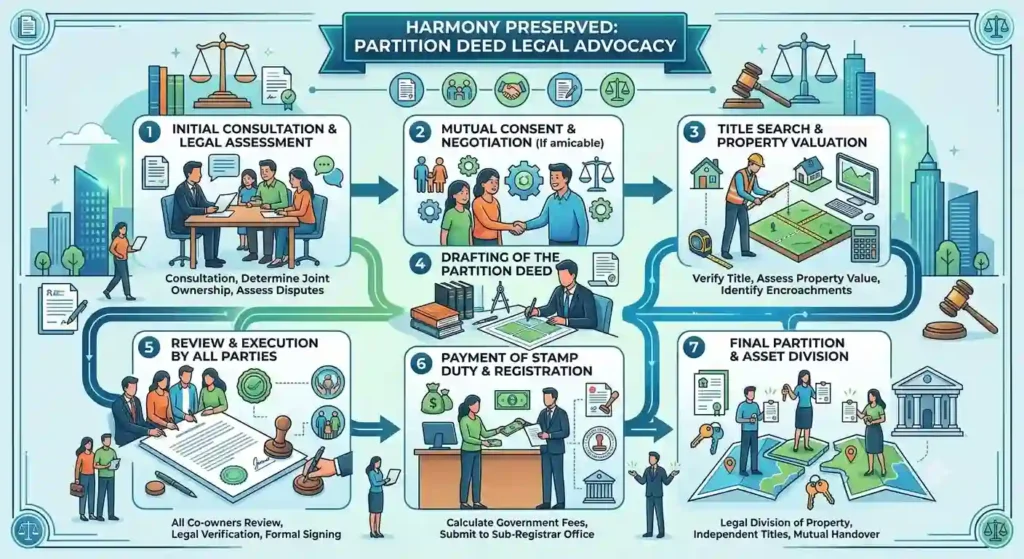
Harmony Preserved: Partition Deed Legal Advocacy
Partition Deed Legal Advocacy – A partition deed legally records division of jointly owned property among eligible co-owners. It identifies each person’s share and specifies the property allotted to them. Therefore, accurate title verification should precede drafting and execution of the deed. Lawyers examine parent deeds, encumbrance certificates, revenue records, tax receipts, wills, settlements, and previous partitions. Family relationships also require careful verification because succession rights may determine ownership shares. Under the Hindu Succession Act, daughters receive coparcenary rights under the statutory framework. However, personal laws may differ depending upon the parties and property circumstances. Partition agreements should clearly describe boundaries, survey numbers, measurements, access rights, and existing encumbrances. Additionally, the deed should identify liabilities attached to individual properties. Proper drafting reduces ambiguity and future family disputes. Virtuoso Legal Services assists clients with partition deed preparation, negotiations, registration, title verification, and property dispute resolution throughout appropriate Tamil Nadu forums and jurisdictions.
Harmony Preserved: Partition Deed Legal Advocacy – Virtuoso Legal Services
Determine Ownership and Share Entitlements
Determining ownership remains the foundation of every successful partition deed. Family members may hold property through inheritance, purchase, settlement, gift, succession, or earlier partition. Consequently, lawyers must trace the complete title chain before calculating individual shares. A person’s apparent family relationship alone may not establish the exact legal entitlement. The Hindu Succession Act can determine succession and coparcenary interests for Hindu families. Other personal laws can apply depending upon the parties and circumstances. Therefore, advocates examine death certificates, legal-heir documents, previous deeds, wills, and court orders. They also identify minors, persons under representation, absent co-owners, and disputed claimants. Furthermore, agricultural land may involve separate revenue restrictions and tenancy considerations. A detailed ownership chart can clarify each person’s proposed entitlement. This process helps prevent defective partition arrangements and later challenges. Ultimately, accurate share determination creates a stronger foundation for voluntary settlement and enforceable documentation. Legal review also protects women, overseas heirs, and vulnerable family members.
Draft a Clear and Enforceable Partition Deed
A partition deed should translate agreed property division into precise legal language. Each schedule should describe the property using official survey and registration particulars. The deed should identify parties, existing ownership, shares, consideration if applicable, possession, liabilities, and future obligations. Clear clauses can prevent disputes concerning access, common areas, utilities, taxes, and boundaries. Moreover, the document should address pending litigation, mortgages, leases, attachments, and third-party claims. Lawyers should verify whether any party lacks capacity to execute the proposed arrangement. Where minors hold interests, additional legal safeguards may apply. The deed should also reflect whether the partition creates separate ownership or preserves common rights. Tamil Nadu stamp requirements can vary according to the instrument and circumstances. Official Tamil Nadu material identifies specific stamp provisions for partition instruments involving family members. Therefore, professional drafting should consider stamp duty, registration requirements, and applicable exemptions. A carefully prepared deed can convert family consensus into durable property rights and reduce future litigation risks.
Complete Stamp Duty and Registration Compliance
Partition documentation requires careful attention to stamp duty and registration rules. Tamil Nadu maintains statutory provisions governing partition instruments and related registration matters. Official state material specifies stamp-duty provisions for partition instruments among family members. However, the applicable amount depends upon the instrument, property, parties, and current statutory notifications. Therefore, parties should obtain a transaction-specific assessment before execution. Registration procedures also require accurate identification of parties and properties. The document should contain correct schedules, measurements, consideration details, and supporting identity records. Additionally, parties should verify encumbrances and prior registered transactions before registration. Tamil Nadu registration rules recognise specific particulars concerning shares assigned under partition deeds. Errors can create future complications involving mutation, sale, mortgage, or inheritance. Lawyers can coordinate drafting, stamp assessment, registration preparation, and post-registration documentation. Furthermore, proper registration strengthens the evidentiary position concerning transferred interests. A compliant partition deed therefore protects both present ownership and future transactions involving separately allotted properties.
Protect Women’s Property and Succession Rights
Women can face partition disputes involving ancestral property, inherited assets, matrimonial settlements, or family-held properties. The Hindu Succession Act recognises important coparcenary rights for daughters within its applicable framework. Therefore, families should not assume that daughters automatically receive reduced shares. Each matter requires examination of the property’s character, succession history, and relevant dates. Married daughters can also possess enforceable property interests when statutory requirements apply. Additionally, widows and other female heirs may receive succession rights depending upon the governing personal law. Lawyers should identify whether previous releases, partitions, settlements, or family arrangements affect those rights. Any relinquishment should receive careful legal review before execution. Coercion, undue influence, fraud, or misrepresentation can create separate legal challenges. Consequently, women should obtain independent legal advice before signing partition documents. Virtuoso Legal Services can review proposed family settlements and protect lawful ownership interests. Proper advice promotes genuine consent and prevents later allegations concerning unfair division or improper exclusion from family property.
Partition Disputes, Courts and Legal Remedies
Resolve Family Property Disputes
Family property disputes often involve disagreement over shares, possession, valuation, boundaries, or title. Early negotiation can sometimes preserve relationships while producing a legally enforceable settlement. However, negotiations should follow complete title and entitlement verification. Lawyers can prepare settlement proposals that identify each person’s property allocation and obligations. Mediation may provide a practical forum when family members remain willing to negotiate. If negotiations fail, a civil partition suit may become necessary. The Code of Civil Procedure governs many procedural aspects of civil litigation. Courts can determine shares, order division, appoint commissioners, and grant consequential reliefs where legally appropriate. Furthermore, temporary injunctions may protect disputed property from sale or alteration. Parties should also examine limitation, jurisdiction, court fees, and valuation before filing proceedings. A strong case requires documentary evidence supporting ownership and entitlement. Therefore, early legal assessment can prevent procedural mistakes. Virtuoso Legal Services supports negotiation, mediation, partition litigation, injunction proceedings, appeals, and execution strategies before competent courts in Tamil Nadu and elsewhere.
Address Disputed Title and Encumbrances
Partition becomes difficult when title records reveal mortgages, attachments, leases, settlements, or competing claims. A lawyer should identify every encumbrance before recommending final division. Encumbrance certificates provide useful registration information, but lawyers should also inspect underlying documents. Revenue records, tax receipts, patta details, survey records, and municipal documents may provide additional context. However, revenue entries do not always conclusively establish title. Therefore, title analysis must connect every document with the underlying ownership history. Existing loans may require lender consent or discharge arrangements before partition. Similarly, pending suits can affect possession and transferability. Parties should not distribute disputed property without understanding litigation consequences. Furthermore, third-party claims may require separate pleadings or settlement arrangements. Legal remedies can include declaration, partition, injunction, cancellation, rectification, or possession proceedings, depending upon facts. Careful title investigation reduces future litigation and protects purchasers receiving partitioned assets. It also helps families identify defective documents before completing registration or physical division.
Protect Possession and Prevent Illegal Transfers
Possession disputes frequently accompany partition disagreements among family members. One co-owner may attempt to sell, mortgage, lease, construct, or otherwise alter disputed property. Therefore, immediate legal assessment becomes important when such conduct threatens another co-owner’s rights. Lawyers can examine whether temporary or permanent injunction relief is appropriate. Courts consider statutory requirements and factual circumstances before granting interim protection. A properly prepared application should establish the claimant’s legal interest and potential prejudice. Evidence may include title deeds, tax records, photographs, notices, correspondence, and previous possession documents. Additionally, parties should monitor registration activity where a disputed property faces potential alienation. If fraud or criminal conduct occurs, separate remedies may arise under applicable laws. BNS and BNSS may become relevant where facts disclose offences requiring criminal investigation. However, family property disagreements do not automatically constitute criminal offences. Consequently, counsel should distinguish civil ownership disputes from genuine criminal allegations. Strategic representation can protect possession while the underlying partition claim proceeds before the competent civil forum.
Approach Chennai Courts and Appropriate Forums
Partition litigation requires correct territorial and pecuniary jurisdiction before filing. Property location, defendant residence, cause of action, and statutory rules can influence forum selection. Chennai property disputes may proceed before competent civil courts or the Madras High Court, depending upon jurisdiction. Commercial property disputes may also involve the Commercial Courts framework when statutory requirements apply. Ordinary family partition disputes generally require civil-court analysis rather than automatic commercial treatment. Lawyers should assess valuation, court fees, reliefs, and territorial jurisdiction before drafting pleadings. The CPC provides important procedural mechanisms concerning pleadings, evidence, interim orders, appeals, and execution. Additionally, appellate courts can review qualifying judgments according to statutory requirements. Where registration issues arise, the Sub-Registrar and registration authorities may become relevant. Revenue authorities may handle mutation and related land-record functions. Therefore, the correct forum depends upon the precise legal issue. Virtuoso Legal Services provides representation before civil courts, appellate forums, registration authorities, and appropriate constitutional courts when legally justified.
Use Mediation and Family Settlement Strategies
Mediation can offer families an opportunity to resolve partition disputes without prolonged adversarial litigation. A neutral mediator can help parties identify practical solutions while lawyers protect legal interests. Settlement discussions may address property division, cash adjustments, possession, maintenance, liabilities, and future cooperation. However, parties should verify title and statutory rights before accepting any proposed settlement. A family arrangement can sometimes resolve wider disputes than a narrowly drafted partition deed. Courts may recognise genuine family settlements when their legal requirements are satisfied. Nevertheless, enforceability depends upon the terms, execution, registration requirements, and surrounding circumstances. Therefore, advocates should document settlement terms with precision. The agreement should also identify consequences for default and future disputes. Where mediation fails, parties can proceed with appropriate civil remedies without abandoning substantive claims. This approach preserves negotiation opportunities while protecting litigation rights. Virtuoso Legal Services assists families with mediation preparation, settlement drafting, consent arrangements, partition deeds, and litigation strategy. Early negotiation can reduce expense, delay, and emotional strain.
Obtain Certified Property Documents
Certified and original property documents provide the foundation for accurate partition advice. Lawyers should collect sale deeds, gift deeds, settlement deeds, wills, previous partitions, release deeds, and court orders. Revenue records can include patta, chitta, adangal, survey records, and tax receipts where relevant. Registration searches can identify mortgages, transfers, attachments, and earlier instruments. Additionally, death certificates and legal-heir documentation can establish succession events. Families should preserve older documents because historical instruments may determine present ownership. Where records contain inconsistent names, rectification may require separate legal action. Survey discrepancies can also require measurement and revenue verification. Therefore, document collection should occur before negotiation or drafting. Lawyers can create a property-document index showing document date, executant, registration number, property description, and legal significance. This systematic approach helps identify missing links and conflicting claims. It also strengthens pleadings and evidence if litigation becomes necessary. Accurate documentation therefore remains one of the most important safeguards against partition disputes and defective property division.
Determine Shares Through Succession Analysis
Share determination requires careful application of the governing succession law and property history. For Hindu families, the Hindu Succession Act remains central to intestate succession and coparcenary analysis. The 2005 amendment significantly changed daughters’ coparcenary rights under the statutory framework. Therefore, lawyers must examine family composition and relevant transactions carefully. Previous partitions may affect current entitlements, particularly where legally completed divisions exist. Wills can also alter succession outcomes where valid testamentary dispositions govern the property. Additionally, self-acquired property requires different analysis from ancestral or coparcenary property. Muslim, Christian, Parsi, and other succession matters may require different statutory or personal-law analysis. Consequently, generic share calculations can produce serious errors. Lawyers should prepare a family tree alongside a title chronology and property classification. This method clarifies who holds what interest and why. It also helps identify excluded heirs, disputed releases, and potential claims. Proper succession analysis promotes equitable settlements while protecting enforceable legal rights.
Address Registration and Stamp Disputes
Registration and stamp issues can affect the enforceability and practical usefulness of partition documentation. Tamil Nadu’s official materials provide specific provisions concerning partition instruments and family-member transactions. Parties should therefore verify current duty requirements before executing documents. The Registration Act and applicable state rules also govern registration procedures and document particulars. Tamil Nadu registration rules require partition-related records to identify shares assigned to parties. If a document carries inadequate stamping, legal consequences can arise during judicial proceedings. A Collector can adjudicate stamp duty questions under applicable statutory procedures. Lawyers can assist with stamp assessment, adjudication, registration objections, rectification, and related proceedings. They can also review whether a document requires registration based upon its legal effect. Furthermore, parties should verify whether prior agreements already affected property rights. Correct compliance reduces objections during future sale, mortgage, mutation, or litigation. Professional assistance is particularly valuable where properties involve multiple jurisdictions, old deeds, or complex family settlements.
Protect NRIs and Overseas Heirs
NRIs frequently encounter partition difficulties because they cannot attend every negotiation or registration appointment. Power of attorney arrangements can help when properly structured and legally executed. However, overseas execution may require additional authentication, attestation, or procedural compliance. Lawyers should verify the applicable requirements before relying upon foreign-executed documents. NRIs should also provide complete title records and family documents before authorising local representatives. Digital communication can facilitate document review, but original evidence may remain necessary. Additionally, property located in different Indian states can create jurisdictional complications. Tax, FEMA, banking, and repatriation considerations may also arise from subsequent property transactions. Therefore, NRI partition planning should consider both immediate division and future sale consequences. Lawyers can coordinate with registration offices, local representatives, and professional advisers where necessary. A clear power of attorney should define authority without creating unnecessary risks. Virtuoso Legal Services assists overseas heirs with document review, partition negotiations, registration support, litigation, and settlement coordination. This approach allows NRIs to protect Indian property interests while managing overseas commitments efficiently.
Respond to Fraud and Forgery Allegations
Partition disputes can sometimes involve allegations of forged deeds, impersonation, fabricated wills, or fraudulent registrations. Such allegations require immediate preservation of documents and careful legal assessment. Parties should obtain certified copies from the registration authority and compare disputed instruments. Handwriting, signature, biometric, witness, and registration records may provide relevant evidence. Electronic records may also require consideration under the Bharatiya Sakshya Adhiniyam, 2023. Criminal allegations may invoke BNS provisions, while procedural matters follow BNSS requirements. However, advocates should distinguish genuine fraud from ordinary disagreements concerning ownership or consent. A criminal complaint should rely upon facts supporting a cognisable offence rather than property frustration alone. Civil remedies may include cancellation, declaration, injunction, partition, possession, or rectification. Police authorities can investigate genuine criminal allegations according to law. Courts can also examine documentary authenticity during appropriate proceedings. Therefore, coordinated civil and criminal strategy can protect clients from fraudulent transactions while preserving lawful property claims and procedural rights.
Pursue Appeals and Execution Remedies
Partition litigation does not necessarily end with the first judgment. A dissatisfied party may possess statutory appellate remedies depending upon the order and applicable law. Lawyers must evaluate limitation, grounds, findings, evidence, and jurisdiction before filing an appeal. Execution can become equally important when a decree requires actual division or delivery of possession. Courts may appoint commissioners to identify physical divisions where appropriate. Parties may also need mutation, registration, revenue updates, or possession assistance after final adjudication. Therefore, legal representation should continue beyond obtaining a preliminary decree. Counsel can monitor compliance and address objections raised during final decree proceedings. Where an opposing party disobeys enforceable orders, appropriate execution remedies may become necessary. CPC provisions provide the procedural framework for many civil decree and execution processes. Additionally, appellate courts may examine legal errors or substantial questions where statutory conditions apply. Virtuoso Legal Services can assist with appeals, final decrees, execution, injunctions, and post-decree property documentation. Comprehensive support ensures that a successful judgment produces practical ownership outcomes.
Secure Long-Term Property Harmony
A well-structured partition deed should achieve more than immediate division of family property. It should reduce future disagreements concerning possession, access, expenses, taxes, development, and resale. Therefore, lawyers should anticipate practical issues that may arise after physical separation. Common pathways, wells, parking areas, utilities, and shared structures require specific clauses. Property boundaries should correspond with survey and registration records wherever possible. Additionally, parties should clarify responsibility for existing loans, taxes, maintenance, and pending proceedings. Family settlements should also address future claims and obligations where legally permissible. Clear documentation can prevent repeated litigation between relatives. Furthermore, separate mutation and revenue updates can help maintain consistent public records. Parties should retain registered copies and supporting documents securely. Where properties remain jointly used, the deed should define continuing rights and responsibilities. Virtuoso Legal Services provides continuing legal assistance after execution and registration. Ultimately, thoughtful partition advocacy preserves both property rights and family relationships through clarity, fairness, and enforceable documentation.
Below is a WordPress-ready article with the requested SEO/AEO structure, current Indian legal references, Chennai jurisdiction, remedies, forums, and government authorities.
Harmony Preserved: Partition Deed Legal Advocacy
Partition Deed Planning and Property Rights
Understand Partition Deed Legal Requirements
A partition deed legally records division of jointly owned property among eligible co-owners. It identifies each person’s share and specifies the property allotted to them. Therefore, accurate title verification should precede drafting and execution of the deed. Lawyers examine parent deeds, encumbrance certificates, revenue records, tax receipts, wills, settlements, and previous partitions. Family relationships also require careful verification because succession rights may determine ownership shares. Under the Hindu Succession Act, daughters receive coparcenary rights under the statutory framework. (India Code) However, personal laws may differ depending upon the parties and property circumstances. Partition agreements should clearly describe boundaries, survey numbers, measurements, access rights, and existing encumbrances. Additionally, the deed should identify liabilities attached to individual properties. Proper drafting reduces ambiguity and future family disputes. Virtuoso Legal Services assists clients with partition deed preparation, negotiations, registration, title verification, and property dispute resolution throughout appropriate Tamil Nadu forums and jurisdictions.
Determine Ownership and Share Entitlements
Determining ownership remains the foundation of every successful partition deed. Family members may hold property through inheritance, purchase, settlement, gift, succession, or earlier partition. Consequently, lawyers must trace the complete title chain before calculating individual shares. A person’s apparent family relationship alone may not establish the exact legal entitlement. The Hindu Succession Act can determine succession and coparcenary interests for Hindu families. (India Code) Other personal laws can apply depending upon the parties and circumstances. Therefore, advocates examine death certificates, legal-heir documents, previous deeds, wills, and court orders. They also identify minors, persons under representation, absent co-owners, and disputed claimants. Furthermore, agricultural land may involve separate revenue restrictions and tenancy considerations. A detailed ownership chart can clarify each person’s proposed entitlement. This process helps prevent defective partition arrangements and later challenges. Ultimately, accurate share determination creates a stronger foundation for voluntary settlement and enforceable documentation. Legal review also protects women, overseas heirs, and vulnerable family members.
Draft a Clear and Enforceable Partition Deed
A partition deed should translate agreed property division into precise legal language. Each schedule should describe the property using official survey and registration particulars. The deed should identify parties, existing ownership, shares, consideration if applicable, possession, liabilities, and future obligations. Clear clauses can prevent disputes concerning access, common areas, utilities, taxes, and boundaries. Moreover, the document should address pending litigation, mortgages, leases, attachments, and third-party claims. Lawyers should verify whether any party lacks capacity to execute the proposed arrangement. Where minors hold interests, additional legal safeguards may apply. The deed should also reflect whether the partition creates separate ownership or preserves common rights. Tamil Nadu stamp requirements can vary according to the instrument and circumstances. Official Tamil Nadu material identifies specific stamp provisions for partition instruments involving family members. (Stationery Printing Department) Therefore, professional drafting should consider stamp duty, registration requirements, and applicable exemptions. A carefully prepared deed can convert family consensus into durable property rights and reduce future litigation risks.
Complete Stamp Duty and Registration Compliance
Partition documentation requires careful attention to stamp duty and registration rules. Tamil Nadu maintains statutory provisions governing partition instruments and related registration matters. Official state material specifies stamp-duty provisions for partition instruments among family members. (Stationery Printing Department) However, the applicable amount depends upon the instrument, property, parties, and current statutory notifications. Therefore, parties should obtain a transaction-specific assessment before execution. Registration procedures also require accurate identification of parties and properties. The document should contain correct schedules, measurements, consideration details, and supporting identity records. Additionally, parties should verify encumbrances and prior registered transactions before registration. Tamil Nadu registration rules recognise specific particulars concerning shares assigned under partition deeds. (India Code) Errors can create future complications involving mutation, sale, mortgage, or inheritance. Lawyers can coordinate drafting, stamp assessment, registration preparation, and post-registration documentation. Furthermore, proper registration strengthens the evidentiary position concerning transferred interests. A compliant partition deed therefore protects both present ownership and future transactions involving separately allotted properties.
Protect Women’s Property and Succession Rights
Women can face partition disputes involving ancestral property, inherited assets, matrimonial settlements, or family-held properties. The Hindu Succession Act recognises important coparcenary rights for daughters within its applicable framework. (India Code) Therefore, families should not assume that daughters automatically receive reduced shares. Each matter requires examination of the property’s character, succession history, and relevant dates. Married daughters can also possess enforceable property interests when statutory requirements apply. Additionally, widows and other female heirs may receive succession rights depending upon the governing personal law. Lawyers should identify whether previous releases, partitions, settlements, or family arrangements affect those rights. Any relinquishment should receive careful legal review before execution. Coercion, undue influence, fraud, or misrepresentation can create separate legal challenges. Consequently, women should obtain independent legal advice before signing partition documents. Virtuoso Legal Services can review proposed family settlements and protect lawful ownership interests. Proper advice promotes genuine consent and prevents later allegations concerning unfair division or improper exclusion from family property.
Partition Disputes, Courts and Legal Remedies
Resolve Family Property Disputes
Family property disputes often involve disagreement over shares, possession, valuation, boundaries, or title. Early negotiation can sometimes preserve relationships while producing a legally enforceable settlement. However, negotiations should follow complete title and entitlement verification. Lawyers can prepare settlement proposals that identify each person’s property allocation and obligations. Mediation may provide a practical forum when family members remain willing to negotiate. If negotiations fail, a civil partition suit may become necessary. The Code of Civil Procedure governs many procedural aspects of civil litigation. Courts can determine shares, order division, appoint commissioners, and grant consequential reliefs where legally appropriate. Furthermore, temporary injunctions may protect disputed property from sale or alteration. Parties should also examine limitation, jurisdiction, court fees, and valuation before filing proceedings. A strong case requires documentary evidence supporting ownership and entitlement. Therefore, early legal assessment can prevent procedural mistakes. Virtuoso Legal Services supports negotiation, mediation, partition litigation, injunction proceedings, appeals, and execution strategies before competent courts in Tamil Nadu and elsewhere.
Address Disputed Title and Encumbrances
Partition becomes difficult when title records reveal mortgages, attachments, leases, settlements, or competing claims. A lawyer should identify every encumbrance before recommending final division. Encumbrance certificates provide useful registration information, but lawyers should also inspect underlying documents. Revenue records, tax receipts, patta details, survey records, and municipal documents may provide additional context. However, revenue entries do not always conclusively establish title. Therefore, title analysis must connect every document with the underlying ownership history. Existing loans may require lender consent or discharge arrangements before partition. Similarly, pending suits can affect possession and transferability. Parties should not distribute disputed property without understanding litigation consequences. Furthermore, third-party claims may require separate pleadings or settlement arrangements. Legal remedies can include declaration, partition, injunction, cancellation, rectification, or possession proceedings, depending upon facts. Careful title investigation reduces future litigation and protects purchasers receiving partitioned assets. It also helps families identify defective documents before completing registration or physical division.
Protect Possession and Prevent Illegal Transfers
Possession disputes frequently accompany partition disagreements among family members. One co-owner may attempt to sell, mortgage, lease, construct, or otherwise alter disputed property. Therefore, immediate legal assessment becomes important when such conduct threatens another co-owner’s rights. Lawyers can examine whether temporary or permanent injunction relief is appropriate. Courts consider statutory requirements and factual circumstances before granting interim protection. A properly prepared application should establish the claimant’s legal interest and potential prejudice. Evidence may include title deeds, tax records, photographs, notices, correspondence, and previous possession documents. Additionally, parties should monitor registration activity where a disputed property faces potential alienation. If fraud or criminal conduct occurs, separate remedies may arise under applicable laws. BNS and BNSS may become relevant where facts disclose offences requiring criminal investigation. However, family property disagreements do not automatically constitute criminal offences. Consequently, counsel should distinguish civil ownership disputes from genuine criminal allegations. Strategic representation can protect possession while the underlying partition claim proceeds before the competent civil forum.
Approach Chennai Courts and Appropriate Forums
Partition litigation requires correct territorial and pecuniary jurisdiction before filing. Property location, defendant residence, cause of action, and statutory rules can influence forum selection. Chennai property disputes may proceed before competent civil courts or the Madras High Court, depending upon jurisdiction. Commercial property disputes may also involve the Commercial Courts framework when statutory requirements apply. Ordinary family partition disputes generally require civil-court analysis rather than automatic commercial treatment. Lawyers should assess valuation, court fees, reliefs, and territorial jurisdiction before drafting pleadings. The CPC provides important procedural mechanisms concerning pleadings, evidence, interim orders, appeals, and execution. Additionally, appellate courts can review qualifying judgments according to statutory requirements. Where registration issues arise, the Sub-Registrar and registration authorities may become relevant. Revenue authorities may handle mutation and related land-record functions. Therefore, the correct forum depends upon the precise legal issue. Virtuoso Legal Services provides representation before civil courts, appellate forums, registration authorities, and appropriate constitutional courts when legally justified.
Use Mediation and Family Settlement Strategies
Mediation can offer families an opportunity to resolve partition disputes without prolonged adversarial litigation. A neutral mediator can help parties identify practical solutions while lawyers protect legal interests. Settlement discussions may address property division, cash adjustments, possession, maintenance, liabilities, and future cooperation. However, parties should verify title and statutory rights before accepting any proposed settlement. A family arrangement can sometimes resolve wider disputes than a narrowly drafted partition deed. Courts may recognise genuine family settlements when their legal requirements are satisfied. Nevertheless, enforceability depends upon the terms, execution, registration requirements, and surrounding circumstances. Therefore, advocates should document settlement terms with precision. The agreement should also identify consequences for default and future disputes. Where mediation fails, parties can proceed with appropriate civil remedies without abandoning substantive claims. This approach preserves negotiation opportunities while protecting litigation rights. Virtuoso Legal Services assists families with mediation preparation, settlement drafting, consent arrangements, partition deeds, and litigation strategy. Early negotiation can reduce expense, delay, and emotional strain.
Obtain Certified Property Documents
Certified and original property documents provide the foundation for accurate partition advice. Lawyers should collect sale deeds, gift deeds, settlement deeds, wills, previous partitions, release deeds, and court orders. Revenue records can include patta, chitta, adangal, survey records, and tax receipts where relevant. Registration searches can identify mortgages, transfers, attachments, and earlier instruments. Additionally, death certificates and legal-heir documentation can establish succession events. Families should preserve older documents because historical instruments may determine present ownership. Where records contain inconsistent names, rectification may require separate legal action. Survey discrepancies can also require measurement and revenue verification. Therefore, document collection should occur before negotiation or drafting. Lawyers can create a property-document index showing document date, executant, registration number, property description, and legal significance. This systematic approach helps identify missing links and conflicting claims. It also strengthens pleadings and evidence if litigation becomes necessary. Accurate documentation therefore remains one of the most important safeguards against partition disputes and defective property division.
Determine Shares Through Succession Analysis
Share determination requires careful application of the governing succession law and property history. For Hindu families, the Hindu Succession Act remains central to intestate succession and coparcenary analysis. (India Code) The 2005 amendment significantly changed daughters’ coparcenary rights under the statutory framework. Therefore, lawyers must examine family composition and relevant transactions carefully. Previous partitions may affect current entitlements, particularly where legally completed divisions exist. Wills can also alter succession outcomes where valid testamentary dispositions govern the property. Additionally, self-acquired property requires different analysis from ancestral or coparcenary property. Muslim, Christian, Parsi, and other succession matters may require different statutory or personal-law analysis. Consequently, generic share calculations can produce serious errors. Lawyers should prepare a family tree alongside a title chronology and property classification. This method clarifies who holds what interest and why. It also helps identify excluded heirs, disputed releases, and potential claims. Proper succession analysis promotes equitable settlements while protecting enforceable legal rights.
Address Registration and Stamp Disputes
Registration and stamp issues can affect the enforceability and practical usefulness of partition documentation. Tamil Nadu’s official materials provide specific provisions concerning partition instruments and family-member transactions. (Stationery Printing Department) Parties should therefore verify current duty requirements before executing documents. The Registration Act and applicable state rules also govern registration procedures and document particulars. Tamil Nadu registration rules require partition-related records to identify shares assigned to parties. (India Code) If a document carries inadequate stamping, legal consequences can arise during judicial proceedings. A Collector can adjudicate stamp duty questions under applicable statutory procedures. (Stationery Printing Department) Lawyers can assist with stamp assessment, adjudication, registration objections, rectification, and related proceedings. They can also review whether a document requires registration based upon its legal effect. Furthermore, parties should verify whether prior agreements already affected property rights. Correct compliance reduces objections during future sale, mortgage, mutation, or litigation. Professional assistance is particularly valuable where properties involve multiple jurisdictions, old deeds, or complex family settlements.
Protect NRIs and Overseas Heirs
NRIs frequently encounter partition difficulties because they cannot attend every negotiation or registration appointment. Power of attorney arrangements can help when properly structured and legally executed. However, overseas execution may require additional authentication, attestation, or procedural compliance. Lawyers should verify the applicable requirements before relying upon foreign-executed documents. NRIs should also provide complete title records and family documents before authorising local representatives. Digital communication can facilitate document review, but original evidence may remain necessary. Additionally, property located in different Indian states can create jurisdictional complications. Tax, FEMA, banking, and repatriation considerations may also arise from subsequent property transactions. Therefore, NRI partition planning should consider both immediate division and future sale consequences. Lawyers can coordinate with registration offices, local representatives, and professional advisers where necessary. A clear power of attorney should define authority without creating unnecessary risks. Virtuoso Legal Services assists overseas heirs with document review, partition negotiations, registration support, litigation, and settlement coordination. This approach allows NRIs to protect Indian property interests while managing overseas commitments efficiently.
Respond to Fraud and Forgery Allegations
Partition disputes can sometimes involve allegations of forged deeds, impersonation, fabricated wills, or fraudulent registrations. Such allegations require immediate preservation of documents and careful legal assessment. Parties should obtain certified copies from the registration authority and compare disputed instruments. Handwriting, signature, biometric, witness, and registration records may provide relevant evidence. Electronic records may also require consideration under the Bharatiya Sakshya Adhiniyam, 2023. Criminal allegations may invoke BNS provisions, while procedural matters follow BNSS requirements. However, advocates should distinguish genuine fraud from ordinary disagreements concerning ownership or consent. A criminal complaint should rely upon facts supporting a cognisable offence rather than property frustration alone. Civil remedies may include cancellation, declaration, injunction, partition, possession, or rectification. Police authorities can investigate genuine criminal allegations according to law. Courts can also examine documentary authenticity during appropriate proceedings. Therefore, coordinated civil and criminal strategy can protect clients from fraudulent transactions while preserving lawful property claims and procedural rights.
Pursue Appeals and Execution Remedies
Partition litigation does not necessarily end with the first judgment. A dissatisfied party may possess statutory appellate remedies depending upon the order and applicable law. Lawyers must evaluate limitation, grounds, findings, evidence, and jurisdiction before filing an appeal. Execution can become equally important when a decree requires actual division or delivery of possession. Courts may appoint commissioners to identify physical divisions where appropriate. Parties may also need mutation, registration, revenue updates, or possession assistance after final adjudication. Therefore, legal representation should continue beyond obtaining a preliminary decree. Counsel can monitor compliance and address objections raised during final decree proceedings. Where an opposing party disobeys enforceable orders, appropriate execution remedies may become necessary. CPC provisions provide the procedural framework for many civil decree and execution processes. Additionally, appellate courts may examine legal errors or substantial questions where statutory conditions apply. Virtuoso Legal Services can assist with appeals, final decrees, execution, injunctions, and post-decree property documentation. Comprehensive support ensures that a successful judgment produces practical ownership outcomes.
Secure Long-Term Property Harmony
A well-structured partition deed should achieve more than immediate division of family property. It should reduce future disagreements concerning possession, access, expenses, taxes, development, and resale. Therefore, lawyers should anticipate practical issues that may arise after physical separation. Common pathways, wells, parking areas, utilities, and shared structures require specific clauses. Property boundaries should correspond with survey and registration records wherever possible. Additionally, parties should clarify responsibility for existing loans, taxes, maintenance, and pending proceedings. Family settlements should also address future claims and obligations where legally permissible. Clear documentation can prevent repeated litigation between relatives. Furthermore, separate mutation and revenue updates can help maintain consistent public records. Parties should retain registered copies and supporting documents securely. Where properties remain jointly used, the deed should define continuing rights and responsibilities. Virtuoso Legal Services provides continuing legal assistance after execution and registration. Ultimately, thoughtful partition advocacy preserves both property rights and family relationships through clarity, fairness, and enforceable documentation.
Frequently Asked Questions
What is a partition deed?
A partition deed records the division of jointly owned property among eligible co-owners. It specifies individual shares, allotted properties, possession rights, and related responsibilities.
Can daughters claim a share in ancestral property?
Yes, applicable Hindu succession law recognises daughters as coparceners. However, property history, previous partitions, and other facts require careful legal examination before determining the exact share.
Is partition deed registration mandatory?
Registration requirements depend upon the legal effect and circumstances of the document. Parties should obtain professional advice concerning stamp duty, registration, and applicable Tamil Nadu requirements.
Can an NRI participate in partition proceedings?
Yes. NRIs can participate through appropriate legal representation and properly executed powers of attorney. Overseas execution requirements should receive advance legal and registration review.
What remedies are available in a partition dispute?
Available remedies can include negotiation, mediation, partition suits, declaration, injunction, cancellation, possession, appeals, execution, and appropriate criminal remedies where genuine offences exist.
Which court handles partition disputes in Chennai?
Jurisdiction depends upon property location, valuation, parties, reliefs, and applicable law. Competent civil courts and the Madras High Court may hear qualifying matters.