![Virtuoso Legal Services [Best Legal Opinion Services 24×7]](https://legalopinion.org.in/wp-content/uploads/2023/09/cropped-logo.png)
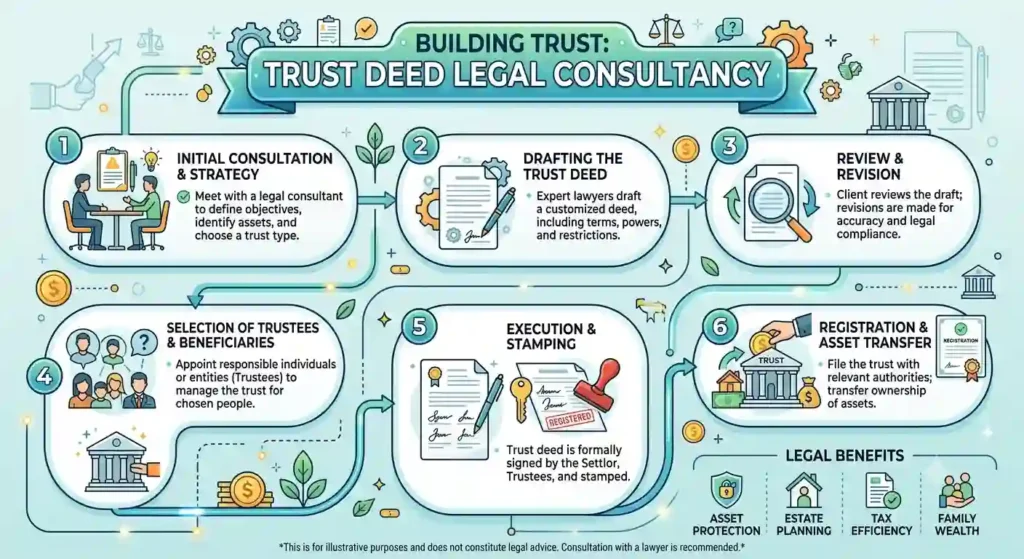
Building Trust: Trust Deed Legal Consultancy
Trust Deed Legal Consultancy – A trust deed records the settlor’s intention to create and govern a trust. It identifies trustees, beneficiaries, trust property, objectives, powers, duties, and operational rules. Therefore, precise drafting prevents uncertainty during administration and future disputes. The Indian Trusts Act, 1882 primarily governs private trusts and trustees. However, public charitable and religious trusts may follow different statutory frameworks. A lawyer should therefore identify the trust category before preparing documents. Virtuoso Legal Services provides trust deed legal consultancy for individuals, families, institutions, and charitable initiatives. Our legal review covers ownership, succession, trustee powers, beneficiary rights, and dispute prevention. Additionally, we assess applicable stamp duty and registration requirements. Proper drafting creates stronger evidence of intention and reduces avoidable litigation risks.
Building Trust: Trust Deed Legal Consultancy – Virtuoso Legal Services
Key Clauses Every Trust Deed Should Address
A carefully drafted trust deed should clearly define its purpose, administration, and legal safeguards. Important provisions generally include the following:
- Settlor identity and declaration.
- Trustee appointment and removal.
- Beneficiary identification or beneficiary class.
- Trust property description.
- Trustee powers and fiduciary duties.
- Accounts, audits, and financial controls.
- Amendment and dissolution provisions.
- Dispute resolution and jurisdiction clauses.
Additionally, the deed should address trustee succession and conflicts of interest. Clear clauses help trustees act consistently with the trust’s objectives. Consequently, beneficiaries receive greater certainty about their rights and remedies. Legal drafting should also consider applicable property, taxation, stamp, registration, and succession rules. Where charitable purposes exist, separate compliance requirements may arise under income-tax legislation. The Income Tax Department recognises charitable or religious trusts for specified tax purposes. Therefore, professional trust deed review remains important before execution and registration.
Private, Public and Charitable Trust Structures
Trust structures differ according to their purpose, beneficiaries, property, and governing law. A private trust generally serves identified persons or defined beneficiary groups. Conversely, a charitable trust pursues recognised public-benefit objectives. The Indian Trusts Act itself excludes public or private religious and charitable endowments from its general application. Therefore, legal classification requires careful examination before drafting. Charitable trusts may also require income-tax registration and continuing statutory compliance. Furthermore, institutions seeking donor tax benefits may need appropriate approval under Section 80G. The Income Tax Department confirms that Section 80G benefits depend upon specified statutory conditions. Virtuoso Legal Services helps clients select suitable structures while considering property, succession, governance, taxation, and regulatory requirements.
Trust Property, Ownership and Beneficial Rights
Trust property requires accurate identification because ownership and beneficial interests operate differently within trust arrangements. The deed should describe movable or immovable assets with sufficient clarity. Property schedules should include relevant title particulars, boundaries, documents, and ownership information. Additionally, lawyers should examine encumbrances, existing claims, mortgages, and pending litigation. Property transferred into a trust may trigger stamp duty, registration, or taxation consequences. Therefore, clients should obtain title verification before executing property-related trust documents. Beneficiaries may also require legal remedies when trustees misuse trust property. Depending upon circumstances, civil proceedings may seek injunctions, declarations, accounts, possession, or other appropriate relief. Virtuoso Legal Services provides trust property legal due diligence and documentation support. Consequently, proper title examination strengthens the trust and reduces property litigation exposure.
Trust Registration, Compliance and Legal Due Diligence
Trust Deed Registration and Stamp Compliance
Trust deed execution requires attention to applicable stamp and registration laws. Requirements can differ according to the trust’s nature and the property involved. Therefore, clients should obtain jurisdiction-specific advice before signing documents. Where registration applies, the appropriate Sub-Registrar office handles the relevant registration process. Lawyers can verify identity documents, property records, execution requirements, and supporting papers beforehand. Additionally, stamp duty must receive careful consideration because inadequate stamping can create evidentiary and procedural problems. The deed should also contain consistent names, addresses, property descriptions, and trustee particulars. Virtuoso Legal Services assists with document preparation, legal scrutiny, registration coordination, and compliance planning. Consequently, clients can reduce technical objections and avoid preventable registration delays.
Documents Required for Trust Deed Processing
Trust deed preparation normally requires documents establishing the parties, property, and intended trust structure. Exact requirements depend upon the transaction and applicable jurisdiction. Common documents may include:
- Identity and address proofs of settlor and trustees.
- PAN details where applicable.
- Photographs and execution documents.
- Title documents for trust property.
- Encumbrance and property records.
- Beneficiary particulars where required.
- Draft trust deed and schedules.
- Relevant resolutions or authorisations.
For written trusts, tax authorities may also require a registered trust deed for certain applications. Therefore, document consistency remains essential throughout registration and tax processes. Additionally, property documents should undergo legal verification before execution. Virtuoso Legal Services identifies missing records and drafting inconsistencies early. This approach helps clients avoid repeated visits, objections, and costly corrections.
Charitable Trust Tax and Regulatory Compliance
Charitable trusts require ongoing compliance beyond deed execution. Income-tax registration can become important where the trust seeks statutory exemptions. The Income Tax Department provides Form 10A for specified charitable or religious trust registration applications. Moreover, eligible trusts may need audit reporting through Form 10B under prescribed circumstances. Section 80G approval may also matter when donors seek eligible deductions. Therefore, trustees should maintain accurate books, donation records, expenditure records, and supporting documents. Periodic legal and tax reviews can identify compliance gaps before notices arise. Virtuoso Legal Services coordinates legal guidance around trust governance and regulatory obligations. Consequently, trustees can protect tax positions while maintaining transparent charitable administration.
Trust Governance, Trustee Duties and Accountability
Trustees carry responsibilities requiring honesty, diligence, loyalty, and compliance with the governing instrument. A trustee should administer trust assets according to the deed and applicable law. Additionally, trustees should maintain proper accounts and preserve supporting records. Conflicts of interest require careful handling because personal interests can undermine fiduciary responsibilities. Beneficiaries may challenge improper transactions through appropriate legal proceedings. Depending upon the dispute, remedies may include injunctions, account rendition, recovery of property, or trustee-related relief. Fraudulent conduct may also create criminal consequences under applicable criminal law. Since BNS replaced the Indian Penal Code framework, lawyers should assess relevant current provisions. BNSS governs criminal procedure, while BSA governs evidentiary matters. Virtuoso Legal Services evaluates governance failures and recommends suitable civil, criminal, or regulatory remedies.
Trust Disputes, Remedies and Legal Representation
Resolving Trust Disputes Through Appropriate Legal Forums
Civil Court Remedies in Trust Disputes
Trust disputes frequently involve property, trustee conduct, beneficiary rights, accounts, succession, or interpretation of deed provisions. Civil courts may hear appropriate disputes depending upon the governing law and jurisdiction. The Code of Civil Procedure remains relevant to civil litigation and procedural remedies. A claimant may seek declarations, injunctions, possession, recovery, accounts, or other suitable relief. Furthermore, interim injunctions can protect trust property from unauthorised transfers or misuse. Lawyers must identify limitation periods, territorial jurisdiction, pecuniary jurisdiction, and maintainability before filing proceedings. Virtuoso Legal Services prepares pleadings, evidence strategies, applications, and legal arguments for trust-related civil disputes. Therefore, early legal intervention can preserve documents, property, and beneficiary interests.
Trust Fraud, Forgery and Criminal Remedies
Trust-related fraud may involve forged deeds, dishonest transfers, misappropriation, impersonation, cheating, or falsification of records. Such conduct can create both civil and criminal consequences. Since the Bharatiya Nyaya Sanhita governs current substantive criminal offences, lawyers should identify applicable provisions carefully. BNSS governs investigation, arrest, bail, complaints, and other criminal procedures. BSA governs admissibility and proof of relevant evidence. Therefore, clients should preserve original deeds, registration records, communications, bank records, and electronic evidence. A complaint may be submitted before the jurisdictional police station when cognisable offences arise. Appropriate remedies can also include magistrate proceedings, civil injunctions, recovery actions, and property protection measures. Virtuoso Legal Services evaluates the facts before recommending coordinated civil and criminal strategies.
Trustee Removal, Injunctions and Recovery Actions
Trustee misconduct can threaten trust property and beneficiary interests. Legal remedies depend upon the deed, applicable statute, evidence, and nature of misconduct. Courts may grant appropriate injunctions when unlawful acts threaten property or legal rights. Beneficiaries may also seek accounts where financial management requires judicial scrutiny. Furthermore, recovery proceedings may address unauthorised transfers, possession, or misuse of trust assets. Trustee removal depends upon the governing legal framework and factual circumstances. Lawyers should therefore avoid relying on generic procedures without reviewing the trust deed. Virtuoso Legal Services examines trustee powers, breach allegations, transaction records, and beneficiary rights. Consequently, clients receive a remedy strategy suited to the actual dispute rather than a standard template.
Appeals, Tax Proceedings and Regulatory Representation
Trust disputes can extend beyond ordinary civil litigation when tax or regulatory decisions affect the trust. Income-tax disputes may involve assessing authorities, appellate authorities, or the Income Tax Appellate Tribunal. Therefore, trustees should preserve notices, returns, audit reports, applications, and supporting evidence. Charitable trusts may also require responses concerning registration, exemption, donations, or compliance. Section 80G benefits remain subject to statutory requirements and approval conditions. Additionally, applicable regulatory authorities may exercise powers concerning charitable institutions under relevant state laws. Virtuoso Legal Services provides legal representation and strategic assistance across appropriate forums. Early review of orders and limitation periods helps preserve appellate remedies. Consequently, trustees can respond efficiently while protecting the organisation’s legal position.
Legal Support for NRIs and Family Trusts
NRIs frequently establish trusts involving Indian property, family succession, or beneficiaries residing across countries. Cross-border arrangements require careful consideration of Indian property, taxation, foreign exchange, and succession rules. Therefore, NRI trustees should obtain legal advice before transferring Indian assets. Powers of attorney may require proper execution, authentication, stamping, or registration. Additionally, overseas documents may require appropriate attestation or legalisation procedures. Family trusts should clearly address beneficiary succession, trustee replacement, distributions, and dispute resolution. Virtuoso Legal Services assists NRIs with trust deed drafting, property due diligence, trustee arrangements, and Indian legal proceedings. Where disputes arise, appropriate Indian courts or authorities may become relevant. Consequently, early legal planning can reduce cross-border misunderstandings and future family litigation.
Legal Remedies and Strategic Protection for Trusts
Trust disputes require remedies matched to the underlying legal injury. A lawyer may consider several options after reviewing the deed and evidence:
- Declaration of legal rights.
- Temporary or permanent injunctions.
- Recovery of trust property.
- Rendition of accounts.
- Challenge to unauthorised transactions.
- Trustee-related relief.
- Criminal complaint for qualifying offences.
- Tax appeals or statutory representations.
- Mediation or negotiated settlement.
However, every remedy depends upon facts, limitation, jurisdiction, and applicable legislation. Civil courts, criminal courts, tribunals, tax authorities, and appellate forums have different powers. Police complaints should ordinarily address conduct falling within criminal jurisdiction. Therefore, clients should avoid filing multiple proceedings without coordinated legal strategy. Virtuoso Legal Services evaluates the dispute and identifies practical remedies. Effective representation combines documentation, evidence preservation, procedural compliance, and timely litigation.
Why Choose Virtuoso Legal Services for Trust Matters?
Virtuoso Legal Services offers end-to-end legal consultancy for trust creation, registration, governance, compliance, and disputes. Our approach begins with understanding the client’s objectives, property structure, beneficiaries, and risk profile. Then, we examine the proposed deed for ambiguity, conflicting clauses, and regulatory concerns. Additionally, our lawyers review trust property documents and identify potential title issues. We assist with legal notices, negotiations, injunction proceedings, recovery claims, criminal complaints, and appellate strategies. Our team can also coordinate with relevant Sub-Registrar offices, Income Tax authorities, police stations, courts, and tribunals. Consequently, clients receive integrated legal support instead of fragmented advice. Strong trust documentation protects relationships, assets, charitable objectives, and future generations.
Frequently Asked Questions
What is trust deed legal consultancy?
Trust deed legal consultancy covers drafting, reviewing, registration, property verification, trustee guidance, tax compliance, dispute prevention, and representation before appropriate authorities or courts.
Is registration of a trust deed compulsory?
The requirement depends upon the trust type, property involved, and applicable law. Professional advice helps determine registration and stamping obligations before execution.
Can a trust deed be challenged in court?
Yes. Eligible parties may challenge trust actions or documents through appropriate proceedings. Grounds can include fraud, breach of trust, invalid execution, or unlawful transactions.
Can trustees face criminal proceedings?
Yes. Qualifying conduct such as cheating, forgery, dishonest misappropriation, or falsification may attract criminal proceedings under applicable current laws.
What remedies are available against trustee misconduct?
Possible remedies include injunctions, declarations, accounts, recovery, trustee-related relief, criminal complaints, negotiated settlement, and appropriate appellate proceedings.
Can Virtuoso Legal Services assist NRIs with Indian trusts?
Yes. Legal support can cover trust drafting, Indian property due diligence, powers of attorney, trustee arrangements, compliance, disputes, and representation before appropriate Indian forums.